
Coffee-break snackers keeping an eye on portions
You fancy cashews with your morning coffee and want to know how much energy the portion you actually eat provides. Keep the portion weight separate from the product claim.


First, weigh your portion and use the label on the exact pack to calculate its energy content. The Netherlands Nutrition Centre lists 154 kcal per 25 g of unsalted cashews. This is not a low-calorie product choice: under the European Commission’s rules, the ‘low calorie’ claim for solid foods is limited to a maximum of 40 kcal (170 kJ) per 100 g. Then choose based on salt level, preparation and pack size: these factors do not, by themselves, determine how much energy your portion provides.
You fancy cashews with your morning coffee and want to know how much energy the portion you actually eat provides. Keep the portion weight separate from the product claim.
You’re looking for an unsalted snack for a regular break and want to choose between unroasted and roasted cashews. The Netherlands Nutrition Centre includes unsalted nuts in its daily nut recommendation.
You’re looking for a pack that suits how you use it and want to portion the contents yourself. Check the storage instructions on the specific pack, too.
For a coffee break, the key things to consider are the energy content of your portion, the salt level, how the cashews are prepared and the pack size.
| What to consider | What should you look for? | Who should pay particular attention? |
|---|---|---|
| Energy in your portion | Weigh your portion and use the kcal per 100 g shown on the label to calculate the energy content for that weight. | If I want to know what my weighed coffee-break snack provides, I check both the label and the portion weight; around 42% of consumers give portion energy the highest priority. |
| Unsalted ingredients | Check the ‘unsalted’ description and the ingredients list; also read the allergen information on the exact pack. | When I want to eat unsalted cashews regularly, I look for that detail on the pack; around 25% of consumers prioritise an unsalted variety. |
| Flavour and preparation | Check whether the cashews are unroasted, roasted or oven-roasted, and check the salt level separately. | If my choice depends on the roasted or savoury variety I want, I compare the preparation and salt information; around 17% of consumers consider these the most important factors. |
| Pack size | Compare the net weight with how you plan to use the cashews, and follow the storage instructions on the pack. | For several coffee breaks, I want a suitable bag that I can portion and store myself; around 16% of consumers prioritise pack size and portioning. |
A portion may provide less energy because you eat fewer grams. That does not change the product’s nutritional value per 100 g.
Compare the energy value per 100 g with the weight of your own portion, and keep nutritional information separate from claims on the pack.
The description of how a product is prepared does not tell you how much energy it contains per 100 g. For this specific Duyvis variety, Flink lists 604 kcal per 100 g.
Assess the preparation description and nutrition table separately.
The packs described from Jumbo, PLUS and ALDI contain 130 g, 200 g and 250 g respectively. The net weight is not a recommended snack portion.
Weigh the amount you want to eat and store the rest according to the instructions on the pack.
A larger pack means you’ll need to portion it yourself and store it carefully.
Albert Heijn lists an AH Unsalted Cashews variety.
Jumbo lists Unsalted Cashews in a 130 g pack.
The PLUS variety described is unsalted and unroasted, in a 200 g bag.
ALDI lists TRADER JOE’S Roasted and Unsalted Cashews in a 250 g pack.
Lidl lists a variety called Unsalted Cashews.
The Dutch variety described is Oven roasted cashews salted, in a 125 g pack.
These Joybuy products are cashews for a measured coffee-break portion; check the salt level, preparation and nutritional information for each variety.
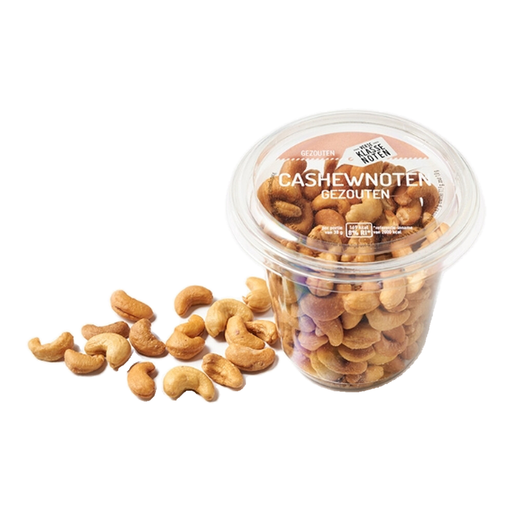 No image available
This salted variety may suit you if you’re specifically looking for salted cashews for your coffee break.
The product description mentions cashews with their skins on and freshly roasted nuts; the pack contains 150 g.
 No image available
The listed nutritional values can help you calculate the energy in a weighed portion; they do not make this a low-calorie product.
The description lists 604 kcal and 0.028 g of salt per 100 g, 100% cashew kernels and a 160 g pack.
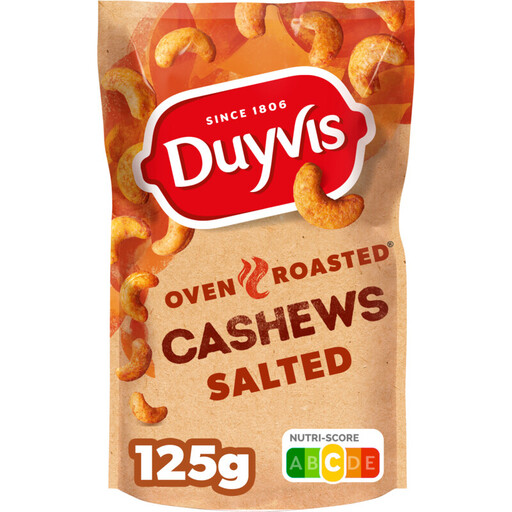 No image available
This salted variety may suit you if you’re looking for oven-roasted cashews without added oil or fat; that doesn’t make them low in calories.
The description lists 586 kcal and 0.92 g of salt per 100 g, and states that a 125 g pack contains 4–5 portions.
 No image available
The title describes roasted, unsalted cashews; the listed nutritional values can be used to calculate the energy in your weighed portion.
The description lists 596 kcal and 0.067 g of salt per 100 g. The pack contains 200 g.
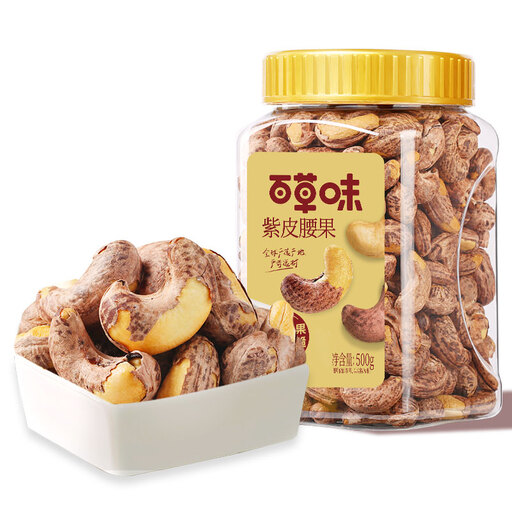 No image available
This salted variety may suit you if you’re looking for cashews with purple skins; for a coffee break, remember to consider the individual portion rather than the whole bag.
The description lists 679 kcal and 1.2 g of salt per 100 g. The pack contains 500 g.
No, not just because the portion is small. Under the European Commission’s rules, the ‘low calorie’ nutrition claim for solid foods is limited to a maximum of 40 kcal (170 kJ) per 100 g. You can, however, state the actual portion weight and its calculated energy content.
Multiply the kcal per 100 g on the label by the number of grams in your portion, then divide by 100. Use the nutrition table for the exact variety; label values are averages, not personal measurements.
Cashews are a tree-nut allergen and are not suitable if you have a diagnosed cashew allergy. Also check the ingredients and allergen information on the exact pack; the NVWA says allergens must be clearly stated on the label.
The NVWA warning of 20 May 2026 concerns TRADER JOE’S unsalted cashews in a 170 g pack, with barcode 2003020120930 and best-before date 23-09-2026, due to possible metal fragments. Do not eat a pack you have kept if it matches these details exactly; the fact that the best-before date has passed does not cancel the warning.
No, the net weight of a bag is not a portion recommendation. Weigh the amount you want to eat during your coffee break, and follow the storage instructions on the relevant pack for the rest.