
A lighter lunch snack
You want to know whether choosing a different product or having a smaller portion will help you consume less fat. Compare products per 100 g, then calculate the amount for the portion you’ll eat.


If you want to consume less fat while eating the same amount of cashews, compare the fat content per 100 g. If your main aim is to eat fewer cashews, weigh out a smaller portion for lunch. A smaller portion doesn’t change the nutritional composition, and ‘no added oil’ describes how the cashews are prepared; it doesn’t prove that they contain less total fat. The Netherlands Nutrition Centre gives 12.2 g of fat per 25 g portion of unsalted cashews as a general nutritional value, not as a product specification for every variety.
You want to know whether choosing a different product or having a smaller portion will help you consume less fat. Compare products per 100 g, then calculate the amount for the portion you’ll eat.
You’re looking for cashews with no added salt and want to assess unsalted, unroasted and oven-roasted as separate product characteristics.
You want to divide a pack into portions for several lunches. Check the pack size and, once opened, follow the storage advice on the packaging.
If you want less fat in the same amount, start by comparing the fat content per 100 g. If you mainly want to eat fewer cashews with your lunch, decide on a portion size and calculate the nutritional values for that weight.
| What to consider | What to look for | Who this matters most to |
|---|---|---|
| Fat and portion size | Compare fat per 100 g, then calculate the amount for your portion. | If I want less fat in the same amount, I compare the values per 100 g. If I mainly want to eat fewer cashews, I weigh out my lunch portion. Around 36% of consumers put fat and portion size at the top of their list. |
| Salt and preparation | Check the salt information and consider preparation methods separately from fat content. | If I don’t want added salt, I look for ‘unsalted’ and check the product information. Around 21% of consumers prioritise this choice. |
| Packaging and storage | Compare the pack size with how you plan to use it, and follow the storage advice once opened. | For lunches, I want a pack I can divide into portions and store myself. Around 29% of consumers put practical portioning at the top of their list. |
| Allergens | For pre-packed products, read the allergen information; if buying loose, ask which type of nut is included. | If I need allergen information, I ask about cashews before buying and check the label. Around 14% of consumers put this information first. |
This describes how the cashews are prepared, not their total fat content.
Use it as information about the preparation method, and compare the nutrition table on the exact pack to check the fat content.
A pack weighing, for example, 200 or 250 g isn’t a recommended portion size. The nutritional value of what you eat depends on the amount you actually weigh out.
Weigh out the amount you’ve chosen and calculate the nutritional values for that portion.
A larger pack means weighing out more portions yourself and storing the product properly once opened.
Duyvis Cashews Original is worth considering if you’re specifically looking for cashews oven-roasted without added oil.
AH Cashewnoten ongezouten is a useful reference if you’re looking for cashews with no added salt.
Jumbo Cashewnoten Ongezouten 200 g comes in a pack you can divide between lunch breaks.
Lidl’s unsalted cashews are worth considering if salt content is part of your decision.
ALDI lists Trader Joe’s roasted, unsalted cashews in a 250 g pack.
PLUS Cashewnoten ongezouten ongebrand 200 g is worth considering if both salt content and preparation method matter to you.
This selection includes cashews that you can portion yourself. Some product listings specify a preparation method or salt status. Compare the fat content per 100 g in the product information, as none of these characteristics by itself proves a lower fat content.
 Image unavailable
A good choice if you want to weigh out a standard portion of cashews yourself; the product description lists cashew kernels as the only ingredient.
Pack size: 160 g. The nutrition table gives the fat content per 100 g.
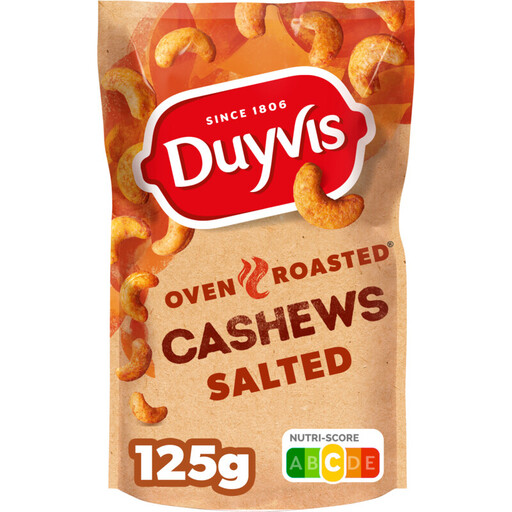 Image unavailable
Suitable if you’re looking for cashews oven-roasted without added oil; this doesn’t in itself indicate a lower total fat content.
Pack size: 125 g. The nutrition table gives the fat and salt content per 100 g.
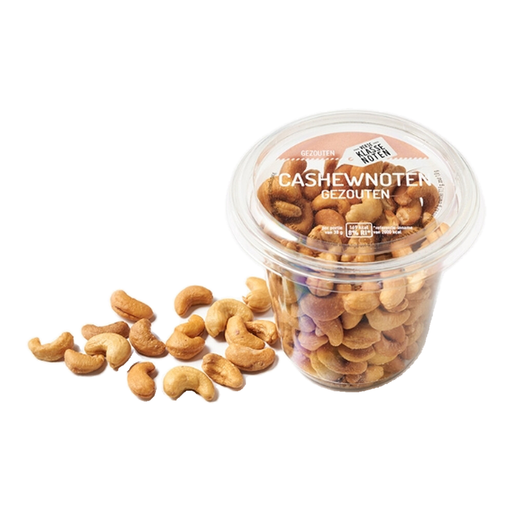 Image unavailable
A salted option to include in your comparison if salt matters as well as fat.
Pack size: 150 g. The nutrition table gives the fat and salt content per 100 g.
 Image unavailable
A good choice if you’re looking for roasted, unsalted cashews and want to weigh out your own lunch portion.
Pack size: 200 g. The product listing gives the fat content per 100 g.
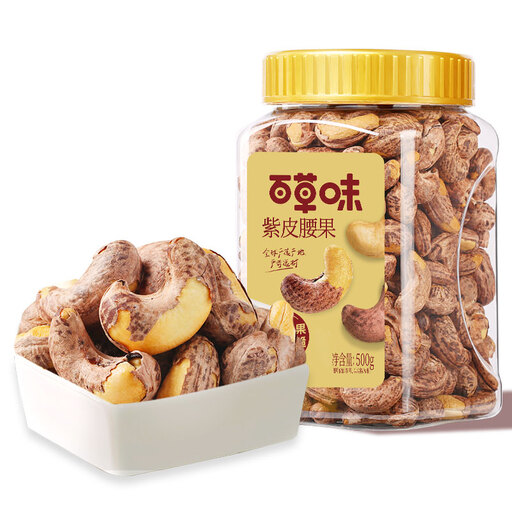 Image unavailable
A salted option in a larger pack, for anyone who wants to divide it into several portions.
The product title gives the grade as 180 and the pack size as 500 g. The nutrition table gives the fat and salt content per 100 g.
Multiply the value per 100 g by the weight of your portion, then divide by 100. Use the table for the product you choose. The Netherlands Nutrition Centre’s general value of 12.2 g of fat per 25 g of unsalted cashews doesn’t automatically apply to every product sold in shops.
According to the NVWA, information about allergens present must be available for unpackaged products. For nuts, it must be clear which type is included. If in doubt, ask specifically whether the snack contains cashews before buying.
Ask the seller for the information before buying the product. The NVWA says consumers can report missing allergen information for food sold in catering businesses or shops.
The Netherlands Nutrition Centre’s general storage guide recommends keeping them for six months in a kitchen cupboard or one year in the freezer; after that, their quality may deteriorate. Also follow the advice on the packaging of your product.
The NVWA warning issued on 20 May 2026 applied only to Trader Joe’s unsalted cashews in a 170 g pack with a best-before date of 23-09-2026, due to the possible presence of metal fragments. The warning advised consumers not to eat that specific pack; it was not a general warning about all ALDI cashews.