
Regular lunch packers
You often take cashews with you alongside your sandwich and want to choose a pack whose contents you’ll use regularly.


A large bag makes sense if you take cashews with you regularly and can store the rest properly; if you eat them less often, a smaller pack is more practical. Choose based on how much you use, and always compare the same preparation and salt options. A larger pack isn’t automatically the right choice.
You often take cashews with you alongside your sandwich and want to choose a pack whose contents you’ll use regularly.
You’re looking for an unsalted addition to your lunch and want to be able to tell the preparation, ingredients and salt option apart.
You don’t eat cashews every day and want an amount that suits how much you use and how you store them.
First, work out how often you eat cashews. Then choose a pack size to suit how much you use, your preferred preparation and salt option.
| What to consider | What to look for | Who is this important for? |
|---|---|---|
| Amount per pack | Choose a pack size to suit how often you eat nuts and how much you want to take with you for lunch. | If I often have a portion alongside my sandwich, I want to use up a larger supply too. Around 36% of consumers say making the most of their supply is their top priority. |
| Unsalted option | Check the exact salt option and read the ingredients on the pack you choose. | If you’re looking for an unsalted option for everyday lunches, don’t rely on the preparation name alone. Around 29% of consumers put this choice first. |
| Storing and taking them with you | Check the storage instructions for after opening, and take a portion with you in a tightly sealed container. | If I only eat nuts occasionally, I want an amount that suits how I use and store them. Around 21% of consumers say this is their main consideration. |
| Preparation and flavour | Tell the difference between unroasted, roasted and seasoned options; check the salt and ingredients separately. | If savoury flavour is my priority, I want to know exactly which option I’m buying. Around 14% of consumers make flavour their top priority when choosing. |
A larger amount won’t necessarily suit how often you eat cashews. The preparation and salt option can also vary between packs.
Choose a pack size to suit how much you use, and compare products with the same preparation and salt option.
The preparation method alone doesn’t tell you how much salt a product contains. Duyvis describes Cashews Original as oven-roasted without added oil; the savoury option examined also contains salt.
Check the salt option, ingredients and nutrition table separately.
Once opened, the pack needs to be sealed properly and stored according to the instructions on the pack you’ve chosen.
Choose an amount that suits how much you use, and take a separate portion for lunch in a tightly sealed container.
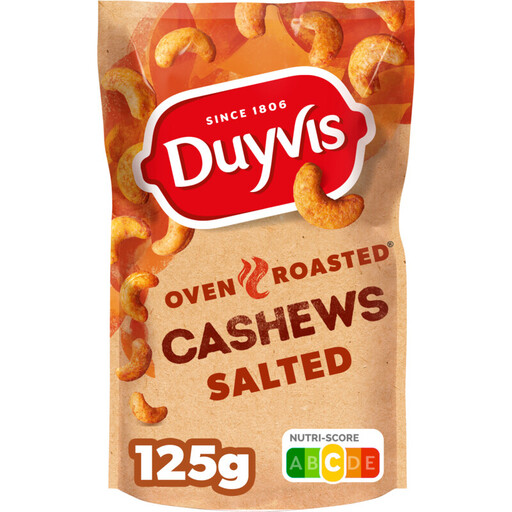
Duyvis offers Cashews Original, among other products, as well as a salted oven-roasted option in a 125 g pack.
AH Terra offers unroasted cashews; the packs mentioned are 200 g and 500 g.
The own-brand range includes salted and unsalted cashews, with packs including 200 g and 500 g options.
Lidl lists 500 g packs of unsalted cashews, which, according to the product page, are available in store only.
ALDI lists, among other options, 250 g packs of roasted unsalted cashews and 500 g Trader Joe’s options.
PLUS lists unsalted, unroasted cashews and a separate unsalted fair-trade option, both in 200 g packs.
These Joybuy products offer a range of pack sizes and salt options for anyone who eats cashews with lunch.
 No image available
This 500 g salted pack suits anyone who regularly uses a larger supply for lunch.
According to the product information, the cashews are ready to eat; store them in a cool, dry place.
 No image available
At 160 g, this is a smaller pack for anyone who wants to store fewer cashews at a time.
The product information lists cashew kernels as the sole ingredient and says they’re ready to eat. Seal the pack well after opening.
 No image available
This small, dry-roasted option suits anyone looking for a savoury, seasoned cashew for lunch.
The product information lists sea salt and says the cashews are ready to eat; seal the pack well after opening. The listed allergens are cashews, gluten, wheat and peanuts.
 No image available
This 200 g unsalted pack is a smaller option for anyone looking for roasted cashews.
The product information advises storing them in a cool, dry place and sealing the pack well after opening.
Follow the instructions on the pack you’ve chosen. For the AH Terra pack examined, Albert Heijn advises storing it in a cool, dark and dry place and sealing it well. The Bewaarwijzer lists rancid, chewy or mouldy nuts as signs of spoilage.
Put a portion in a tightly sealed container beforehand. The MDL Fonds recommends an airtight container as a way to take a snack with you when you’re out and about.
Check the ingredients and warnings on the specific pack. The NVWA requires allergens to be clearly stated on the label; Dutch government information about food labels also says that the information must be available in Dutch and online.
Don’t assume whole cashews are suitable for young children. The Albert Heijn and Jumbo product information examined warns that nuts can pose a choking risk.
No. The NVWA warning issued on 20 May 2026 concerns 170 g packs of Trader Joe’s unsalted cashews with barcode 2003020120930 and best-before date 23-09-2026, due to possible metal fragments. Don’t eat a pack matching this description; the warning doesn’t automatically apply to other sizes or options.