
Shoppers who genuinely want less fat
You’re looking for a lower fat content in the cashews themselves. Compare the fat per 100 g and check which similar product is used as the basis for any fat-reduction claim.


If you want cashews with a demonstrably reduced fat content, choose a product only if its fat reduction compared with a similar standard product is clearly substantiated. ‘Oven-roasted’, ‘unsalted’ and ‘no added oil’ do not prove that fat has been reduced. If your main aim is to have less fat and energy per snacking occasion, weigh your portion and compare the nutritional values per 100 g and for the same portion size.
You’re looking for a lower fat content in the cashews themselves. Compare the fat per 100 g and check which similar product is used as the basis for any fat-reduction claim.
You want to serve cashews while keeping an eye on how much is eaten at each snacking occasion. Check the nutritional values alongside the weight of your measured portion; a pack may contain several portions.
You’re looking for unsalted cashews and want to know whether cooking oil has also been used. Unsalted and no added oil are separate characteristics.
First decide whether you’re looking for a demonstrable fat reduction, want to eat a smaller portion, want to avoid added salt or need the right quantity for a drinks party.
| What to consider | What to look for when buying | Who is this important for? |
|---|---|---|
| Demonstrable fat reduction | Check the claim, the fat per 100 g and the comparable standard product used as the basis for the reduction. According to the European Commission and the Netherlands Nutrition Centre, ‘reduced fat’ or ‘light in fat’ requires at least 30% less fat than a comparable product. ‘Low fat’ means no more than 3 g of fat per 100 g for solid foods. | If your main aim is to have less fat in the product itself, check both the claim and the basis for comparison. Around 36% of consumers make demonstrable fat reduction their top purchasing priority. |
| Portion size and nutritional values | First compare the values per 100 g. Then weigh out the same quantity for each product and calculate the label values for that portion. | If your main aim is to control how much you eat at each snacking occasion, weigh your portion rather than comparing the different serving sizes shown on packs. Around 29% of consumers prioritise portion size and nutritional values. |
| Salt and ingredients | Read both the ingredients list and the salt content. Unsalted cashews can still contain sunflower oil; the Netherlands Nutrition Centre recommends unsalted nuts. | If you want to avoid added salt and are also checking for cooking oil, check both parts of the label separately. Around 21% of consumers prioritise no added salt. |
| Quantity for a drinks party | Compare the net weight with the number of people and the portions you plan to serve. After opening, follow the storage instructions on the pack and seal any leftovers carefully. | If you’re buying for a group, choose a pack size that suits the amount you expect to serve and store. Around 14% of consumers prioritise having the right quantity for a group. |
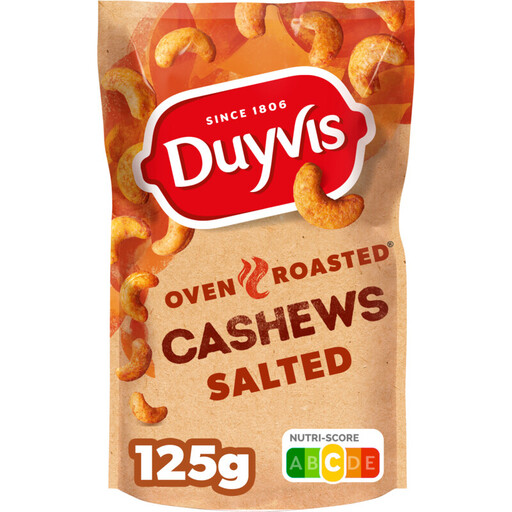
A description of how a product is prepared doesn’t tell you how much fat the finished product contains. An Albert Heijn product listing for Duyvis Oven roasted cashews salted gives 43 g of fat per 100 g.
Assess the nutritional value per 100 g separately from the preparation method. If there’s a fat-reduction claim, check which comparable product is used as the reference.
Labels may show nutritional values for different portion sizes. This can make the figures per portion look different, even when they’re not based on the same quantity.
Compare the values per 100 g first, then calculate them for portions of the same weight.
The unsalted products from Albert Heijn and Jumbo reviewed here contain sunflower oil. Salt content and fat content are different product characteristics.
Read the ingredients list and nutritional table together, and choose based on the characteristic that matters to you.
The NVWA warning of 20 May 2026 applies specifically to Trader Joe’s unsalted cashews, 170 g, with barcode 2003020120930 and best-before date 23-09-2026, due to possible metal fragments. The warning does not automatically apply to other packs or cashew products.
If you still have this specific pack, don’t eat its contents. Check the product name, weight, barcode and best-before date against the NVWA warning.
Duyvis describes Cashews Original, 125 g, as oven-roasted and made without added oil. This describes how they’re prepared; it doesn’t prove that they have a reduced fat content.
AH Cashewnoten ongezouten, 170 g, is an example for anyone looking for unsalted roasted cashews.
Jumbo Cashewnoten Ongezouten, 200 g, is a supermarket own-brand product made with cashews and sunflower oil.
Lidl includes cashews in its Alesto range and describes its Way To Go cashews as Fairtrade.
ALDI describes a roasted, unsalted Trader Joe’s cashew product in a 250 g pack.
PLUS Cashewnoten ongezouten ongebrand, 200 g, is an example for anyone looking for an unroasted product made with cashews.
This selection focuses on dry-roasted cashews for anyone who is mainly concerned with how they’re prepared. The name ‘Dry Roasted’ doesn’t prove that the product has a reduced fat content; check the nutritional table and any claim on the pack.
 No image available
The product name makes this a relevant option if you’re looking for dry-roasted cashews; assess any fat-reduction claim separately.
No. According to the European Commission, ‘low fat’ for solid foods means no more than 3 g of fat per 100 g. A product must contain at least 30% less fat than a comparable product to be labelled ‘reduced fat’ or ‘light in fat’. So check which characteristic is claimed on the pack and what it’s being compared with.
Yes. The product information from Albert Heijn and Jumbo lists sunflower oil in the unsalted products reviewed here. If you want to avoid added oil as well as added salt, check the ingredients list.
Check the ingredients and allergen information on the exact pack, and keep it with the snack. Warnings about possible cross-contamination can vary between products. The NVWA requires allergens present to be clearly distinguished in the ingredients list; a description such as ‘unsalted’ says nothing about whether a product is suitable for someone with an allergy.
Don’t assume that whole cashews are a suitable snack for children. The Albert Heijn, Jumbo, PLUS and Duyvis product pages consulted warn that they pose a choking risk for young children.
No. The NVWA warning of 20 May 2026 specifically names Trader Joe’s unsalted cashews, 170 g, barcode 2003020120930 and best-before date 23-09-2026, due to possible metal fragments. Don’t eat that specific pack if you still have it. The warning doesn’t automatically apply to other ALDI cashews or the separate 250 g product.