
Less fat in a late-night snack
You want to keep eating cashews, but distinguish between a product containing less fat and eating less fat by having a smaller portion. So compare the nutritional values and portion size separately.


If you want cashews with demonstrably less fat, choose a product with a substantiated fat reduction compared with a similar product; unsalted or made without added oil does not mean low in fat. According to the Netherlands Nutrition Centre, the claim ‘reduced’ means at least 30% less fat, while ‘low fat’ has a separate limit: no more than 3 g of fat per 100 g for solid foods, according to the European Commission. The checked AH, PLUS, Jumbo and Duyvis products with published nutritional values contain 45–50 g of fat per 100 g. So, for a lighter snack, you can also consider the nutritional values and the amount you eat separately.
You want to keep eating cashews, but distinguish between a product containing less fat and eating less fat by having a smaller portion. So compare the nutritional values and portion size separately.
You’re looking for a simple cashew snack and want to avoid added salt. Unroasted and unsalted cashews fried in oil are different options. The Netherlands Nutrition Centre includes unsalted nuts in its Dutch Wheel of Five.
Your choice is mainly about how the cashews are prepared and how they taste. Duyvis describes Cashews Original as oven-roasted without added oil; on its own, this tells you nothing about the total fat or salt content.
| What to consider | What to check when buying | Who is this most important to? |
|---|---|---|
| Fat in the product | Compare fat per 100 g and, if the product claims to be ‘reduced’, check what it is being compared with. | I want the product itself to contain less fat, so I check the fat content and any comparison basis; around 33% of consumers prioritise a demonstrable fat reduction. |
| Amount per snack | Check the nutritional values per 100 g and weigh the amount you eat. | I want to limit the fat and energy I consume in one sitting, even if I choose regular cashews; around 27% of consumers prioritise portion control. |
| Added salt | Check the ingredients and salt content; unsalted does not automatically mean made without oil. | I mainly want to avoid added salt, so I check the fat content as well as the ingredients; around 20% of consumers prioritise this. |
| Preparation and flavour | Check whether the nuts are unroasted, fried in oil or oven-roasted, then read the nutritional values. | I choose the preparation method and savoury flavour I’m looking for first, then assess fat and salt separately; around 13% of consumers prioritise this preference. |
| Packaging and storage | Choose a pack size that suits how you use them, and store the nuts in a well-sealed, dry place. | I want packaging that suits how quickly I’ll use the nuts and that I can store properly; around 7% of consumers prioritise this when choosing how much to stock up on. |
These are different product characteristics. Duyvis lists 49 g of fat per 100 g for Cashews Original, which the brand describes as roasted without added oil.
Check the total fat content and assess any fat-reduction claim separately from the preparation method and salt content.
A product with less fat does not necessarily contain proportionally less energy.
Compare both fat and energy per 100 g, then consider the amount you eat.
Nuts are susceptible to mould if they are not stored properly.
Choose a pack size that suits how quickly you’ll use the nuts and store them in a well-sealed, dry place, following the instructions on the packaging.
The NVWA warning dated 20 May 2026 specifically concerns Trader Joe’s unsalted cashews, 170 g, barcode 2003020120930, with a best-before date of 23-09-2026. The date does not change the warning for that pack.
Check the product name, pack size, barcode and best-before date together. Do not eat the pack mentioned in the NVWA warning.
Cashews Original is a savoury, oven-roasted variety in a 125 g pack. Duyvis describes the preparation method as involving no added oil.
The 150 g organic unroasted cashews and the 170 g unsalted variety offer different preparation options.
Jumbo Unsalted Cashews 200 g are fried in sunflower oil, making them an option if you want to avoid added salt.
PLUS Unsalted Unroasted Cashews 200 g are a good fit if you’re looking for unroasted nuts with no added salt or oil in the ingredients list.
Lidl’s product page lists unsalted cashews in a 500 g pack.
ALDI lists Trader Joe’s roasted, unsalted cashews in a 250 g pack.
These Joybuy products are cashews for snacking; preparation, salt content and nutritional values vary by variety. Assess these characteristics separately: ‘roasted’ or ‘unsalted’ does not automatically mean low in fat.
 Image unavailable
A good fit if you’re looking for cashews to eat straight from the pack; the product information also suggests using them in yoghurt, muesli and baking.
 Image unavailable
A good fit if you’re looking for a savoury, roasted snack; the product information says they are oven-roasted without added oil and seasoned with sea salt.
The product information lists 43 g of fat per 100 g. This is above the European Commission’s limit for the ‘low fat’ claim on solid foods.
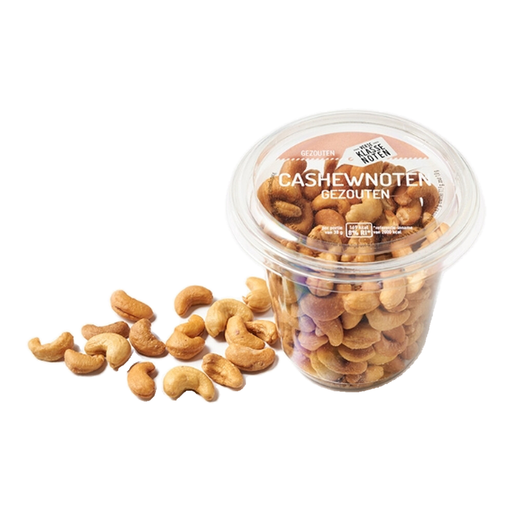 Image unavailable
A good fit if you’re looking for a salted cashew snack that’s ready to eat; the product information lists cashew kernels and salt as ingredients.
The product information lists 60.1 g of fat per 100 g. This is above the European Commission’s limit for the ‘low fat’ claim on solid foods.
 Image unavailable
A good fit if you’re looking for roasted cashews with no added salt.
The product information lists 46.67 g of fat per 100 g. This is above the European Commission’s limit for the ‘low fat’ claim on solid foods.
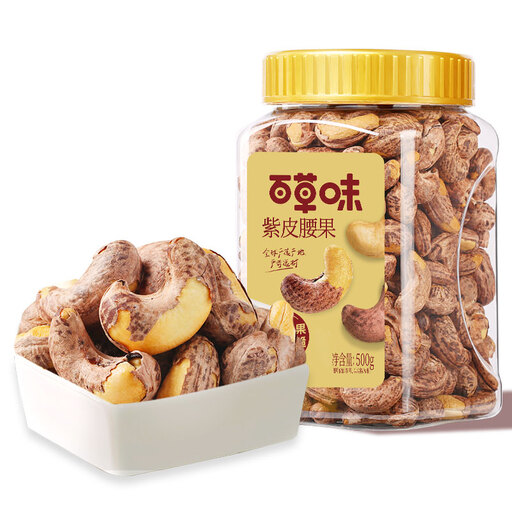 Image unavailable
A good fit if you’re looking for cashews that are ready to eat; the product information lists 100% cashew kernels and recommends storing them in a sealed pack after opening.
The product information lists 47.7 g of fat per 100 g. This is above the European Commission’s limit for the ‘low fat’ claim on solid foods.
For solid foods, the European Commission sets a maximum of 3 g of fat per 100 g for the ‘low fat’ claim. This is a condition for using the claim, not a requirement that all regular cashews must meet. The checked products with published nutritional values are above this limit.
No. ‘Reduced’ describes a reduction compared with a similar product, while ‘low fat’ has an absolute limit. According to the Netherlands Nutrition Centre, ‘light’, ‘lite’ and ‘reduced’ are subject to the same conditions; for a fat reduction, the product must contain at least 30% less fat. Check the energy per 100 g too, as this does not have to decrease proportionally.
Store nuts in a well-sealed, dry place. The Netherlands Nutrition Centre recommends keeping them somewhere cool, for example at 10–15 °C; also follow the storage instructions on the packaging.
No. The checked AH, PLUS and Jumbo products list cashew as an allergen and mention other possible sources of cross-contamination. Being unsalted does not change this. If you have a relevant allergy, check the label on the exact pack; Dutch government information lists allergens as mandatory labelling information.
The NVWA warning dated 20 May 2026 concerns Trader Joe’s unsalted cashews, 170 g, barcode 2003020120930, with a best-before date of 23-09-2026, due to possible metal fragments. Do not eat that specific pack. The warning does not automatically apply to other packs or the entire range.