What should you look for in cashews?
First compare the nutritional values and ingredients for the exact product variant. Then decide which way of serving it and what pack size will suit your lunch.
| What to consider |
What to look for when buying |
Who is this important for? |
| Fat and energy |
Compare total fat and energy per 100 g for the same product variant. Don’t take a preparation claim as information about the total fat content. |
If my main aim is to eat less fat, I compare the nutritional values for the exact product variant first. Around 36% of consumers make fat and energy their top priority when buying. |
| Serving and allergens |
Check how the product should be served, the ingredients and the allergen information. Also look out for any warnings on the packaging. |
When I’m making lunch for children, I check that the way I serve the nuts is suitable and consider any known allergies before sharing them. Around 29% of consumers say that safe suitability for serving is their top priority. |
| Salt and ingredients |
Check the salt and ingredients separately. Unsalted and made without added oil don’t describe the same product characteristic. |
If I want to avoid added salt or oil, I read the ingredients list and check the total fat separately. Around 21% of consumers make ingredients their top priority when buying. |
| Portion and storage |
Choose an amount that suits how you’ll use it and follow the storage instructions. Pack size is not a recommended portion. |
For several lunches, I want to be able to measure out a portion and store the rest properly. Around 14% of consumers say portion size and storage are their top priorities. |
Cashews on Joybuy
These product options are cashew variants to compare for nutritional values, ingredients and preparation method. Check the packaging itself to see whether any reduced-fat claim applies to the exact product variant.
 No image available
Jiazhouyuanye Original Flavour Large Cashew Nuts, 160 g
The nutritional values per 100 g can help you compare a measured lunch portion with the information on the packaging.
The product description lists cashew kernels as the only ingredient. Per 100 g: 47.7 g of fat, 604 kcal and 0.028 g of salt. Contains cashew.
View product on Joybuy
 No image available
Duyvis Dry Roasted Cashews, 125 g
This variant is worth considering if you want to compare the dry-roasted preparation method and measure out your portion.
The product description says the cashews are roasted without added fat or oil. Per 100 g: 43 g of fat, 586 kcal and 0.92 g of salt. The allergen information lists cashew, gluten, wheat and peanuts.
View product on Joybuy
 No image available
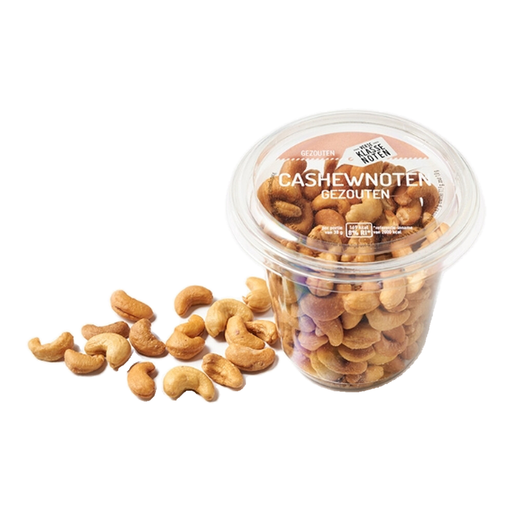
Verse Klassenoten Salted Cashew Nuts, 150 g
This variant is useful if you want to compare a salted product with unsalted options while assessing the fat content separately.
The ingredients list gives 98% cashews, sunflower oil and 1% salt. Per 100 g: 48 g of fat. Contains cashew.
View product on Joybuy
 No image available
g’woon Cashew Nuts Roasted & Unsalted, 200 g
You can use the product information to compare this unsalted variant with other preparation methods and nutritional values.
The ingredients list gives cashews. Per 100 g: 46.67 g of fat, 596 kcal and 0.067 g of salt. The allergen information lists cashew and other tree nuts.
View product on Joybuy
 No image available
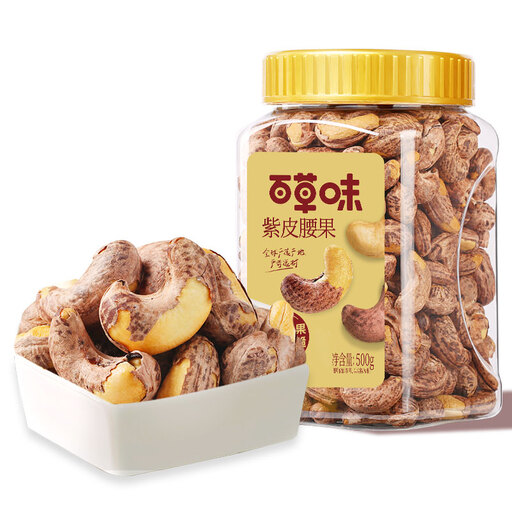
Be&Cheery Cashews with Purple Skin, 180 grade, 500 g
Use the nutritional values per 100 g to compare this variant. The pack size shown is not the same as a lunch portion.
The ingredients list gives cashew kernels and salt. Per 100 g: 60.1 g of fat, 679 kcal and 1.2 g of salt. Contains cashew.
View product on Joybuy
Frequently asked questions
Does reduced fat mean low fat?
No, these are different claims. For solid foods, the European Commission defines low fat as no more than 3 g of fat per 100 g. A reduced-content claim is a comparative claim. Check the evidence and the exact product variant, and don’t treat the terms as interchangeable.
Can I give whole cashews to a young child?
Amsterdam UMC advises giving children under 4 nut butter with no added sugar or salt instead of whole nuts, because of the risk of choking. Make sure children eat calmly at the table and stay with them. This serving advice is not a legal age limit.
How do I check allergens in cashews?
Read both the ingredients list and any warnings about the possible unintended presence of allergens on the packaging. Allergens present as ingredients are different from warnings about possible cross-contamination. Since 1 January 2026, the NVWA has been overseeing new rules for these warnings.
Which ALDI cashews are covered by the safety warning?
The NVWA warning of 20 May 2026 concerns 170 g packs of Trader Joe’s unsalted cashews, barcode 2003020120930, with a best-before date of 23-09-2026, due to possible metal particles. Do not eat the affected pack. The warning applies to this specific pack and batch, not automatically to the 250 g pack.
How should I store an opened pack for several holiday lunches?
Follow the storage instructions on the packaging and seal the nuts well in a dry place. For the AH variant reviewed, the product page says to store in a cool, dark and dry place and to seal the pack securely after use. The Netherlands Nutrition Centre recommends storing nuts in a tightly sealed container in a dry place.


