
Mindful party planners
You’re looking for cashews for a garden party and want to distinguish between less fat in the product and less fat from eating a smaller portion. Compare nutritional values on the same basis.


If you want to eat less fat at a garden party, compare the declared fat per 100 g and pay attention to how much you serve. A smaller portion doesn’t change the product’s nutritional composition. Unsalted, unroasted or made without added oil doesn’t automatically mean lower in fat. Only choose a product labelled ‘reduced fat’ if the claim and the comparison it’s based on are clearly substantiated.
You’re looking for cashews for a garden party and want to distinguish between less fat in the product and less fat from eating a smaller portion. Compare nutritional values on the same basis.
You’re looking for cashews with no added salt, but you’re not ruling out roasted or unroasted varieties. Check the ingredients list too: unsalted doesn’t automatically mean no added oil.
You want to take allergens, young children and leftovers into account. To do so, check the information on the packaging of the exact product you’re serving.
Start with your main priority: a lower fat content per 100 g, no added salt, a suitable quantity or a product that’s right for your guests. The percentages below relate to consumers choosing cashews for a garden party.
| What to consider | What to look for | Who is this important to? |
|---|---|---|
| Less fat | Compare fat per 100 g. For the ‘low fat’ claim, the European Commission sets a maximum of 3 g of fat per 100 g for solid foods; these are not automatically the requirements for ‘reduced fat’. | If I want to eat less fat, I compare the nutritional values first and then decide how much to serve myself. Around 36% of consumers put limiting fat at the top of their shopping priorities. |
| No added salt | Check both the salt content and the ingredients list; unsalted doesn’t rule out added oil. | No added salt is essential for me, even if I’m not specifically looking for less fat. Around 22% of consumers give this the highest priority. |
| Quantity and leftovers | Compare the net weight with your serving plan, and store any leftover nuts in a tightly sealed container in a dry place. | I want to buy enough for the party without being left with a large, open pack afterwards. Around 21% of consumers prioritise quantity and leftovers. |
| Suitable for guests | Check the allergen information on the exact packaging and look out for warnings relevant to the guests you’re expecting. | If any guests have a relevant allergy or there are young children, I check the product information and how it should be served beforehand. Around 21% of consumers name suitability for guests as their top priority. |
These describe different product characteristics. For example, AH Biologisch Cashewnoten ongebrand declares 45 g of fat per 100 g, while the ingredients list for Jumbo Cashewnoten Ongezouten includes sunflower oil.
Check the ingredients and the fat content per 100 g. Don’t use ‘low fat’ as a synonym for ‘unsalted’ or ‘made without added oil’.
Nutritional values given for different portion sizes can’t be compared directly and may distort the differences between products.
Compare per 100 g first, then calculate based on the weight of your own portion. A general example from the Netherlands Nutrition Centre isn’t a product declaration for every brand.
The size of the pack doesn’t determine how much you want to serve. Any nuts left after the party should be stored in a tightly sealed container in a dry place.
Plan your portions, top up bowls as needed and keep the rest of the pack sealed.
The NVWA warning dated 20 May 2026 concerns Trader Joe’s unsalted cashews, 170 g, barcode 2003020120930, with a best-before date of 23-09-2026. The warning mentions possible metal fragments and applies to that specific product, not all ALDI cashews.
Carefully compare the packaging with the details in the warning. Do not eat any packs you may still have that match the notice.
Duyvis Cashews Original is an example of a savoury snack that, according to the product description, is oven-roasted without added oil.
AH Biologisch Cashewnoten ongebrand 150 g is a specific example of unroasted, unsalted cashews.
Jumbo lists unsalted cashews in 200 g and 500 g packs, catering for different quantities.
Lidl Netherlands describes unsalted and spicy roasted cashews as varieties to suit different taste preferences.
ALDI lists roasted, unsalted cashews under the Trader Joe’s name in a 250 g pack.
PLUS Cashewnoten ongezouten ongebrand 200 g is an example of a simple, unroasted variety.
The products below are cashews for a garden party, with different salt and preparation characteristics. These characteristics don’t substantiate a ‘reduced fat’ claim.
 No image available
A salted snack option that’s ready to serve; bear in mind that cashews are an allergen.
 No image available
A plain option for anyone looking for cashew kernels with no added salt; the ingredients information lists 100% cashew kernels. Bear in mind that cashews are an allergen.
 No image available
A dry-roasted variety to serve as a snack. The product information lists cashews, gluten, wheat and peanuts as allergens; bear this in mind if any guests have relevant allergies.
 No image available
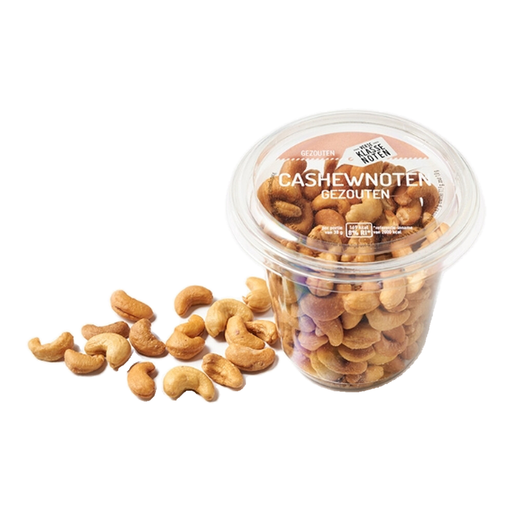
A salted cashew option that’s ready to serve; check that the ingredients suit your guests’ preferences and allergies.
 No image available
A roasted, unsalted option for anyone looking for both characteristics. The ingredients information lists cashews; check the packaging for information relevant to your guests.
No. Made without added oil describes how a product is prepared, not its total fat content. For solid foods, the European Commission sets a maximum of 3 g of fat per 100 g for the ‘low fat’ claim; AH Biologisch Cashewnoten ongebrand, for example, declares 45 g per 100 g.
Multiply the declared fat per 100 g by the weight of your portion in grams, then divide by 100. Based on this calculation, a 20 g portion of the AH Biologisch pack, which contains 45 g of fat per 100 g, has 9 g of fat. This is a calculation based on the product declaration, not advice on portion size.
Store dry cashews in a tightly sealed container in a dry place, and follow the packaging instructions. The Netherlands Nutrition Centre advises storing nuts in a dry and preferably cool place; this advice doesn’t necessarily apply to nuts that have been used in a moist dish.
Check the ingredients list and any warnings on the packaging of the exact product you’re serving. The NVWA states that allergens which must be declared have to appear in the ingredients list; the PLUS variety examined, for example, warns that it may contain peanuts.
The Albert Heijn and Duyvis product pages examined state that young children can choke on nuts. Bear this warning in mind if young children will be there, and keep whole nuts out of their reach.