Who is this relevant to?

Festival-goers keeping an eye on portions

You want to take cashews with you and keep track of how much you eat at each snack break. Weighing them beforehand can help: the Voedingscentrum counts 25 grams as a handful and lists 154 kcal for that amount of unsalted cashews.

Anyone looking for an unsalted snack

You want to avoid added salt, then choose according to the ingredients and how the cashews are prepared. Read the label: unsalted, unroasted and made without added oil describe different things.

Buying for a festival group

You’re buying for several people and want to divide the portions without losing the packaging information. The NVWA states that prepacked products must display allergen information on the label.

What should you look for when choosing?

First decide how much you want to take and weigh out; then choose between unroasted, fried or oven-roasted cashews based on the ingredients, added salt and flavour.

What to consider What should you check? Who might prioritise this?
Calories per portion Check the kcal per 100 grams and weigh out the amount you want to eat. If I want to limit my calorie intake at each snack break, I look at my weighed portion rather than the whole packet. Around 36% of consumers put limiting calories per snack break first.
Salt and ingredients Check the ingredients and salt content separately; the preparation method does not tell you everything about what’s in the product. When I want to avoid added salt, I also check whether the cashews contain oil or flavourings. Around 29% of consumers give top priority to the ingredients and salt content.
Taking them along and portioning Check the net weight and decide in advance how many grams you want to divide between each person. If I want to take a snack with me and reseal the rest properly after weighing out a portion, I check the packaging and storage instructions. Around 21% of consumers prioritise convenience when taking and portioning a snack.
Sharing safely Keep the label and read the allergen information; if there’s a warning, check the exact product and batch details. When I share cashews with others, I want to be able to check the ingredients and allergens clearly. Around 14% of consumers put safe sharing first.

Common pitfalls

  • Assuming a small packet is one portion

    The 100-gram AH packet lists four 25-gram portions. Treating the whole packet as one snack portion means you’ll eat more than the stated serving.

    Weigh out how much you want to take beforehand and pack that amount separately.

  • Confusing unsalted or made without added oil with low in calories

    These terms describe the salt content or preparation, not whether a product is low in energy. For solid foods, the European Commission sets a limit of 40 kcal per 100 grams for a ‘low energy’ claim. The PLUS variety checked lists 598 kcal, while the AH and Jumbo varieties list 622 kcal per 100 grams.

    Compare the nutrition information per 100 grams and calculate the amount for the portion you actually weigh out.

  • Sharing nuts with a group and throwing away the label

    Cashews are an allergen, and some varieties also warn that other allergens may be present. Without the packaging, that information won’t be readily available alongside the snack.

    Keep the label with the snack for the group and check the information for everyone who’ll be eating. The NVWA states that prepacked products must display allergen information on the label.

  • Assuming a safety warning only applies to the best-before date

    The NVWA warning dated 20 May 2026 concerned a specific batch of 170-gram Trader Joe’s unsalted cashews, with barcode 2003020120930 and best-before date 23-09-2026. The warning did not automatically apply to other packets or batches.

    Compare the product name, weight, barcode and best-before date with the warning. Do not eat the affected batch listed.

    Do not eat an affected packet.

Relevant brands to consider

Duyvis

Duyvis describes Cashews Original as oven-roasted cashews with a savoury flavour, prepared without added oil.

  • The manufacturer lists a 125-gram packet.
  • The ingredients include salt and flavourings; made without added oil does not mean unsalted or low in calories.

Albert Heijn

The AH varieties checked are unsalted fried cashews that you can portion yourself.

  • The product pages for the 100- and 170-gram varieties checked list 96% cashews and sunflower oil; the 100-gram packet lists four 25-gram portions.
  • They contain 622 kcal per 100 grams. A small packet is not automatically one portion.

Jumbo

The Jumbo variety checked is unsalted and fried, for anyone looking for this preparation method and wanting to portion it themselves.

  • The product page lists 99% cashews and sunflower oil in the 200-gram packet.
  • It contains 622 kcal and 0.02 grams of salt per 100 grams. The product page explains that the salt is naturally occurring sodium.

Lidl

Lidl offers unsalted cashews; the Way To Go range is worth considering if you’d also like to find out about their origin.

  • Lidl describes Way To Go as Fairtrade-certified and states that the cashews are processed in Tanzania.
  • This information does not mean the cashews are lower in calories. Check the nutrition information on the specific packet before choosing.

ALDI

ALDI lists Trader Joe’s roasted, unsalted cashews in a 250-gram packet, a size you can portion out in advance.

  • The product page confirms that these cashews are roasted and unsalted.
  • The NVWA warning concerned a specific 170-gram packet, not automatically the 250-gram packet or the entire range. Always check the exact batch details.

PLUS

The PLUS variety checked is unsalted and unroasted, for anyone looking for a simple ingredients list.

  • The product page lists cashews as the only ingredient in the 200-gram packet.
  • It contains 598 kcal per 100 grams, so unroasted does not mean low in calories. The product information states that the product may contain peanuts.

Cashews at Joybuy

These products are cashew options to take with you and portion yourself for a snack break. Check the flavour, ingredients and allergen information on each packet.
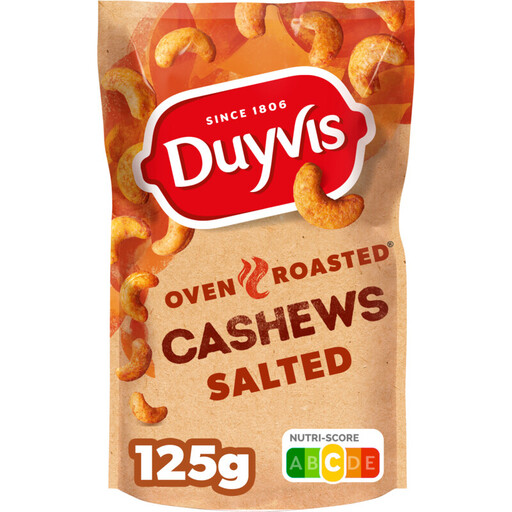
Duyvis Dry Roasted Cashews, 125 g

Duyvis Dry Roasted Cashews, 125 g

An option if you’re after a savoury, oven-roasted flavour. If you’re sharing the nuts, check the allergen information on the packet.

View at Joybuy

Jiazhouyuanye Original Flavour Large Cashew Nuts, 160 g

Jiazhouyuanye Original Flavour Large Cashew Nuts, 160 g

An option if you want to decide how many cashews to take with you. Weigh out your snack portion beforehand and check the ingredients and allergen information on the packet.

View at Joybuy

Frequently asked questions

Are unsalted cashews low in calories?

No. Unsalted does not mean low in calories. The PLUS variety checked lists 598 kcal, while the AH and Jumbo varieties checked list 622 kcal per 100 grams. For solid foods, the European Commission sets a maximum of 40 kcal per 100 grams for a ‘low energy’ claim.

How do I calculate the calories in my festival portion?

Multiply the kcal per 100 grams on the label by the number of grams you’ve weighed out, then divide by 100. For 25 grams, that’s 149.5 kcal for the PLUS variety checked and 155.5 kcal for the AH and Jumbo varieties checked, based on their product information.

How should I store an opened packet?

Follow the instructions on the packet. Albert Heijn recommends storing the unsalted cashews checked in a cool, dark, dry place and sealing the packet tightly. For an opened Duyvis packet, the retailer’s product page checked recommends an airtight, light-proof container.

Does roasting make cashews safe for someone with a nut allergy?

Don’t assume it does. Stichting Voedselallergie states that the allergen remains stable when heated. Keep the ingredients and allergen information from the specific packet with the snack.

What should I do with the recalled 170-gram ALDI cashews?

Do not eat the affected batch. The NVWA warning dated 20 May 2026 lists 170-gram Trader Joe’s unsalted cashews, barcode 2003020120930 and best-before date 23-09-2026. The warning means the batch is not safe to eat, even if the best-before date has passed.
