
Consumers looking for less fat
You want to know whether a claim about less fat genuinely relates to the product’s composition, rather than simply how it’s roasted or whether salt has been added.


Want to eat less fat, snack on less salt or simply have a smaller portion while enjoying a drink on the patio? These are different goals: compare fat and salt per 100 g, and compare portions at the same weight. Unsalted or made without added oil doesn’t automatically mean cashews contain less fat.
You want to know whether a claim about less fat genuinely relates to the product’s composition, rather than simply how it’s roasted or whether salt has been added.
You’re looking for cashews with no added salt, so you check both the ingredients and the salt content without assuming this means they contain less fat.
You want to measure out how many cashews to serve with your drink and store the rest according to the instructions on the packaging.
First decide what you want to change: the fat content, the amount of added salt or the portion size. Then check the nutritional information and ingredients for the exact variety.
| What to consider | What to look for | Who is it most relevant to? |
|---|---|---|
| Fat content | Compare the fat in g per 100 g for the exact variety; if there’s a comparative claim, check what it’s based on. | If I want less fat in the same quantity, I check the fat content and the evidence behind the claim. Around 36% of consumers demonstrably make reducing fat their top purchase priority. |
| Portion size | Weigh the amount you serve and only compare portion values at the same weight. | If my main aim is to snack less during one patio occasion, I decide on my portion beforehand. Around 29% of consumers put portion control first. |
| Salt | Check the ingredients for added salt and read the salt content per 100 g. | If I want a snack with no added salt, I compare the ingredients and salt content of the varieties. Around 21% of consumers make limiting salt their main purchase priority. |
| Roasting and flavour | Choose between unroasted and roasted, and check the ingredients and nutritional values of the flavoured variety. | If I’m mainly looking for a roasted snack to enjoy with a drink, I consider how it’s prepared separately from its fat and salt content. Around 14% of consumers put roasted flavour first. |
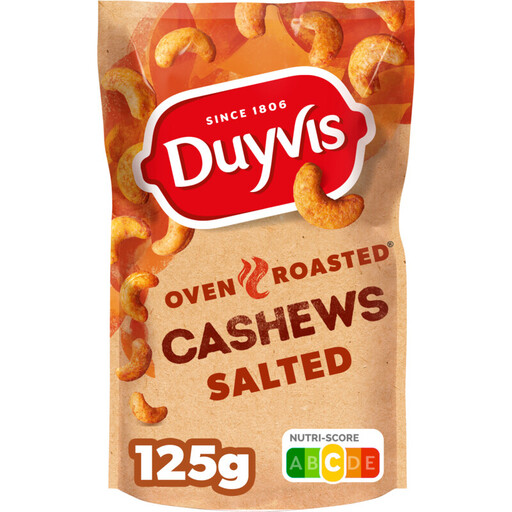
The manufacturer describes Duyvis Cashews Original as oven-roasted without added oil, but lists 49 g of fat per 100 g for this variety. The preparation method alone doesn’t tell you how much fat the product contains.
Read the fat content for the exact variety, and don’t use the preparation description as a substitute for the nutritional information table. According to the European Commission, solid foods can only be labelled low fat if they contain no more than 3 g of fat per 100 g.
Jumbo Unsalted Cashews 200 g lists 48.6 g of fat per 100 g and, according to the product information, contains sunflower oil.
Check salt, fat and ingredients separately, depending on what you want to limit.
The AH Organic variety reviewed lists a 25 g portion; the Duyvis listing at Albert Heijn gives a portion size of 30 g. This means their portion values can’t be compared directly without taking the weight into account.
First compare the nutritional values per 100 g, then use the same weighed portion for both products.
The NVWA warning dated 20 May 2026 applies specifically to Trader Joe’s unsalted cashews, 170 g, with barcode 2003020120930 and best-before date 23-09-2026. The stated best-before date has passed.
If you still have that exact pack, don’t eat the cashews. The warning doesn’t automatically apply to other packs or batches.
Cashews Original is a savoury, oven-roasted variety sold in a 125 g pack.
AH Organic Unroasted Cashews 150 g are unroasted and unsalted.
Jumbo Unsalted Cashews 200 g are an unsalted variety.
Lidl sells cashews under the Alesto range; the range page also features Way To Go cashews.
ALDI lists Trader Joe’s cashews in 250 g packs, in roasted salted and roasted unsalted varieties.
PLUS Unroasted Unsalted Cashews 200 g are unroasted and unsalted.
This selection includes cashews for anyone looking to compare portion size, roasting, salt or ingredients. The product names alone don’t show that a variety is reduced fat; check the nutritional information on the exact pack to find out.
 No image available
The product information describes these cashew kernels as ready to eat and suitable as a snack.
Ingredients: 100% cashew kernels. Fat: 47.7 g per 100 g. Salt: 0.028 g per 100 g.
 No image available
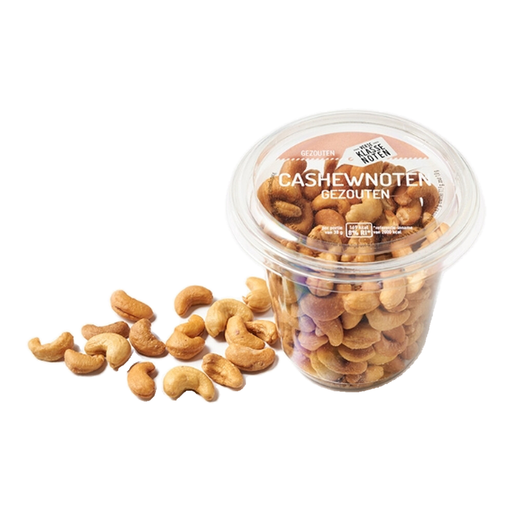
The product description says these cashews are oven-roasted without added fats or oil; they’re intended as a ready-to-eat roasted snack.
Fat: 43 g per 100 g. Salt: 0.92 g per 100 g. The product information gives 4–5 servings per pack.
 No image available
The product information describes salted, freshly roasted cashews as a snack.
Ingredients: 98% cashews and sunflower oil. Salt: 1%. Fat: 48 g per 100 g.
 No image available
According to the product information, these roasted cashews are ready to eat as a snack; the ingredients list contains cashews only.
Fat: 46.67 g per 100 g. Salt: 0.067 g per 100 g.
 No image available
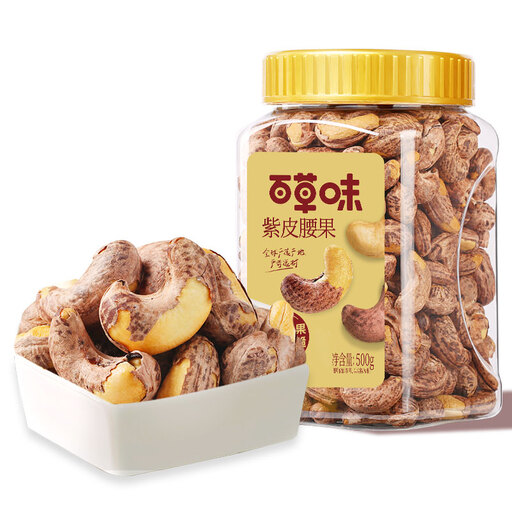
The product information describes these cashews as a ready-to-eat snack.
The ingredients list cashew kernels and salt. Fat: 60.1 g per 100 g.
According to the European Commission, solid foods must contain no more than 3 g of fat per 100 g to be labelled low fat. This is a compositional limit, not a comparison with another product.
Only if the portions weigh the same. The AH Organic variety reviewed lists 25 g per portion, while the Duyvis listing at Albert Heijn gives a portion size of 30 g. First compare the nutritional values per 100 g, then calculate using the same portion weight.
Follow the instructions on the exact pack. The Duyvis listing at Albert Heijn recommends storing the cashews in a cool, dry place and, once opened, in a light- and airtight container. Jumbo recommends storing them in a cool, dry and dark place.
Before ordering, ask which variety is being used and what allergen information applies to it. According to the NVWA, allergen information for non-prepacked foods, such as food served in catering establishments, must be available before purchase. It can be provided in writing or verbally; if given verbally, there must be a notice explaining that you can ask for it.
No. The NVWA warning dated 20 May 2026 specifically names Trader Joe’s unsalted cashews, 170 g, barcode 2003020120930, with a best-before date of 23-09-2026, and advises against eating them because they may contain metal fragments. The stated best-before date has passed; don’t assume the warning applies to other packs or batches.