
Lunch packers weighing up fat and energy
You want to take cashews with you without confusing a smaller portion with a different nutritional composition. First compare the values per 100 g, then work out how they apply to the amount in your lunchbox.


If you want less fat for the same quantity, compare the nutritional values per 100 g and check the evidence behind any claim. ‘Unsalted’ and ‘no added oil’ don’t automatically mean that cashews contain less fat. For an unsalted lunch snack, you can choose a suitable variety, while weighing out a smaller portion will reduce the total amount in your lunchbox without changing the nutritional composition per 100 g.
You want to take cashews with you without confusing a smaller portion with a different nutritional composition. First compare the values per 100 g, then work out how they apply to the amount in your lunchbox.
You’re mainly looking for unsalted cashews for your usual office lunch. The Netherlands Nutrition Centre includes unsalted nuts in its Wheel of Five healthy eating guidelines and recommends unroasted or lightly roasted nuts.
You divide a larger pack between several lunches. So check the net weight and store any remaining nuts in a dry, well-sealed container.
First decide whether you want to manage the nutritional composition per 100 g, the amount in your own portion, the salt content or how easy the nuts are to store.
| What to consider | What should you check? | Who is this important to? |
|---|---|---|
| Less fat for the same quantity | Compare the fat content per 100 g and, if there’s a claim, check what it’s being compared with. | If my main priority is less fat for the same quantity, I look at the nutritional information and the evidence behind the claim. Around 36% of consumers put fat content first. |
| Amount per lunch portion | Weigh your portion, then multiply the nutritional value per 100 g by the portion weight divided by 100. | If I mainly want to manage how many cashews and how much energy I take with me, weighing out a portion helps. Around 27% of consumers prioritise portion size and energy. |
| Unsalted option | Read the product name and ingredients, check the salt content and look for allergen information on the packaging. | For my usual lunch, I first want to know whether the cashews are unsalted. Around 19% of consumers give this the highest priority. |
| Packaging and storage | Check the net weight, best-before information and storage instructions. | If I divide the nuts between several working days, practical packaging that’s easy to store matters. Around 18% of consumers prioritise portioning and storage. |
These terms describe the salt content or preparation method; they don’t automatically tell you how much fat the product contains. According to the European Commission, solid food can contain no more than 3 g of fat per 100 g to carry a ‘low fat’ claim. This EU claim requirement was checked on 12 October 2026.
Check the nutritional information for the exact variety, and consider salt, preparation method and fat separately.
A lower figure per portion may simply be because the stated portion is smaller; the nutritional composition per 100 g may be unchanged.
First compare the values per 100 g, then work them out for the same portion weight.
A larger pack requires a little more planning if you’re dividing the nuts between several lunches.
Choose a pack size that suits how you’ll use the nuts, and follow the storage instructions on the packaging.
Duyvis describes its Cashews Original as oven-roasted with no added oil, in a 125 g pack.
Albert Heijn lists AH Unsalted Cashews and AH Terra Unroasted Cashews.
Jumbo lists cashews in varieties such as unsalted, salted, unroasted and dry-roasted, with different pack sizes.
Lidl sells cashews under the Alesto brand and also lists Way To Go cashews with a Fairtrade label.
ALDI Netherlands lists TRADER JOE'S Roasted Unsalted Cashews in a 250 g pack.
PLUS lists unsalted, unroasted cashews and unsalted Fairtrade cashews, both in 200 g bags.
These products suit shoppers looking for cashews with no added oil or an unsalted variety. These features don’t prove that the fat content is lower.
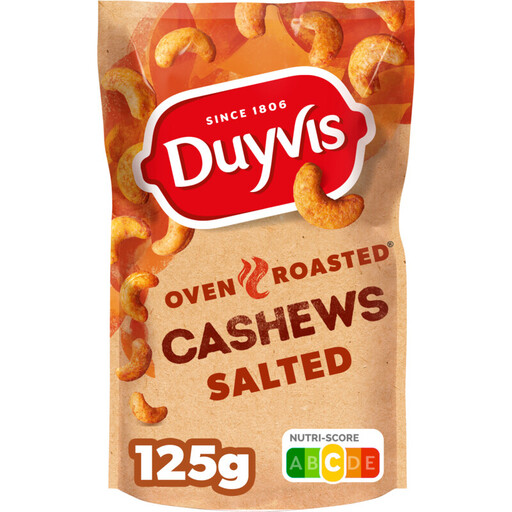 No image available
An option if you want to take cashews with no added oil for lunch; the product description states that each pack contains 4–5 portions.
Per 100 g: 43 g fat, 586 kcal and 0,92 g salt.
Contains cashews. The product description recommends storing in a cool, dry place and sealing the pack tightly after opening.
 No image available
An option if you’re looking for unsalted cashews for lunch and want to divide the pack into several portions.
Per 100 g: 46,67 g fat, 596 kcal and 0,067 g salt.
Contains cashews. The product information recommends keeping the pack tightly sealed after opening.
No. ‘Low fat’ is an absolute claim: according to the European Commission, solid food can contain no more than 3 g of fat per 100 g to qualify. For a reduced-fat claim, check what the product is being compared with and the values per 100 g; a smaller portion doesn’t prove that the nutritional composition is different.
Multiply the value per 100 g by your portion weight in grams, then divide by 100. Use the table on your own pack. As a calculation example, the Netherlands Nutrition Centre lists 154 kcal and 12,2 g of fat for 25 g of unsalted cashews; this isn’t a product specification for every brand.
Store the nuts in a dry, well-sealed container and follow the instructions on the packaging. For an opened bag of Duyvis Oven Roasted, Jumbo recommends an airtight, light-proof container.
No. Roasting doesn’t make the cashew allergen harmless. According to the Food Allergy Foundation, the allergen remains stable when heated; also check the allergen information on the exact pack.
Check the label on the exact pack. The Netherlands Food and Consumer Product Safety Authority states that listing allergens on prepacked foods is a legal requirement.