
People keeping an eye on total fat
You’re looking for a lower total fat content and don’t want to mistake descriptions of how a product is made for proof that its nutritional composition is different.


If you want to eat less fat, it helps to distinguish between getting less fat from the portion you eat and choosing cashews with a lower fat content. Compare the nutritional information for the exact variety per 100 g, and weigh your portion: a smaller portion changes how much you eat, not the composition of the cashews. Unsalted or made without added oil does not automatically mean a product contains less total fat.
You’re looking for a lower total fat content and don’t want to mistake descriptions of how a product is made for proof that its nutritional composition is different.
You want to keep eating cashews while managing the amount of fat in each snack by weighing your portion. The Netherlands Nutrition Centre gives 12.2 g of fat per 25 g portion of unsalted cashews as a general nutritional reference.
You’d prefer a product whose manufacturer explicitly states that no oil has been added, without assuming this automatically means it contains less total fat.
Total fat, portion size, preparation method and salt content answer different questions. So check the exact variety and compare nutritional values on the same basis.
| What to consider | What to look for | Who is this important for? |
|---|---|---|
| Total fat and nutrition claims | Compare the nutritional information per 100 g for the exact variety. A description of how a product is made is not the same as a claim about its composition. | If you want to know whether the nuts themselves contain less total fat, check the nutritional information for the specific product. Around 39% of consumers say total fat is their top buying priority. |
| Fat per portion eaten | Weigh your portion and use the nutritional information for the product you’re buying. The Netherlands Nutrition Centre gives 12.2 g of fat per 25 g of unsalted cashews as a general reference. | If your main aim is to manage the amount of fat you eat at each snack, weighing your portion can help. Around 31% of consumers say portion control is their top buying priority. |
| Made without added oil | Check both the description of how the product is made and the nutritional information for the exact variety; one does not replace the other. | If you want to avoid added oil, look for an explicit statement on the product. Around 15% of consumers say this preparation method is their top buying priority. |
| Unsalted or low in fat | Read the product description and nutritional information separately: ‘unsalted’ refers to salt, not necessarily total fat. | If you’re mainly looking for an unsalted option, assess salt and fat as separate criteria. Around 15% of consumers say ‘unsalted’ is their top buying priority. |
A description of how a product is made doesn’t tell you how much total fat the finished product contains. For example, Duyvis says its Cashews Original are roasted without added oil. That does not prove they have a lower total fat content.
Check the nutritional information for the exact variety alongside the description of how it is made.
A smaller portion may provide less fat, even though the composition of the cashews hasn’t changed. So don’t compare portions as if they were made to different recipes.
First compare the nutritional information for the same quantity of product, then work out the amount for your own portion.
Preparation methods, nutritional values and any warnings may apply to a specific variety or pack. A brand name alone doesn’t make different products interchangeable.
Check the full product name and, if there’s a safety warning, the barcode and best-before date listed as well.
Duyvis describes Cashews Original as oven-roasted without added oil.
Albert Heijn describes AH Cashewnoten ongezouten as an unsalted option.
Jumbo describes Ongezouten Cashewnoten in a 130 g pack.
Lidl describes one variety as unsalted cashews.
ALDI describes TRADER JOE'S roasted unsalted cashews in a 250 g pack.
PLUS describes Cashewnoten ongezouten fairtrade in a 200 g pack.
This selection includes cashews with different preparation and packaging features. Use the nutritional information on the exact pack to check the total fat per 100 g.
 Image unavailable
An option if you want to assess the nutritional information for a cashew product against a fixed weight.
160 g pack.
 Image unavailable
A good fit if you’re looking for a variety whose product description says it is roasted without added fat or oil. This alone does not mean it has a lower total fat content.
The product information gives a pack size of 125 g and 4–5 portions per pack.
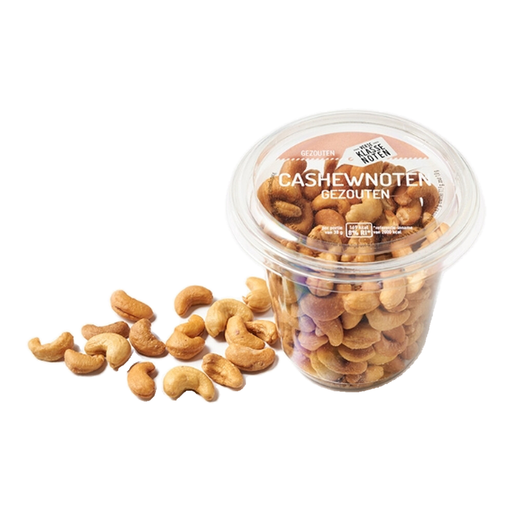 Image unavailable
An option if you want to compare a salted variety and check the ingredients on the exact pack.
150 g pack.
 Image unavailable
A good fit if you’re looking for a roasted, unsalted variety. ‘Unsalted’ does not mean lower in total fat.
200 g pack.
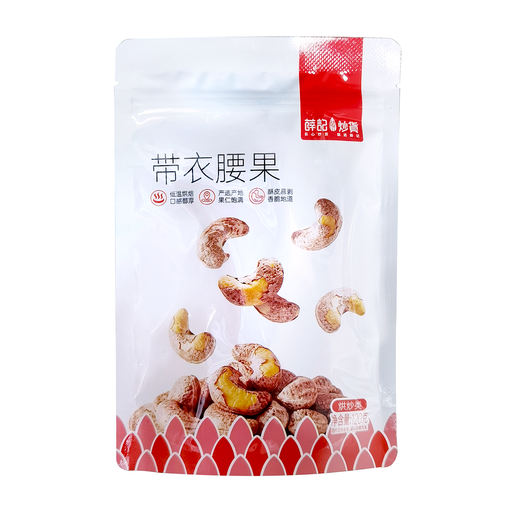 Image unavailable
An option if you’re looking for a smaller pack of salted cashews; check the nutritional information and your portion separately.
The product description lists a sealed, portable 120 g pack.
No. ‘Unsalted’ describes the salt content, not the fat content. Check the nutritional information for the exact variety and weigh your portion to work out how much fat you’re eating.
A smaller portion reduces the amount of fat you get from that portion, but it doesn’t change the composition of the cashews. The Netherlands Nutrition Centre gives 12.2 g of fat per 25 g of unsalted cashews as a general reference. Use the nutritional information for the product you have to calculate your own portion.
No. This description of how the product is made does not, by itself, prove a lower total fat content. Duyvis says its Cashews Original are roasted without added oil; check the nutritional information for the exact variety separately.
Check the allergen information on the packaging before buying. The Netherlands Food and Consumer Product Safety Authority (NVWA) stresses that consumers must have this information before purchase.
The NVWA warning issued on 20 May 2026 concerned 170 g packs of Trader Joe’s unsalted cashews with barcode 2003020120930 and best-before date 23-09-2026. The warning applied to that specific pack, not the whole range. Do not eat a pack matching these details; an expired best-before date does not make an affected pack safe.