
If you’re looking for verifiably lower-fat cashews
You want to be able to assess the fat content of the cashews themselves. A claim that no oil has been added isn’t enough: check the nutrition table too, along with the basis for any claim.


For a lighter late-night snack, start by comparing cashews on the same weight basis, then weigh your portion. If you’re looking for nuts with less fat, check the nutrition table and the basis for any claim: being unsalted or roasted without added oil does not, by itself, prove a lower fat content. A smaller portion reduces the amount you eat, not the composition of the cashews.
You want to be able to assess the fat content of the cashews themselves. A claim that no oil has been added isn’t enough: check the nutrition table too, along with the basis for any claim.
You want to choose your portion mindfully and work out the nutritional values for the amount you eat. The Netherlands Nutrition Centre gives 12.2 g of fat and 154 kcal for a generic 25 g handful of unsalted cashews; these are not values for a specific supermarket variety.
You may be looking for an unsalted variety, but want to assess salt and fat as separate properties. The Netherlands Nutrition Centre includes unsalted nuts in its Wheel of Five; that doesn’t automatically make them low in fat.
| What to consider | What should you look for? | Who is this important for? |
|---|---|---|
| Fat content | Compare total fat per 100 g and check the exact claim and its basis for comparison. | If I’m looking for less fat in the nuts themselves, I want to be able to assess the nutritional values and the comparison. Around 34% of consumers put fat reduction in the product first. |
| Portion and energy | Weigh your portion and calculate the values per 100 g for that amount. | If you mainly want to manage the amount you eat as a late-night snack, values for your own portion are useful. Around 33% of consumers prioritise portion size and energy. |
| Salt and flavour | Check whether the variety is salted or unsalted, and look at the salt content. | If I’m choosing between an unsalted variety and a savoury roasted one, I want to compare those qualities separately from the fat content. For around 20% of consumers, salt or flavour is the top priority. |
| Packaging | Check the weight in grams and follow the storage and usage instructions on the packaging. | If you want to choose an amount that suits how you use the product, check the net weight and what the label says to do after opening. Around 13% of consumers put packaging first. |
This describes how the cashews are prepared; it doesn’t prove that their total fat content is lower than that of a comparable product.
Check the nutrition table and assess any comparative claim separately. Duyvis uses this preparation description for Cashews Original.
Unsalted refers to the salt content, not the fat content. The Netherlands Nutrition Centre gives 12.2 g of fat for a generic 25 g handful of unsalted cashews.
Compare salt and fat as separate values on the label of the variety you buy.
A smaller portion contains less of the same product, but it doesn’t make the cashews a variety with a lower fat content per 100 g.
First compare products using the same quantity, then weigh your own portion.
On 20 May 2026, the NVWA warned that Trader Joe’s unsalted cashews, 170 g, with barcode 2003020120930 and best-before date 23-09-2026, may contain metal fragments. The warning applies to that specific pack.
Check the product name, packaging and barcode. Do not eat the product in question.
Duyvis describes Cashews Original as savoury and oven-roasted without added oil; the product information lists a 125 g pack.
Albert Heijn lists unsalted, salted and unroasted cashew varieties.
Jumbo lists unsalted packs in 200 g and 500 g sizes, as well as unroasted varieties and dry-roasted salted cashews.
Lidl Netherlands lists Way To Go! Unsalted Cashews.
ALDI Netherlands lists Trader Joe’s roasted and unsalted cashews in a 250 g pack.
PLUS lists 200 g packs of unsalted, unroasted cashews and a separate 200 g unsalted Fairtrade variety.
These are regular cashew varieties for anyone comparing portion size, salt or preparation method. Choosing an unsalted variety or roasted cashews without added oil doesn’t automatically mean choosing a product with reduced fat content.
 No image available
A good fit for a weighed snack if you want to calculate the nutritional values per 100 g for your portion. Ingredients: 100% cashew kernels. Contains cashews.
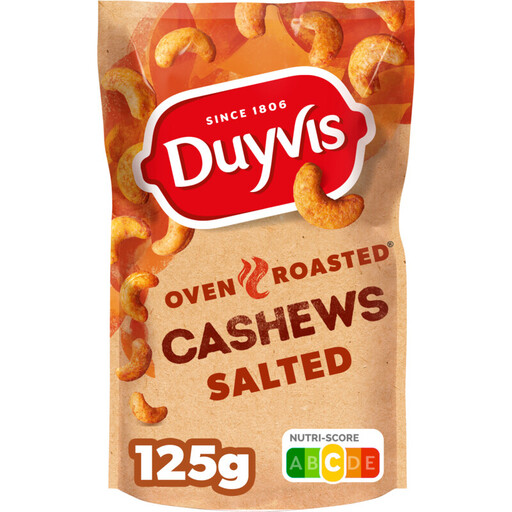 No image available
For anyone looking for dry-roasted cashews with no added fats or oil. Pack size: 125 g. Salt: 0.92 g per 100 g. Allergens listed: cashews, gluten, wheat and peanuts.
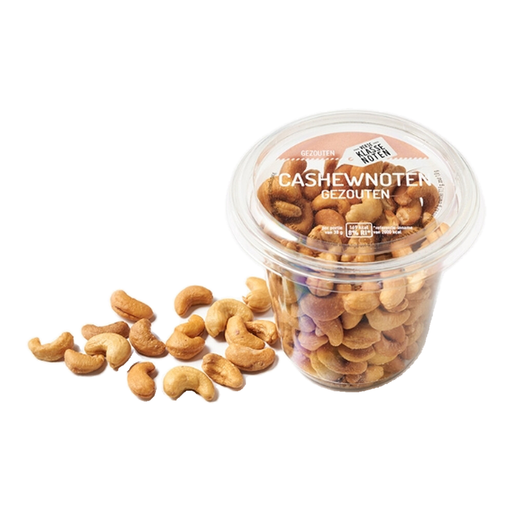 No image available
A roasted, salted variety for anyone who enjoys that flavour. Ingredients: cashews, sunflower oil and salt. Fat: 48 g per 100 g. Salt: 1.0 g per 100 g.
 No image available
A good choice if you’re looking for roasted, unsalted cashews and want to use the values per 100 g to work out your portion. Pack size: 200 g. Fat: 46.67 g per 100 g. Salt: 0.067 g per 100 g.
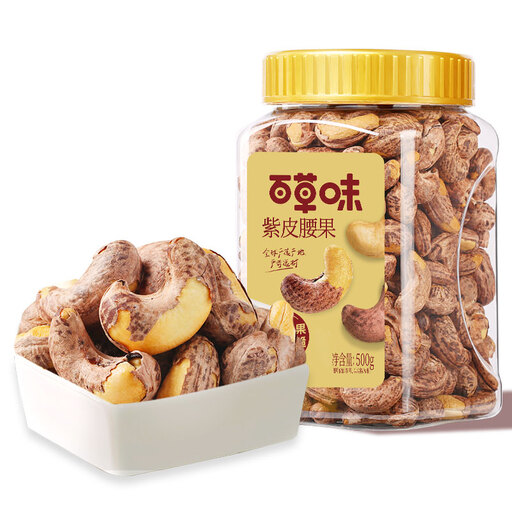 No image available
For anyone looking for salted cashews and wanting to take the nutritional values per 100 g into account when weighing a portion. Pack size: 500 g; the product name lists 180 grade. Fat: 60.1 g per 100 g. Salt: 1.2 g per 100 g. Contains cashews.
No. Unsalted doesn’t mean that cashews are low in fat. The Netherlands Nutrition Centre gives 12.2 g of fat for a generic 25 g handful of unsalted cashews. Check the nutrition table for the exact variety.
Use the values and weight on the same basis. If the values are given per 100 g, multiply them by the weight of your portion in grams, then divide by 100. A different portion size changes the amount you eat, not the composition of the product.
Not by itself. The description tells you how the cashews are prepared, but doesn’t confirm a lower total fat content than a comparable product. Compare the nutrition table and the basis for any claim.
Read the allergen information on the packaging of the exact variety. The NVWA states that allergens must be clearly and correctly listed on the label.
Follow the instructions on the packaging. If it says to store the cashews in a cool place, the Netherlands Nutrition Centre recommends a spot between 15 and 20 °C; this doesn’t automatically mean they need to go in the fridge. Also check whether the label gives different instructions for after opening.