
Label-checkers with diabetes
You’re looking for a snack and comparing carbohydrates per portion, ingredients and salt. The fat content alone won’t tell you how many carbohydrates you’ll eat in your portion.


If you have diabetes and want to choose cashews with less fat or energy, compare carbohydrates as well as fat per weighed portion, along with energy and salt. ‘Unsalted’, ‘no added oil’, ‘low fat’ and ‘reduced fat’ describe different things: according to the European Commission, the ‘low fat’ claim for solid foods means no more than 3 g of fat per 100 g. A nutrition claim does not mean that a product treats diabetes, so stick to your personal dietary advice.
You’re looking for a snack and comparing carbohydrates per portion, ingredients and salt. The fat content alone won’t tell you how many carbohydrates you’ll eat in your portion.
You want to keep an eye on fat or energy without automatically avoiding all nuts. Weighing your portion and understanding the difference between low fat and no added oil will help you assess labels more accurately.
You’re looking for unsalted cashews with a short ingredients list, perhaps unroasted. For you, how they’re prepared and what’s added are important details to check on the packaging.
Compare the nutritional information per 100 g and calculate it for the amount you actually eat. Diabetesvereniging Nederland points out that carbohydrates affect blood glucose.
| What to consider | What should you check? | Who is this important for? |
|---|---|---|
| Fat content | Compare fat per 100 g on the same basis. For ‘reduced fat’ products, also check which comparable products they’re being compared with. | If I want to eat less fat, I check the value on the label and the basis for any claim; around 29% of consumers prioritise reducing fat. |
| Carbohydrates per portion | Check total carbohydrates and ‘of which sugars’, then calculate the amount for your weighed portion. | If I’m tracking carbohydrates, I want to know how much is in my portion, not just how much sugar it contains; around 29% of consumers prioritise carbohydrates per portion. |
| Energy and portion size | Weigh your portion and calculate its energy using the nutritional information per 100 g. | If I want a lighter snack, I focus on what I actually serve myself rather than the size of the bag; around 24% of consumers prioritise energy and portion control. |
| Salt and ingredients | Check the salt per 100 g, ingredients list and allergen information on the packaging of the product itself. | If I’m looking for unsalted nuts with few added ingredients, I want to check both the salt and the ingredients; around 18% of consumers prioritise salt and simple ingredients. |
Cashews naturally contain fat. The product listing for Duyvis Oven roasted cashews salted gives 43 g of fat per 100 g, despite being made without added oil.
Compare the fat content per 100 g and check what any reduced-fat claim is based on.
The amount of sugars is not the same as total carbohydrates. Looking only at the sugar information leaves other carbohydrates out of the picture.
Check total carbohydrates and calculate the amount for the portion you weigh out.
Diabetes Fonds gives around 15 g as a handful of nuts, while Voedingscentrum’s nutritional example uses 25 g. Comparing different portion sizes can distort the comparison of energy and nutrients.
Weigh your portion and use the same amount when comparing products.
The pack size doesn’t tell you how much you eat in one sitting. Once opened, the bag also needs to be sealed properly and stored in a dry place; Voedingscentrum notes that nuts are susceptible to mould.
Divide the contents into weighed portions and follow the storage instructions on the packaging.
Duyvis describes Cashews Original as oven-roasted without added oil. That, in itself, says nothing about whether the product has reduced fat.
The AH Unsalted Cashews 170 g product reviewed is roasted and, according to the product information, contains sunflower oil.
The Jumbo Unsalted Cashews 200 g product reviewed is roasted and, according to the product information, contains sunflower oil.
Lidl sells cashews under the Alesto brand and also lists cashews in its Way To Go range.
ALDI lists Trader Joe's Roasted Unsalted Cashews 250 g.
PLUS Unsalted Unroasted Cashews 200 g is an option if you’re looking for a simple ingredients list.
These Joybuy products are cashew varieties you can compare by ingredients, preparation and nutritional values. Based on the stated fat values, none of them meet the ‘low fat’ threshold of no more than 3 g of fat per 100 g for solid foods.
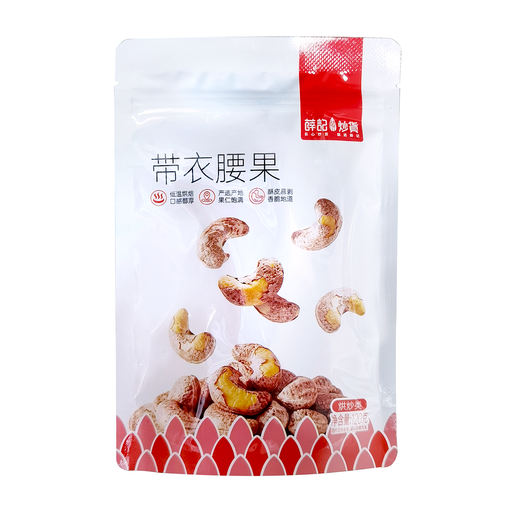 Image unavailable
A good fit if you’re looking for salted cashews with their skins on; the product information lists 596 kcal, 42.9 g of fat, 37.2 g of carbohydrates and 0.9 g of salt per 100 g. The fat content does not meet the ‘low fat’ threshold.
 Image unavailable
If you’re looking for a short ingredients list, the product information states 100% cashew kernels. Per 100 g, it lists 604 kcal and 47.7 g of fat, so this is not a low-fat variety.
 Image unavailable
The title describes roasted, unsalted cashews. The product information lists 46.67 g of fat per 100 g, so unsalted does not mean low fat.
 Image unavailable
If you’re looking for oven-roasted cashews with no added oil, the product information lists 586 kcal, 43 g of fat, 30 g of carbohydrates and 0.92 g of salt per 100 g. The preparation method doesn’t make this salted variety low fat.
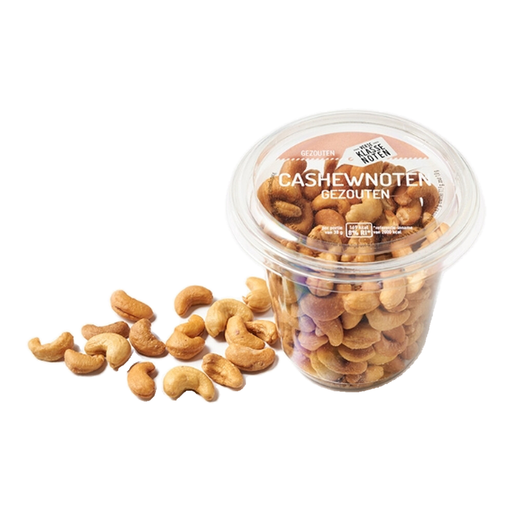 Image unavailable
If you’re looking for roasted, salted cashews, the product information lists 2555 kJ, 48 g of fat and 1.0 g of salt per 100 g. These values describe the variety shown and do not make it low fat.
No. For solid foods, the European Commission defines the ‘low fat’ claim as no more than 3 g of fat per 100 g. Nederlands Bakkerij Centrum explains ‘reduced’ as a comparison with similar products in which the relevant nutrient is at least 30% lower; this is industry guidance, not an assessment of a specific product. So a relative reduction can still mean a considerable fat content.
No. Diabetesvereniging Nederland points out that carbohydrates affect blood glucose. So check total carbohydrates and calculate the amount for the portion you actually eat; follow your own dietary advice when making personal choices.
The sources cited use different amounts: Diabetes Fonds gives around 15 g, while Voedingscentrum’s nutritional example uses 25 g. Weigh your portion if you want to compare nutritional values, and don’t treat these amounts as personal recommendations.
Not necessarily. Duyvis describes Cashews Original as oven-roasted without added oil, while the Duyvis Oven roasted cashews salted product reviewed contains 43 g of fat per 100 g, according to Albert Heijn. Check the nutritional information for the specific variety.
Store them in a dry place in a well-sealed container, and follow the instructions on the packaging. Voedingscentrum notes that nuts are susceptible to mould.
Check the ingredients and allergen warnings on the packaging of the product itself, even if it’s described online as unroasted or unsalted. The Netherlands Food and Consumer Product Safety Authority states that new rules for warnings about possible cross-contamination have applied since 1 January 2026.
Do not eat the product if it is Trader Joe's Unsalted Cashews, 170 g, with barcode 2003020120930 and a best-before date of 23-09-2026. On 20 May 2026, the Netherlands Food and Consumer Product Safety Authority warned that this specific product may contain metal fragments. The warning does not automatically apply to other varieties.