What should you look for when choosing?
First, check the ingredients and total carbohydrates on the label of the exact pack. Then calculate the amount for the portion you actually eat. Diabetesvereniging Nederland explains how to use the label information for this.
| What to consider |
What to look for |
Who is this important for? |
| Ingredients and carbohydrates |
Check the total carbohydrates per 100 g and the ingredients of the exact variety; calculate the amount for your weighed portion. |
If you want to know what’s in your portion, look beyond the sugars figure alone. Around 36% of consumers prioritise ingredients and carbohydrates. |
| Portion size for a large bag |
Weigh your portion and don’t treat the pack size as a recommended portion. Albert Heijn lists 25 g as the label portion for its 500 g product. |
If you buy a large bag but want to measure your portion carefully, sticking to a set weighed amount can help you plan. Around 29% of consumers prioritise portion control. |
| Packaging and usage |
Compare the net weight and preparation method of the different varieties; a larger pack is best suited to regular use. |
If you only want to choose a larger pack when you’ll use the contents regularly, consider the quantity and the exact variety. Around 21% of consumers prioritise pack size and regular use. |
| Stocking up and storage |
Choose an amount that suits how much you use and follow the storage instructions on the pack. Voedingscentrum advises storing nuts in a sealed container in a cool, dry place. |
If you only eat cashews occasionally, you won’t want to store more than is practical. Around 14% of consumers prioritise keeping a limited, manageable stock. |
Cashews at Joybuy
These Joybuy products come in different pack sizes and varieties, so you can compare them with your usage and the information on the label.
 Image unavailable
Jiazhouyuanye Original Flavour Large Cashew Nuts, 160 g
A smaller pack to consider if you don’t want to stock up on a large quantity.
Ingredients: 100% cashew kernels.
Carbohydrates: 22,6 g per 100 g.
Contains cashew kernels; relevant if you have a cashew or tree nut allergy.
Joybuy
 Image unavailable
g’woon Cashew Nuts Roasted & Unsalted, 200 g
A roasted, unsalted variety in a 200 g pack.
Ingredients: cashews.
Carbohydrates: 22,67 g per 100 g.
Contains cashews; relevant if you have a cashew or tree nut allergy.
Joybuy
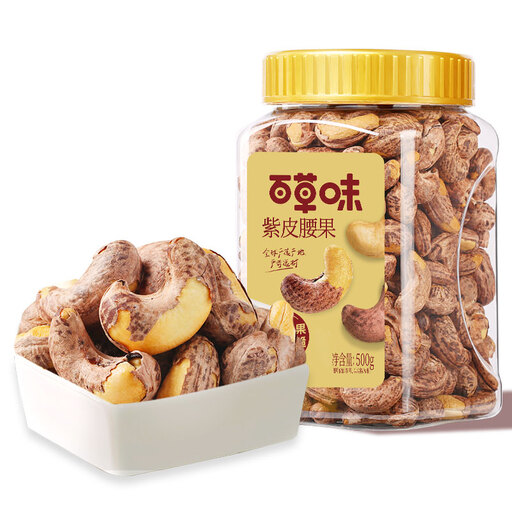 Image unavailable
Be&Cheery Cashews with Purple Skin, 180 grade, 500 g
The listed 500 g pack is a larger quantity; check that it suits your usage and storage options.
Carbohydrates: 19,8 g per 100 g.
Salt: 1,2 g per 100 g.
Contains cashews; relevant if you have a cashew or tree nut allergy.
Joybuy
Frequently asked questions
If you have diabetes, should you only look at the sugars figure?
No. Check the total carbohydrates and calculate the amount for the weight of the portion you actually eat. Diabetesvereniging Nederland explains how to use the label information for this.
How do you calculate the carbohydrates in a weighed portion?
Multiply the carbohydrates per 100 g by the portion weight, then divide the result by 100. For a 25 g portion, the AH variety examined, with 22 g per 100 g, works out at 5,5 g; the Jumbo variety, with 23 g per 100 g, works out at 5,75 g. These are calculations based on label values, not personal portion recommendations or predictions of your blood glucose.
How should you store an opened large bag of cashews?
Store the nuts in a tightly sealed container in a cool, dry place and follow the instructions on the pack. Voedingscentrum highlights the importance of sealed, dry storage; for the variety examined, Jumbo recommends storing it in a cool, dry, dark place.
How many portions are there in a 500 g bag?
At 25 g per portion, you can get 20 portions from 500 g. Albert Heijn gives the same breakdown for its product. Use this as an example for planning your supplies, not as general advice on a suitable portion size.
What should you look for in allergen information on the label?
Check the ingredients list and any warnings on the pack of the exact variety. The NVWA states that 14 allergens must be declared; product information may also warn of the possible presence of other nuts or peanuts.
Which ALDI cashews does the NVWA warning apply to?
The NVWA warning dated 20 May 2026 concerns Trader Joe’s unsalted cashews, 170 g, with barcode 2003020120930 and best-before date 23-09-2026, due to possible metal fragments: do not eat this pack. The warning applies to this specific pack and not automatically to other sizes or batches. The best-before date has now passed; check whether you still have this exact pack at home.


