
Less fat in the cashews themselves
You want to compare labels for fat per 100 g and find a product that genuinely contains less fat, rather than simply an unsalted option or one made without added oil.


If your main aim during your coffee break is to eat fewer cashews, weigh out a smaller portion beforehand. If you want less fat in the nuts themselves, compare the fat content per 100 g. The Duyvis, Albert Heijn, Jumbo and PLUS labels reviewed list between 43 and 50 g of fat per 100 g. According to the European Commission, solid foods can contain no more than 3 g of fat per 100 g to make the ‘low fat’ claim. This is not the same as the requirements for a reduced-fat claim.
You want to compare labels for fat per 100 g and find a product that genuinely contains less fat, rather than simply an unsalted option or one made without added oil.
You want to keep eating regular cashews, but decide in advance how much to have during your morning break. The weight and nutritional value of your portion matter.
You’re looking for cashews with no added salt and want to check whether the ingredients list includes oil or flavourings as well as nuts.
First decide what matters most to you: the nutritional composition per 100 g, the amount you have during each coffee break, the salt and ingredients, or how easy the product is to store.
| What to consider | What should you look for? | Who is this important to? |
|---|---|---|
| Fat content of the nuts | Compare the exact product variant for fat per 100 g. The European Commission sets a maximum of 3 g per 100 g for the ‘low fat’ claim on solid foods. | If I’m looking for less fat in the cashews themselves, I compare the nutritional information rather than relying on ‘unsalted’ or ‘no added oil’. Around 36% of consumers prioritise the product’s composition. |
| Amount per coffee break | Weigh your portion in advance and compare nutritional values for the same weight. Serving sizes on labels can vary. | For a smaller snack, I want to decide on the amount in advance without pretending that the composition of the cashews has changed. Around 29% of consumers prioritise portion control. |
| Salt and ingredients | Read the ingredients list and check the salt per 100 g. ‘Unsalted’ doesn’t automatically mean that no oil has been added. | If I don’t want added salt, I also check what other ingredients are in the pack. Around 21% of consumers focus mainly on an unsalted product with simple ingredients. |
| Packaging and storage | Compare the pack size with how you plan to weigh out portions, and follow the storage instructions on the packaging. | For regular coffee breaks, I want packaging that’s easy to store and lets me measure out individual portions. Around 14% of consumers prioritise practical storage and use. |
These descriptions refer to salt or the preparation method, not necessarily the fat content. The labels reviewed for unsalted varieties list between 46.5 and 50 g of fat per 100 g. For solid foods, the European Commission sets a maximum of 3 g per 100 g for the ‘low fat’ claim.
Compare the nutritional information per 100 g and check the ingredients, salt and any claims separately.
Albert Heijn lists a 25 g serving, while Duyvis lists an average serving of 30 g. Differences per serving may therefore be partly due to the serving size, not just the product’s composition.
Compare per 100 g first, or calculate the nutritional values for the same weighed amount.
A tub or bag may contain several servings. Weighing out portions and storing the rest properly are separate steps. If the pack doesn’t reseal securely, you may need an airtight storage container.
Take the amount you want from the pack in advance, then follow the label’s storage instructions for the rest.
Duyvis describes Cashews Original as oven-roasted without added oil. This tells you how they’re prepared, not whether they’re low in fat.
The own-brand product reviewed is AH Cashewnoten ongezouten, in a 170 g tub.
The own-brand product reviewed is unsalted cashews, available in a 200 g pack.
Lidl sells cashews under the Alesto brand and also mentions Way To Go cashews, which are positioned as a fairtrade product.
The ALDI product page reviewed describes Trader Joe’s roasted, unsalted cashews in a 250 g pack.
The PLUS variant reviewed is unsalted and unroasted, in a 200 g bag.
This selection of Joybuy products includes salted, unsalted and roasted cashew varieties for anyone comparing ingredients and portion sizes. The stated fat content ranges from 42.9 to 48 g per 100 g, which is above the European Commission’s maximum of 3 g per 100 g for the ‘low fat’ claim on solid foods. This alone doesn’t determine whether the requirements for a reduced-fat claim have been met.
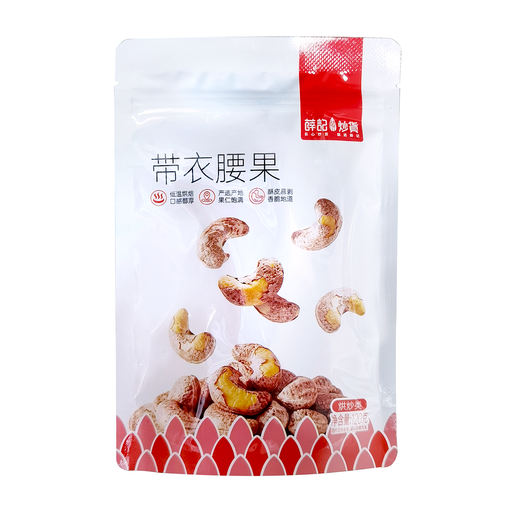 Image unavailable
A good fit if you’re looking for salted cashews to enjoy with your coffee.
The product information lists cashews and salt as ingredients, with 42.9 g of fat and 0.9 g of salt per 100 g. The pack contains 120 g.
 Image unavailable
A good fit if you’re looking for oven-roasted cashews with no added oil.
The product information lists 43 g of fat and 0.92 g of salt per 100 g. The pack contains 125 g and the description states that it contains 4–5 servings. The allergen information lists cashews, gluten, wheat and peanuts.
 Image unavailable
A good fit if you want to compare roasted cashews with no added salt.
The product information lists cashews as the only ingredient and 46.67 g of fat per 100 g. The bag contains 200 g.
 Image unavailable
A good fit if you’re looking for a simple cashew option for a snack.
The ingredients list states 100% cashew kernels, and the nutritional information lists 47.7 g of fat per 100 g. The pack contains 160 g.
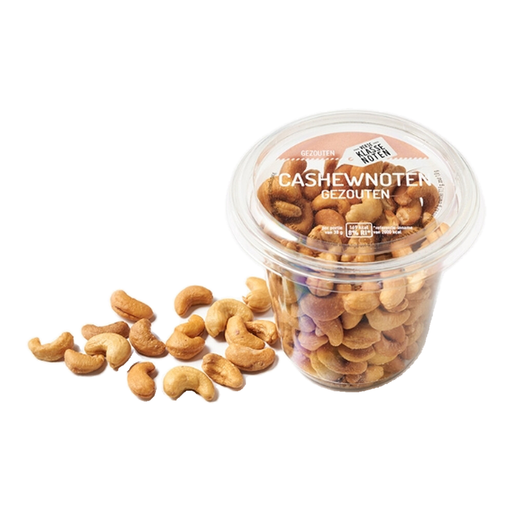 Image unavailable
A good fit if you’re looking for salted cashews to enjoy with your coffee.
The ingredients information lists 98% cashews, sunflower oil and 1% salt. The label states 48 g of fat per 100 g; the pack contains 150 g.
No. ‘Unsalted’ doesn’t in itself tell you anything about the fat content. The unsalted varieties reviewed list between 46.5 and 50 g of fat per 100 g. For solid foods, the European Commission sets a maximum of 3 g of fat per 100 g for the ‘low fat’ claim. Meeting this limit doesn’t automatically mean the requirements for a reduced-fat claim have been met.
No. 25 g isn’t automatically the right amount for everyone or for every coffee break. Voedingscentrum uses 25 g as a serving in its calorie checker; the 25 g Albert Heijn serving and 30 g Duyvis serving are details from the labels, not personal recommendations.
Follow the storage instructions for the variety you buy. Albert Heijn recommends storing them somewhere cool, dark and dry, and sealing the pack securely. Duyvis recommends keeping an opened bag in a light- and airtight container. Voedingscentrum gives six months in a kitchen cupboard and one year in the freezer as quality guidelines for opened unsalted cashews.
For pre-packed cashews, allergen information is shown on the label. The NVWA says that sellers must inform consumers about allergens present; for unpackaged products, this information can be given in writing or verbally. Check the information on the specific pack, including for the possible presence of other allergens.
The NVWA warning dated 20 May 2026 concerns Trader Joe’s 170 g unsalted cashews with barcode 2003020120930 and best-before date 23-09-2026, due to the possible presence of metal fragments. Do not eat the specifically identified batch. The warning doesn’t automatically apply to other pack sizes, batches or brands.