
Portion-conscious campers
You want to take cashews with you and keep an eye on the amount of fat in each snack. Measuring out a portion is not the same as choosing a product with a lower fat content.


If you want to eat less fat at each snack time, start with the portion: a smaller serving of regular cashews contains less fat, but it doesn’t make the nuts themselves low in fat. Also compare the fat content per 100 g, and consider salt, preparation method and pack size separately. For solid foods, the European Commission sets a maximum of 3 g of fat per 100 g for a ‘low fat’ claim.
You want to take cashews with you and keep an eye on the amount of fat in each snack. Measuring out a portion is not the same as choosing a product with a lower fat content.
You’re looking for an unsalted snack to enjoy on the go and don’t want to mistake a lower-salt option for one with less fat.
You want to match the pack size to the number of times you expect to snack, and store opened nuts according to the storage instructions.
First decide whether you mainly want to limit the amount you eat at each snack time or find a product with a lower fat content. Then consider salt, storage and pack size.
| What to consider | What should you look for? | Who is this most relevant to? |
|---|---|---|
| Fat per snack | Compare the fat per 100 g as well as the amount you eat; check the exact product claim. | If I want to eat less fat at each snack time, I look at both the portion size and the fat per 100 g. Around 36% of consumers prioritise managing their fat intake. |
| Salt and preparation | Check the variety, salt information and preparation method separately. | If I’m looking for unsalted nuts or a specific preparation method, I check those features separately from the fat content. Around 29% of consumers prioritise this choice. |
| Storage after opening | Follow the storage instructions on the pack and think about where you can keep the opened bag at the campsite. | If I’m taking nuts to a campsite where storage conditions can vary, I check the storage instructions and how much I’ll open at once. Around 21% of consumers prioritise storage. |
| Pack size | Choose a net weight that suits how much you expect to use during your stay. | If I want to avoid opening more than I’ll use, I choose a pack size that suits my snacking habits. Around 14% of consumers prioritise pack size and stock management. |
Choosing an unsalted variety or a particular preparation method doesn’t, in itself, mean the total fat content is lower. For solid foods, the European Commission sets a maximum of 3 g of fat per 100 g for a ‘low fat’ claim.
Check the exact claim and compare the nutritional values per 100 g; consider the portion size separately.
Storage instructions don’t necessarily apply in every situation. Voedingscentrum identifies rancid, chewy or mouldy nuts as signs of spoilage.
Follow the instructions on the pack and store the nuts in a cool, dry, dark place if this is recommended for that variety.
A larger pack doesn’t change the fat content per 100 g, and it means you’ll have more stock to manage.
Choose a pack size based on how much you expect to use during your stay.
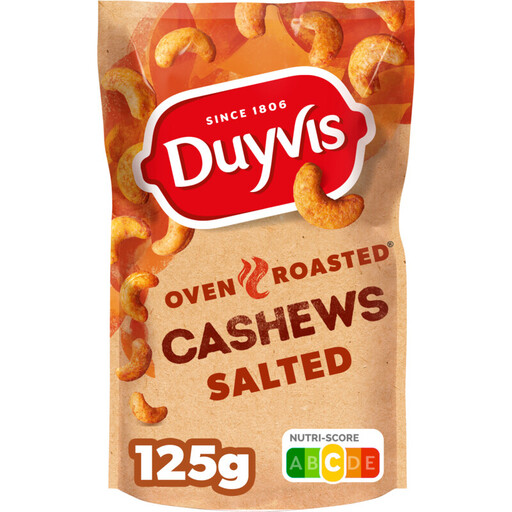
Duyvis describes its Cashews Original as oven-roasted without added oil.
AH Cashewnoten ongezouten is an own-brand option if you’re looking for unsalted cashews.
Jumbo lists unsalted cashews in 200 g and 500 g packs; storage advice is provided for the 130 g variety.
Lidl lists unsalted cashews and also refers to Way To Go cashews in its Alesto range.
ALDI lists TRADER JOE'S roasted, unsalted cashews in a 250 g pack.
PLUS Cashewnoten ongezouten ongebrand, 200 g, is an option if you’re specifically looking for an unroasted, unsalted variety.
These Joybuy products let you compare preparation methods, salt and pack sizes. The fat values shown mean that none of these varieties is low in fat.
 No image available
The description says the cashews are oven-roasted without added fat or oil; this doesn’t make them low in fat.
Listed fat content: 43 g per 100 g.
The product description says the pack contains 4–5 servings and should be stored in a cool, dry place.
 No image available
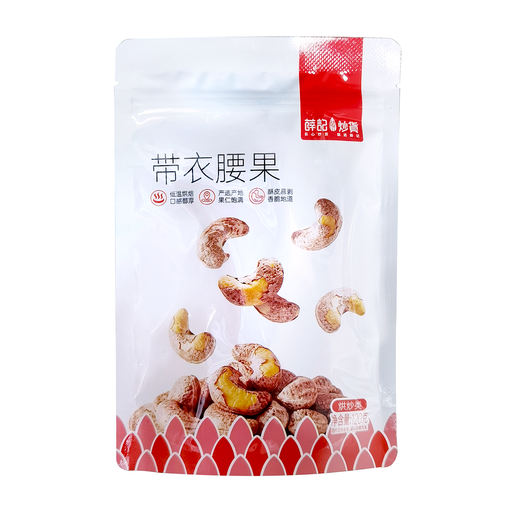
This salted variety may suit you if you’re looking for cashews in a 120 g pack; the salt choice doesn’t indicate a lower fat content.
Listed fat content: 42,9 g per 100 g.
The product description says to store in a cool, dry place.
 No image available
The title lists roasted, unsalted cashews in a 200 g pack.
Listed fat content: 46,67 g per 100 g; listed salt content: 0,067 g per 100 g.
The product description says to store in a cool, dry place and reseal the pack after opening.
 No image available
The ingredients list names 100% cashew kernels as the only ingredient; check the packaging if you need a specific composition.
Listed fat content: 47,7 g per 100 g.
The product description says to store in a closed pack in a cool, dry place.
 No image available
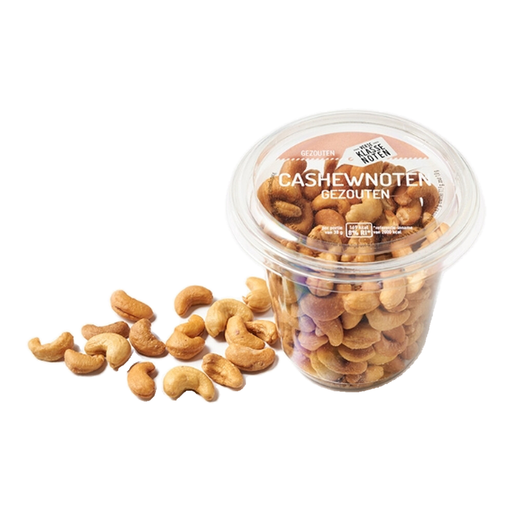
This salted variety is listed in a 150 g pack; the ingredients list includes sunflower oil and salt.
Listed fat content: 48 g per 100 g.
The product description says to store in a cool, dry place.
No. For solid foods, the European Commission sets a maximum of 3 g of fat per 100 g of product for a ‘low fat’ claim. A smaller serving doesn’t change the amount of fat per 100 g.
Voedingscentrum lists 12,2 g of fat and 154 kilocalories in 25 g of regular unsalted cashews. These are general values for the category; check the nutritional information on the packaging for a specific variety.
Not automatically. Voedingscentrum says unsalted cashews can be kept in a kitchen cupboard for six months, but this is not specific advice for a warm tent. Jumbo says its 130 g pack of unsalted cashews should be stored in a cool, dry, dark place. Follow the instructions on the packaging and look out for rancid, chewy or mouldy nuts.
Check the ingredients, allergen information and any cross-contamination warnings on the current packaging. The NVWA says allergens must be clearly and correctly listed on the label. According to the NVWA, new rules for warnings about allergen cross-contamination apply in the Netherlands from 1 January 2026; this doesn’t mean cashews are automatically suitable for anyone with a nut allergy.
The NVWA warning dated 20 May 2026 concerns TRADER JOE'S unsalted cashews, 170 g, with barcode 2003020120930 and best-before date 23-09-2026, due to possible metal fragments. Don’t eat this specific batch if you still have it. The warning does not apply to all ALDI cashews.