What should you look for when choosing?
First decide which variety you want and how much you’re likely to use. Then compare the price per kilogram and the amount you’ll be keeping in stock.
| What to consider |
What to look for |
Who should pay particular attention? |
| Price per kilogram |
Compare the net weight and price per kilogram. Don’t assume that ‘value’ or ‘XXL’ means a bag is the cheapest option. |
If I mainly want to know what I’m paying per kilo, I compare the unit price rather than just the price of the whole bag. Around 33% of consumers prioritise the price per kilogram. |
| Variety and preparation |
Read the full variety name and the label. Unsalted, unroasted and made without added oil don’t mean the same thing. |
If I’m looking for an unsalted variety for regular use, I don’t want to rely only on terms such as ‘roasted’ or ‘made without added oil’. Around 27% of consumers prioritise their preferred variety or preparation method. |
| How much to keep in stock |
Choose a weight that suits the number of people sharing and how often you serve cashews. Follow the storage instructions on the pack. |
If I don’t share cashews often, I want to avoid buying more than I’ll use. Around 20% of consumers prioritise buying an appropriate amount and minimising waste. |
| Flavour for your coffee break |
Check the full product name and flavour, even when you’re looking at a large pack. |
If I’m mainly after a savoury, roasted flavour, I want to make sure it suits my coffee break before choosing a pack. Around 13% of consumers prioritise their preferred flavour. |
| Fairtrade label |
Check that the label appears on the specific product. Don’t assume it applies to every variety sold by a retailer. |
If a Fairtrade label is essential for me, I check for it on the pack I’ve chosen. Around 7% of consumers prioritise this product feature. |
Brands and product ranges
These examples can help you compare product ranges and varieties from the brands reviewed. A listing alone says nothing about availability or whether a product is right for everyone.
Duyvis
Cashews Original is described as a savoury, oven-roasted variety; the manufacturer lists a 125 g pack.
- Duyvis says Original is roasted without added oil. This is the manufacturer’s product description, not an independent taste assessment.
- The Oven Roasted variety listed by Jumbo is salted; ‘made without added oil’ does not mean ‘unsalted’.
Albert Heijn
AH Terra is sold as a range that includes unroasted cashews. Albert Heijn lists a 500 g pack in its Dutch category overview.
- The product description makes it easy to identify the unroasted variety.
- Albert Heijn advises checking the label, as product information can change. The preparation method alone says nothing about flavour or quality.
Jumbo
The range includes, among other options, a 500 g value pack of unsalted cashews and a smaller unsalted pack.
- The product descriptions make it easier to compare pack sizes and varieties across the range.
- A value pack doesn’t prove it’s the cheapest option on the market. Choose an amount that suits how much you use.
Lidl
Lidl lists Alesto and describes Way To Go cashews as Fairtrade.
- The Fairtrade reference is a product-range feature as described by Lidl.
- A commercial product listing describes a 500 g roasted, unsalted Alesto variety. Don’t treat this information as an independent comparison test or assume it applies to every variety.
ALDI
According to its product page, the Trader Joe’s range includes 250 g packs of roasted, unsalted cashews and a 500 g page featuring salted and unsalted varieties.
- The different pack sizes give you options for matching the amount you buy to how much you use.
- The 500 g page groups different flavours together, so check which variety is on the pack. An NVWA warning about a specific 170 g pack does not automatically apply to the whole range.
PLUS
PLUS lists a 200 g pack of salted Fairtrade cashews.
- The product description states both the Fairtrade label and the pack size.
- This variety is salted; its product description does not mean the entire cashew range has the same feature.
Cashews at Joybuy
Cashew options at Joybuy, with different pack sizes and product descriptions to help you choose what suits your needs.
 Image unavailable
Three Squirrels Purple-Shell Cashews, 500 g
The 500 g pack is suited to sharing regularly; the product description mentions cashews with purple skin and salt.
Joybuy
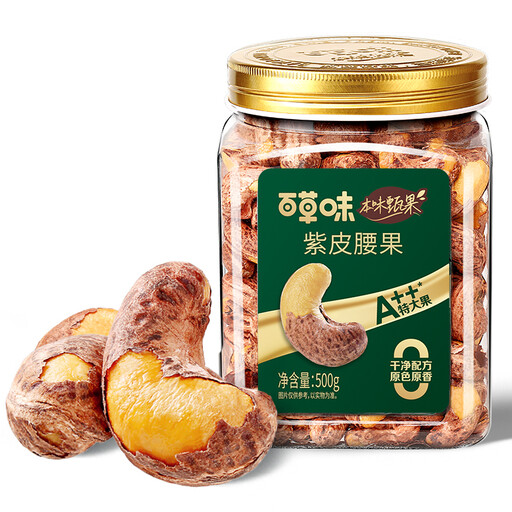 Image unavailable
BE&CHEERY Premium Cashews with Purple Skin, 500 g
The product description lists 500 g for sharing with family and states that it contains 2% salt; check the label on the pack you choose.
Joybuy
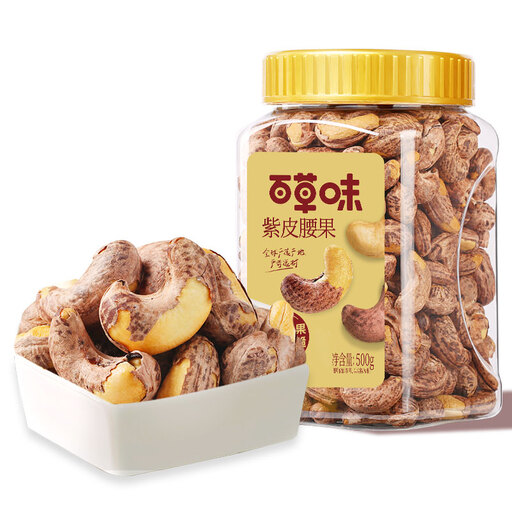 Image unavailable
Be&Cheery Cashews with Purple Skin, 180 grade, 500 g
The pack lists 500 g; the product description mentions cashews with purple skin and salt.
Joybuy
 Image unavailable
Jiazhouyuanye Original Flavour Large Cashew Nuts, 160 g
The smaller pack may suit you if you want to keep less in stock; the product description lists cashew kernels as the only ingredient.
Joybuy
 Image unavailable
Duyvis Dry Roasted Cashews, 125 g
The smaller pack is an option if you’re looking for a limited amount of roasted cashews. The product description lists sea salt and also mentions gluten, wheat and peanuts; check the latest allergen information on the pack.
Joybuy
Frequently asked questions
How can I work out how many coffee breaks a bag will last?
Divide the net weight by the amount each person actually takes. As an example, 500 g provides twenty portions of 25 g, while 250 g provides ten. If you’re sharing with one other person, you’ll use two portions at each coffee break. This is a way to plan your supplies, not personal dietary advice.
How should I store an opened pack of cashews?
Follow the storage instructions on the pack for your variety. The 130 g Jumbo pack checked says to store it in a cool, dry and dark place. The Netherlands Nutrition Centre lists rancidity, a chewy texture and mould as signs to look out for in mixed unsalted nuts; this general information doesn’t guarantee that every cashew variety will keep for the same amount of time.
What allergen information must appear on packaged nuts sold in the Netherlands?
According to the Netherlands Food and Consumer Product Safety Authority (NVWA), allergen information must appear on the label of prepacked foods. Also read any warnings about the possible unintended presence of other allergens. Since 1 January 2026, Dutch precautionary allergen labelling rules have applied; the label does not prove that an individual product is suitable for your allergy.
Does the NVWA warning apply to all Trader Joe’s cashews?
No. The Netherlands Food and Consumer Product Safety Authority warning dated 20 May 2026 concerns 170 g packs of Trader Joe’s unsalted cashews with barcode 2003020120930 and a best-before date of 23-09-2026, due to the possible presence of metal fragments. Do not eat this specific pack. The warning does not automatically apply to all 250 g or 500 g packs.
Can I give whole cashews to young children without any concerns?
Bear in mind the warning on the Jumbo pack that was checked: young children may choke on nuts. Take this warning into account when young children are eating with you; it relates to that specific situation.


