
Less fat per serving
For people who want to keep eating cashew nuts but care more about the fat content and amount per serving than a claim on the pack. Compare the nutritional information per 100 g and weigh out the portion you’ll eat.


Choose a reduced-fat product only if the claim is substantiated and based on a comparison with a similar product; unsalted or made without added oil does not automatically mean lower in fat. If you’re on a tight student budget, compare the price per kilo and pack size too, and consider how much you’ll actually use.
For people who want to keep eating cashew nuts but care more about the fat content and amount per serving than a claim on the pack. Compare the nutritional information per 100 g and weigh out the portion you’ll eat.
For people who keep an eye on both the price per kilo and how much they spend at the time of purchase. A larger pack is only practical if you’ll use what’s inside.
For people who want to use cashew nuts in an evening meal and decide for themselves how much salt or other flavourings to add. Unsalted does not automatically mean no added oil.
Choose this option if: a lower fat content in the product itself is your main priority and the claim is supported by an appropriate comparison.
The trade-off: reduced fat is not the same as low fat; check the nutritional information and serving size too.
Choose this option if: you want to decide for yourself how many nuts and flavourings to add to a meal.
The trade-off: the specific AH and Jumbo varieties contain sunflower oil; being unsalted says nothing in itself about the fat content.
Choose this option if: you’re looking for a variety made without added oil.
The trade-off: Duyvis describes Cashews Original as roasted without added oil; this does not prove that it has a reduced fat content.
| What to consider | What should you check? | Who is this important to? |
|---|---|---|
| Fat content and portion | Compare the fat per 100 g and check what a reduced-fat claim is based on. Weigh the amount you eat too. | If I want less fat per serving, I check both the nutritional information and my portion; around 34% of consumers make fat content their top buying priority. |
| Pack size and budget | Compare the price per kilo, the amount you pay at the till and the pack’s net weight. | If I want to keep to my food budget, I compare both the price per kilo and the amount I pay upfront; around 33% of consumers put affordability first. |
| Ingredients and salt | Read the ingredients list and nutritional information; check the allergen information on the exact pack too. | If I want to choose how much salt, oil and seasoning to add to an evening meal, I check the information for each variety; around 20% of consumers prioritise the meal’s ingredients. |
| Quantity and storage | Choose a pack that suits how much you use and follow the storage advice on the pack. | If I want to avoid leaving a pack unused, I think about how often I use the nuts and how I’ll store them once opened; around 13% of consumers make using up and storing a product appropriately their top priority. |
The specific AH and Jumbo varieties are unsalted, but contain sunflower oil. Their product information lists 50 g and 48.6 g of fat per 100 g respectively.
Check salt, ingredients and fat content separately, then choose according to what matters most to you.
Duyvis describes a method of preparation; this does not automatically mean the product has less fat than a similar one.
Use the information about oil to understand how the product is prepared, and assess any fat claim separately.
Packs can differ in weight and preparation. A larger pack isn’t practical if you won’t use what’s inside.
Compare the price per kilo, total cost, variety and how much you expect to use.
A larger pack may go unused if its contents don’t suit how much you use.
Duyvis describes Cashews Original as savoury cashew nuts roasted in the oven without added oil.
AH Unsalted Cashew Nuts 170 g are a regular unsalted, roasted variety.
Jumbo Unsalted Cashew Nuts 200 g are a regular unsalted variety.
PLUS Unsalted Unroasted Cashew Nuts 200 g are an unroasted variety to compare.
ALDI describes 250 g of roasted unsalted cashew nuts sold under the product name TRADER JOE'S.
Lidl describes roasted salted cashew nuts in 250 g and 500 g packs.
These cashew nuts available from Joybuy are suitable for snacking or adding to dishes. Compare the ingredients, nutritional information and quantity for each pack; the preparation methods described are not in themselves proof of reduced fat.
 Image unavailable
The product information suggests enjoying them as a snack or adding them to yoghurt, muesli or recipes.
The ingredients list contains only cashew kernels. The Joybuy product listing gives 47.7 g of fat per 100 g.
 Image unavailable
This roasted, unsalted variety is a good choice if you want to decide how much salt and other flavourings to add.
The ingredients list contains cashew nuts. The Joybuy product listing gives 46.67 g of fat per 100 g.
 Image unavailable
These oven-roasted cashew nuts are a good choice if you’re specifically looking for a variety roasted without added oil.
The product description mentions savoury flavourings, including salt, and 4–5 servings per pack. The Joybuy product listing gives 0.92 g of salt per 100 g.
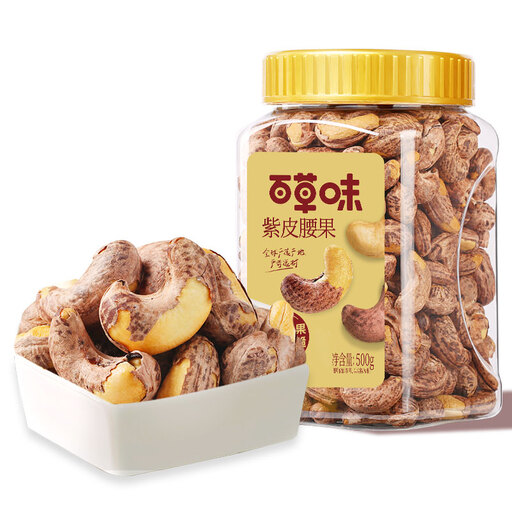 Image unavailable
The product description suggests using them as a snack or in dishes, and gives the pack size as 500 g.
The Joybuy product listing gives 60.1 g of fat and 1.2 g of salt per 100 g.
No. The European Commission defines low-fat for solid foods as a maximum of 3 g of fat per 100 g; this is not the definition of reduced fat. Assess a reduced-fat claim by comparing the product with a similar one.
Compare the price per kilo and the amount you pay at the time of purchase. Also check the net weight, variety and how much you expect to use.
Check the allergen information on the exact pack, even if you’ve bought the same variety before. PLUS Unsalted Unroasted Cashew Nuts lists cashew nuts and may contain peanuts; don’t assume this information applies to other brands or packs.
Follow the storage advice on the pack you buy. Albert Heijn recommends closing the pack securely and storing it in a cool, dark, dry place. The Voedingscentrum’s general storage guide says regular unsalted cashew nuts keep for six months in a kitchen cupboard after opening; this is not a guarantee for every variety.
No. The NVWA warning issued on 20 May 2026 concerned TRADER JOE'S unsalted cashew nuts, 170 g, with barcode 2003020120930 and best-before date 23 September 2026, due to possible metal fragments. The warning did not apply to the separate 250 g pack. If you still have the 170 g pack with those details, do not eat the cashew nuts.