
Less fat with your coffee
You want to keep cashew nuts as a coffee-time snack, but distinguish between choosing a different recipe and eating less of the same product. Compare total fat per 100 g and consider your own portion too.


If you want to eat less total fat with your coffee on the go, weighing out a smaller portion reduces the amount you eat each time, but not the fat content per 100 g. The Duyvis, PLUS, Jumbo and AH varieties reviewed list 43–50 g of fat per 100 g; the European Commission sets a maximum of 3 g per 100 g for a ‘low fat’ claim on solid foods. So a lower fat content than another cashew variety does not automatically mean it is ‘low fat’.
You want to keep cashew nuts as a coffee-time snack, but distinguish between choosing a different recipe and eating less of the same product. Compare total fat per 100 g and consider your own portion too.
You regularly take a snack to work and want to portion it in advance and store the rest properly. Pack size and instructions for closing and storing the pack are practical considerations.
You’re looking for cashew nuts with no added salt or a simple ingredients list. Check the exact variety: unsalted does not automatically mean oil-free or low fat. If you have a relevant allergy, check the warnings on the packaging too.
First compare total fat per 100 g, then calculate how much that is for the amount you take with you. Check salt, ingredients and packaging as separate features.
| What to consider | What should you check? | Who is this important for? |
|---|---|---|
| Actually lower in fat | Compare total fat per 100 g and read the exact claim. For solid foods, the European Commission sets a maximum of 3 g of fat per 100 g for a ‘low fat’ claim. | If I’m mainly looking for a product with less total fat, I want to compare labels on the same basis. Around 36% of consumers make this their top purchasing priority. |
| A portion to take with you | Check the portion size on the label and weigh out the amount you’ll actually take with you. | If you want to decide in advance how many cashew nuts to take with your coffee, focus on your own portion. Around 29% of consumers put portion control first. |
| Ingredients and salt | Read the ingredients list and check the salt per 100 g. Check allergen information separately if it’s relevant to you. | If I’m looking for unsalted cashew nuts or a short ingredients list, I want to know what else is in the product. Around 21% of consumers prioritise this choice of recipe. |
| Packaging and storage | Choose a pack size that suits how you use the product, and follow the instructions for closing and storing it after opening. | If you take cashew nuts with you regularly, you’ll want packaging that suits your needs and can be resealed properly. For around 14% of consumers, buying for the pantry is the deciding factor. |
A smaller portion contains less total fat than a larger portion of the same product, but it doesn’t change the fat content per 100 g.
First compare the nutritional values per 100 g, then calculate what they mean for your own portion. Don’t use ‘low fat’ as another way of saying you’re taking less with you.
The unsalted Jumbo and AH varieties reviewed list sunflower oil in their ingredients. Unsalted, unroasted and no added oil describe different features.
Check the ingredients and salt content separately, then assess the total fat per 100 g.
The AH pack reviewed contains 500 g and lists 20 portions; Duyvis lists 4–5 portions for 125 g. A pack containing several portions means you’ll need to weigh them out yourself.
Decide in advance how much you want to take with you and reseal the rest of the pack according to the label instructions.
The NVWA warning dated 20 May 2026 concerns Trader Joe’s unsalted cashew nuts, 170 g, barcode 2003020120930, with a best-before date of 23-09-2026. The warning mentions possible metal fragments and says not to eat the product.
Check the product name, pack size, barcode and best-before date. Do not eat the specific pack named in the warning; don’t assume it applies to other ALDI packs.
Duyvis describes its Cashews Original as oven-roasted with no added oil. The salted variety reviewed is a separate, specific product listing.
The AH Unsalted cashew nuts, 500 g, reviewed here come in a larger pack that you can portion yourself.
The Jumbo Unsalted Cashew Nuts, 200 g, reviewed here are an unsalted variety with sunflower oil.
Lidl describes cashew nuts in unsalted and spicy roasted varieties; its product page says they are available in store.
The ALDI product page reviewed describes Trader Joe’s roasted unsalted cashew nuts, 250 g.
The PLUS Unsalted, unroasted cashew nuts, 200 g, reviewed here may suit you if you’re looking for a simple ingredients list.
These Joybuy products are standard cashew varieties to compare by portion, preparation method and salt content. Don’t assume that roasted or unsalted, or a lower fat figure, automatically means a low-fat claim; check the nutritional values and ingredients for the exact variety.
 No image available
The product name describes dry-roasted cashew nuts. Compare the label per 100 g and check the salt and allergens if you’re looking for a different recipe.
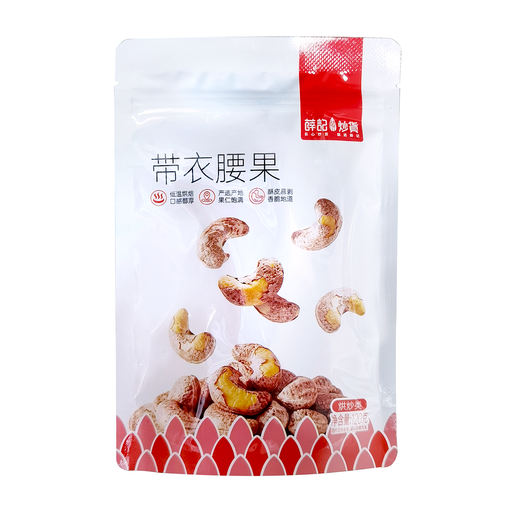 No image available
The product information describes a sealed 120 g pack that’s easy to take with you. This variety is salted; check the label if you also want to compare the fat content.
 No image available
This variety may suit you if you’re looking for a simple ingredients list. Check the ingredients and nutritional values on the product packaging, especially if you need to avoid cashews or tree nuts.
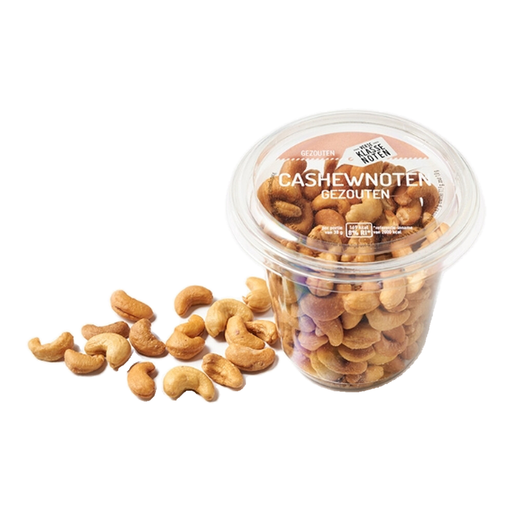 No image available
This roasted, salted variety is worth comparing if you’re happy to have salt. Check the ingredients and total fat per 100 g on the packaging.
 No image available
The product name describes roasted, unsalted cashew nuts; that doesn’t automatically mean they’re low fat. The 200 g pack needs to be portioned yourself and resealed properly after opening.
No. The Duyvis variety reviewed is described as roasted with no added oil, but Albert Heijn’s product information lists 43 g of fat per 100 g. According to the European Commission, a ‘low fat’ claim can only be used for solid foods containing no more than 3 g of fat per 100 g.
Multiply the grams of fat per 100 g by the weight of your portion, then divide by 100. For a 25 g portion of the Duyvis variety reviewed, that’s 43 × 25 ÷ 100 = 10.75 g of total fat. Use the same portion size when comparing products.
Follow the instructions for the exact variety. Albert Heijn advises closing the pack securely; Duyvis recommends storing an opened bag in a light- and airtight container. For opened unsalted cashew nuts, the Netherlands Nutrition Centre gives a general storage recommendation of 6 months in a kitchen cupboard; the quality may deteriorate during that time.
Before buying and eating the product, read the ingredients and allergen information on the exact pack. The PLUS variety reviewed may contain peanuts; Duyvis product information mentions possible traces of wheat, peanuts and various nuts, among other things. The NVWA requires allergens to be clearly and correctly listed on the label.
The NVWA warning dated 20 May 2026 concerns Trader Joe’s unsalted cashew nuts, 170 g, barcode 2003020120930, with a best-before date of 23-09-2026, due to possible metal fragments. Do not eat the specific pack named. The fact that the best-before date has passed does not cancel the warning, and the notice does not mean that all ALDI cashew nuts are affected.