
Snackers keeping an eye on portions
You want to work out the calories in your snack without mistaking ‘unsalted’ for ‘low calorie’. Weighing your portion and checking the nutrition table on the exact pack can help.


To reduce the calories in a cashew snack, weigh your portion and use the nutrition table for the exact variant; a smaller portion doesn’t make the product itself low in calories. The checked unsalted variants from AH, Jumbo and PLUS contain 598 to 622 kcal per 100 g, well above the EU limit of 40 kcal per 100 g for a ‘low calorie’ claim. Also consider the ingredients, salt content and how you’ll use them: whole nuts aren’t suitable for children under four.
You want to work out the calories in your snack without mistaking ‘unsalted’ for ‘low calorie’. Weighing your portion and checking the nutrition table on the exact pack can help.
You might be looking for an unsalted or unroasted option, and want to distinguish cashew nuts with no extra ingredients from varieties containing oil or flavourings. Check the ingredients list and product name.
You buy cashew nuts for adults, but also need to consider allergens, storage and young children at home. The MDL Fonds warns that whole nuts aren’t safe for children under four because of the risk of choking.
First decide how much you want to eat, then compare the ingredients, salt content and packaging of the exact variant.
| What to consider | What should you check? | Who is this important for? |
|---|---|---|
| Calories per portion | Compare the kcal per 100 g on the exact pack and calculate the amount for the portion you’ve weighed. AH and Jumbo list 622 kcal per 100 g; PLUS lists 598 kcal. For 25 g, that works out at 155.5, 155.5 and 149.5 kcal respectively, according to the product information from these brands. | If you want to estimate the calories in your snack, calculate them based on the amount you actually weigh out. Around 36% of consumers put calories per portion at the top of their list. |
| Ingredients and salt | Check both the ingredients list and the salt per 100 g; unsalted, unroasted and no added oil don’t mean the same thing. | If you’re mainly looking for an unsalted option or a particular preparation method, you’ll want to know what else is in the pack besides cashew nuts. Around 29% of consumers prioritise ingredients and salt. |
| Safe use at home | Check the allergen information and any product warnings on the exact pack. Don’t give whole nuts to children under four. | If you share snacks at home, take allergens and age-related risks into account before putting the pack out. Around 21% of consumers put family safety first. |
| Packaging and storage | Check the net weight and follow the storage instructions; the Voedingscentrum recommends storing nuts in a sealed container in a dry place. | If you want to portion and store snacks during busy family days, choose packaging that suits how you’ll use them. Around 14% of consumers prioritise practical storage. |
These terms describe different qualities from the energy content. The product tables for AH Unsalted Cashew Nuts, Jumbo Unsalted Cashew Nuts and PLUS Unsalted Unroasted Cashew Nuts list 622, 622 and 598 kcal per 100 g respectively. According to the European Commission, solid foods can only be labelled ‘low calorie’ if they contain no more than 40 kcal per 100 g.
Check the kcal per 100 g on the exact pack, then calculate the amount for your weighed portion.
Packs of 170, 200 or 250 g aren’t the same as a portion. A smaller amount changes the calories in your snack, but not the energy content per 100 g of the product.
Weigh out the amount you want and store the rest in a sealed container in a dry place, as recommended by the Voedingscentrum.
The MDL Fonds says whole nuts aren’t safe for children under four because of the risk of choking.
Keep whole cashew nuts for adults separate from food for young children.
The warning issued by the Netherlands Food and Consumer Product Safety Authority on 20 May 2026 applies specifically to Trader Joe’s unsalted cashew nuts, 170 g, barcode 2003020120930 and best-before date 23-09-2026. The warning mentions possible metal fragments and doesn’t automatically apply to other ALDI packs.
If you still have the affected pack at home, check all the identification details and don’t eat it.
There are several savoury roasted cashew varieties; compare them by their exact product name.
AH Unsalted Cashew Nuts are a baked variety with a stated portion size of 25 g.
Jumbo Unsalted Cashew Nuts are an own-brand variety with product information on ingredients and nutritional values.
The official product name supports choosing unsalted cashew nuts.
In the Netherlands, ALDI offers several Trader Joe’s products, including unsalted cashew nuts in a 170 g pack and roasted, unsalted cashew nuts in a 250 g pack.
PLUS Unsalted Unroasted Cashew Nuts are an unroasted variety.
These Joybuy products are cashew nuts for adult snacking. Compare the stated portion, ingredients and salt content of the variety that suits your preferences.
 No image available
Suitable if you’re looking for a short ingredients list and want to calculate the energy in a weighed portion.
Ingredients: cashew kernels. Energy: 604 kcal per 100 g. Salt: 0.028 g per 100 g.
 No image available
Suitable if you’re looking for a roasted, unsalted variety and want to calculate the energy in a weighed portion.
Ingredients: cashew nuts. Energy: 596 kcal per 100 g. Salt: 0.067 g per 100 g.
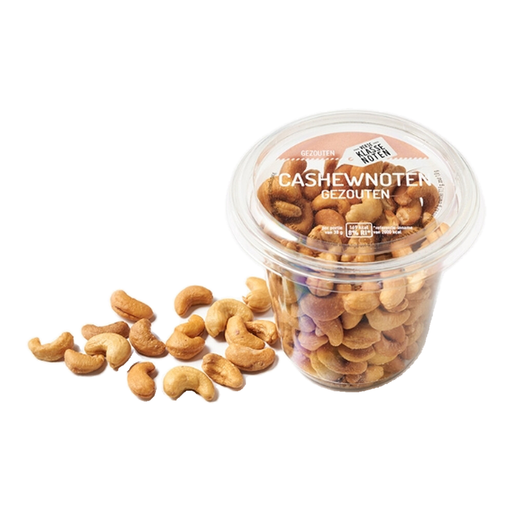 No image available
Suitable if you’re looking for a salted variety and want to compare the listed ingredients and nutritional values.
Ingredients: 98% cashew nuts, sunflower oil and 1% salt. Energy: 2555 kJ per 100 g. Salt: 1.0 g per 100 g.
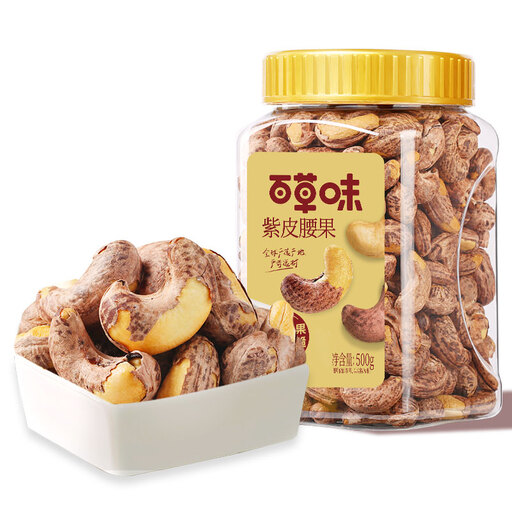 No image available
Suitable if you’re looking for cashew nuts with their skins on and want to take the energy and salt per 100 g into account.
Ingredients: cashew kernels and salt. Energy: 679 kcal per 100 g. Salt: 1.2 g per 100 g.
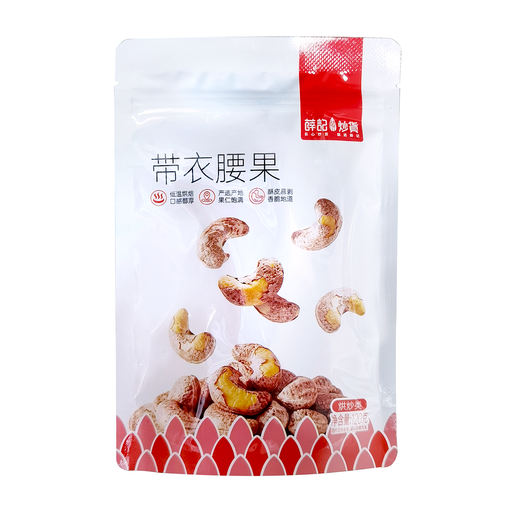 No image available
Suitable if you’re comparing a salted variety with skins on by its energy and salt content per 100 g.
Ingredients: cashew nuts and salt. Energy: 596 kcal per 100 g. Salt: 0.9 g per 100 g.
No. A smaller portion doesn’t make the product itself low in calories. According to the European Commission, solid foods must contain no more than 40 kcal (170 kJ) per 100 g to make a ‘low calorie’ claim.
Multiply the kcal per 100 g on the pack by the number of grams you weigh out, then divide by 100. For a product containing 622 kcal per 100 g, 25 g works out as: 622 × 25 ÷ 100 = 155.5 kcal. Always use the table for your exact variety.
Don’t give whole nuts to children under four because of the risk of choking, as advised by the MDL Fonds. This isn’t specific advice on when cashews can be introduced to a child.
The warning issued by the Netherlands Food and Consumer Product Safety Authority on 20 May 2026 concerns Trader Joe’s unsalted cashew nuts, 170 g, barcode 2003020120930 and best-before date 23-09-2026, because of possible metal fragments. Don’t eat the affected pack; the warning doesn’t apply to all ALDI cashew nuts.
Consider the snack as part of your overall daily diet, rather than focusing only on the lowest possible calorie count. The Voedingscentrum provides guidance on eating while breastfeeding and sample daily menus for inspiration; these aren’t individual dietary advice.