
Regular stock-up shoppers
You use cashew nuts regularly at home and want to choose a pack that suits your household’s consumption. Look at the pack size and how quickly you get through it, not just the description on the packaging.


Choose a large bag if your household eats cashew nuts regularly and you can store them properly. If you only snack on them occasionally, a smaller pack may better suit how much you use. Also check how they’re prepared, their salt content and the ingredients: unsalted doesn’t necessarily mean unroasted or made without added oil.
You use cashew nuts regularly at home and want to choose a pack that suits your household’s consumption. Look at the pack size and how quickly you get through it, not just the description on the packaging.
You’re looking for a snack to enjoy later in the evening and want to distinguish between unsalted and savoury roasted varieties. Preparing a portion in advance can help you avoid snacking straight from a large bag.
You eat cashew nuts occasionally and would rather not buy more than you’ll use. A smaller bag may be more practical; make sure you seal it well after use.
A 500-gram pack may suit regular use, while 200 to 250 grams may be a better fit for an occasional snack. Also make a considered choice between unroasted, roasted and salted, and follow the storage advice on the packaging.
The Netherlands Nutrition Centre recommends storing nuts in a dry place in a well-sealed container. If you have an allergy, check the label on the specific pack; the Netherlands Food and Consumer Product Safety Authority (NVWA) says allergens must be clearly identified.
| What to consider | What should you check? | Who should consider this? |
|---|---|---|
| Pack size and consumption | Net weight and how much your household typically uses. | If I often keep cashew nuts at home, I want a bag that suits our consumption; around 20% of consumers make pack size and stock their top priority. |
| Portion and salt | Portion information and salt per 100 grams in the nutrition table. | If I snack in the evening, I want to prepare a portion and choose between salted and unsalted options with care; around 20% of consumers focus mainly on portion size and salt content. |
| Storage | Whether the packaging can be resealed and the storage instructions. | If a bag lasts me a while, I want to be able to seal it properly and store it according to the label; around 20% of consumers put managing and storing their supplies first. |
| Preparation and flavour | Whether the nuts are unroasted, fried or roasted; check the ingredients too. | If I’m looking for a particular flavour or preparation method, I want to know what else is in the pack besides cashew nuts; around 20% of consumers look at this first. |
| Label and allergens | Ingredients, clearly identified allergens and any warnings. | If I need information about ingredients or possible cross-contamination, I check the packaging itself; around 20% of consumers give label information top priority. |
A large bag is only convenient if your household will get through it. It also takes up more space and needs to be sealed carefully after use.
Choose a pack size based on how often you eat cashew nuts and how many people will be sharing them. Compare packs prepared in the same way.
Preparation, salt and ingredients are separate characteristics. For example, Jumbo’s product information lists sunflower oil for an unsalted variety; a product prepared without oil isn’t necessarily unsalted.
Read the preparation description, ingredients list and nutrition table separately before making your choice.
The NVWA warning dated 20 May 2026 concerns ALDI’s 170-gram packs of Trader Joe’s unsalted cashew nuts, with barcode 2003020120930 and best-before date 23-09-2026. The warning reports possible metal fragments; the date having passed does not make an affected pack safe.
If you have this exact pack, don’t eat the cashew nuts. Contact ALDI for advice on what to do next. The warning applies to this specific pack, not automatically to all ALDI cashew nuts.
The unsalted cashew nuts reviewed are available in 250- and 500-gram packs.
Jumbo offers a 500-gram pack of unsalted cashew nuts.
ALDI sells Trader Joe’s cashew nuts, including a 250-gram roasted, unsalted variety.
The 200-gram bag reviewed is described as unroasted and unsalted.
Duyvis describes Cashews Original as oven-roasted without added oil.
Lidl has product ranges for unsalted cashew nuts and a separate Way To Go! variety.
These products suit different snacking occasions, from a smaller portion to a larger stock-up, and include both salted and unsalted varieties.
 No image available
The 160-gram pack is an option for keeping a smaller supply of snacks.
The product information lists 100% cashew kernels and says they’re ready to eat as a snack.
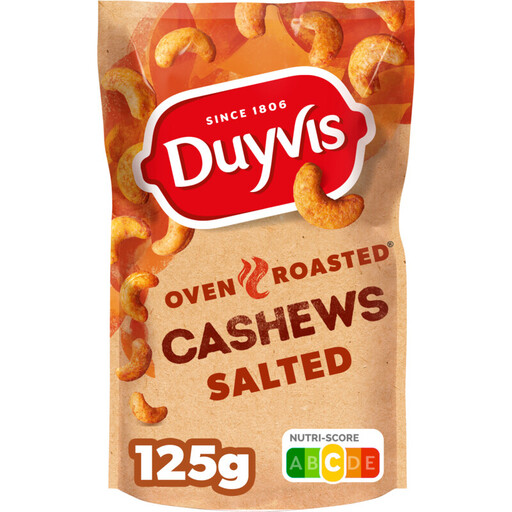 No image available
This variety is a good fit if you’re looking for a smaller, savoury roasted snack.
The product information lists sea salt and 0.92 g of salt per 100 g; no oil or fat is added.
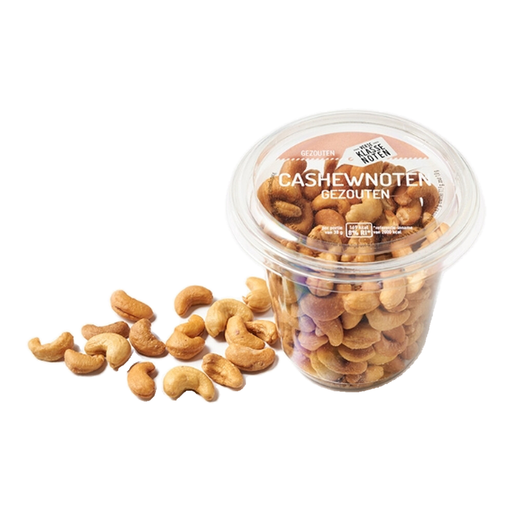 No image available
The 150-gram pack is a smaller salted snack option.
The product information lists 98% cashew nuts, sunflower oil and 1.0 g of salt per 100 g.
 No image available
The 500-gram pack is designed for a larger stock-up or for sharing.
The product information lists 99% cashew nuts and 0.9 g of salt per 100 g. Salt is also listed among the ingredients.
 No image available
This 200-gram pack is a smaller roasted, unsalted option.
The product information lists 0.067 g of salt per 100 g and recommends sealing the pack well after use.
Divide the pack size by the portion you choose and consider how many portions your household actually gets through. At 25 grams per portion, 500 grams makes 20 portions; this is a stock calculation, not advice on how often you should eat cashew nuts.
Store nuts in a dry place in a well-sealed container, and follow any additional instructions on the packaging. The Netherlands Nutrition Centre recommends storing nuts in a cool, dry place; how long an opened bag stays fresh also depends on how you store it.
Check the ingredients list and any warnings on the specific pack. The NVWA says allergens must be clearly identified; from 1 January 2026, new rules apply in the Netherlands to warnings about the unintended presence of allergens due to cross-contamination. If you have a food allergy, check these warnings too.
Do not eat Trader Joe’s 170-gram pack of unsalted cashew nuts with barcode 2003020120930 and best-before date 23-09-2026. The NVWA warning reports possible metal fragments. The best-before date has passed, but that doesn’t clear a pack covered by the warning; contact ALDI for advice on what to do next.
No. Salt, preparation and ingredients are separate characteristics. An unsalted product may contain sunflower oil, for example, while a roasted variety may be salted. So check the preparation description, ingredients list and nutrition table separately.