
Regular lunch-packers
You often take cashew nuts to the office and compare pack sizes with the amount you use. A large bag isn’t necessarily the most convenient choice.


For an office lunch, choose a pack size that suits how many cashew nuts you actually use; a larger pack isn’t automatically the most convenient choice. The Netherlands Nutrition Centre recommends a handful of unsalted nuts each day and varying the types you eat, but doesn’t insist that they must be unroasted. Then choose between unroasted and roasted, and keep storage advice for loose nuts separate from advice for other lunch items.
You often take cashew nuts to the office and compare pack sizes with the amount you use. A large bag isn’t necessarily the most convenient choice.
You want to choose unsalted nuts, then decide whether you’d prefer to take unroasted or roasted cashew nuts with you.
You don’t use cashew nuts as often and want an amount that suits your needs. Storage information and any Fairtrade label may also influence your choice.
These points are relevant to shoppers taking cashew nuts to the office for lunch. The percentages show which purchase priority matters most to them.
| What to consider | What should you check? | Who is this most important to? |
|---|---|---|
| Unsalted and preparation method | Check that the variety is unsalted, then choose between unroasted and roasted. | If I want to take unsalted nuts with me, I also check how they’ve been prepared. Around 40% of shoppers prioritise an unsalted product. |
| A suitable pack size | Compare the net weight with how much you actually use, and check the storage advice for after opening. | If I don’t take cashew nuts with me often, I want an amount that suits my needs. Around 30% of shoppers prioritise a suitable quantity. |
| Storage after opening | Follow the storage advice for the specific nut variety, and keep it separate from guidance for other lunch items. | If I prepare cashew nuts in advance, I want to know how to store them on their own. Around 20% of shoppers make storage considerations their top priority. |
| Fairtrade label | Check that the label appears on the exact variety; don’t assume it applies to the entire range. | If a Fairtrade label influences my choice, I check the specific pack. Around 10% of shoppers prioritise this product label. |
On 20 May 2026, the NVWA issued a warning about Trader Joe’s Unsalted Cashews, 170 g, barcode 2003020120930 and best-before date 23-09-2026, because they may contain metal fragments. The warning applies to this specific pack.
If you still have the pack mentioned, check the barcode and best-before date and don’t eat the product. Don’t confuse this warning with other pack sizes or varieties.
Duyvis describes Cashews Original as oven-roasted without added oil. The Duyvis variety reviewed at PLUS is salted, so being roasted without oil doesn’t mean a product is unsalted.
If you want unsalted cashew nuts, check that this is explicitly stated in the product information or on the packaging.
The Netherlands Nutrition Centre provides storage advice for unsalted cashew nuts, not for every ingredient in a packed lunch.
Store the nuts separately and follow the relevant storage instructions for other lunch items.
The AH Terra listing is for unroasted cashew nuts in a 500 g pack.
The Dutch product listings distinguish unsalted cashew nuts in 200 g and 500 g packs.
Trader Joe’s listings include 250 g packs of roasted unsalted cashew nuts, as well as a 500 g option available in salted and unsalted varieties.
The listings distinguish unsalted unroasted cashew nuts from an unsalted variety labelled Fairtrade; both come in 200 g packs.
Lidl lists cashew nuts in its shop range and describes its Way To Go variety as Fairtrade.
Duyvis describes Cashews Original as oven-roasted without added oil. The shop listing reviewed is for salted oven-roasted cashews, 125 g.
The Joybuy products below include cashew nuts in packs ranging from 125 to 500 g, with both salted and unsalted varieties.
 No image available
The product description suggests eating them as they are or adding them to yoghurt or muesli.
Net weight: 160 g. Ingredient: 100% cashew kernels.
 No image available
An option if you’re looking for a 200 g pack of roasted, unsalted cashew nuts.
Net weight: 200 g. Preparation: roasted. Variety: unsalted.
 No image available
A good option if you’re looking for a small pack of roasted, salted cashews.
Net weight: 125 g. The product description mentions salt and roasting without added fat or oil. The allergen information lists cashew, gluten, wheat and peanuts.
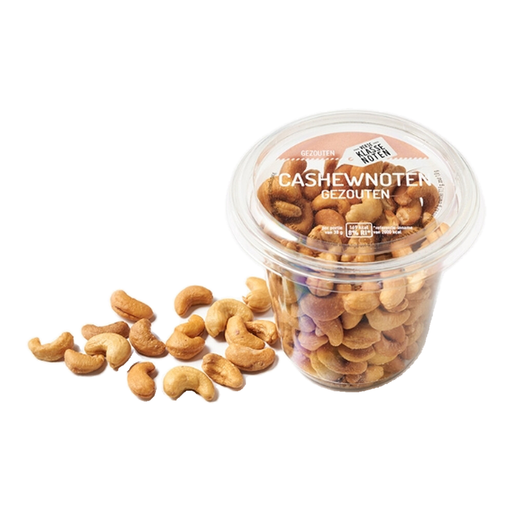 No image available
An option if you’re looking for a 150 g pack of roasted, salted cashews.
Net weight: 150 g. The product description mentions sunflower oil and salt.
 No image available
A good option if you’re looking for a larger pack of salted cashews.
Net weight: 500 g. The product description mentions salt.
No. The Netherlands Nutrition Centre recommends unsalted nuts and varying the types you eat, but doesn’t make unroasted nuts a general requirement when buying. Unroasted and roasted are separate product choices.
For unsalted cashew nuts, the Netherlands Nutrition Centre’s Storage Guide recommends six months in a kitchen cupboard and one year in the freezer; quality may deteriorate after that. Nuts that are rancid, chewy or mouldy may be showing signs of spoilage. This advice is for loose cashew nuts, not a complete lunch.
Read the current ingredients list and allergen information on the packaging. The NVWA says allergens must be declared clearly and accurately; according to the official EU guidance, any allergens present must be highlighted in the ingredients list.
No. The NVWA warning concerns Trader Joe’s Unsalted Cashews, 170 g, barcode 2003020120930 and best-before date 23-09-2026, because they may contain metal fragments. Don’t eat that specific pack; the warning doesn’t automatically apply to other packs or varieties.
Not necessarily. Check whether the amount suits how often you take cashew nuts with you, and follow the storage advice for the specific variety. The products listed in this article come in packs ranging from 125 g to 500 g.