
You want demonstrably less fat
You want to compare the fat content of equal quantities and distinguish a ‘reduced fat’ claim from descriptions such as ‘unroasted’ or ‘made without added oil’.


If you’re looking for less fat per 100 g, only a substantiated ‘reduced fat’ claim can help: according to the Netherlands Nutrition Centre, this means at least 30% less fat than in a comparable standard product. ‘Low fat’ is a different claim; the European Commission sets a limit of 3 g of fat per 100 g for solid foods. If your main aim is to have less fat and energy per snack, weigh out a smaller portion of regular cashew nuts: unsalted or made without added oil doesn’t automatically mean lower in fat.
You want to compare the fat content of equal quantities and distinguish a ‘reduced fat’ claim from descriptions such as ‘unroasted’ or ‘made without added oil’.
You want to manage how many cashew nuts you have per snack. In that case, portion weight and nutritional information matter more than an appealing product name.
You’re choosing between unsalted and savoury varieties, and checking the allergen information and whether the pack can be resealed. According to the Netherlands Food and Consumer Product Safety Authority, allergen information for loose products must be available before purchase.
| What to look for | What should you check? | Who is this important for? |
|---|---|---|
| Actual fat reduction | Compare the fat per 100 g with that of a comparable standard product; also check the energy per 100 g. | If you want less fat in the same quantity, look beyond preparation terms on the packaging. Around 31% of consumers prioritise demonstrable fat reduction. |
| Portion per snack | Weigh the amount you eat and compare the nutritional information on the same weight basis. | If I mainly want a smaller snack, I pay attention to the amount I eat at a time, not just the bag as a whole. Around 25% of consumers prioritise portion control. |
| Salt and flavour | Compare the salt per 100 g and read the ingredients as well as the preparation description. | If you’re choosing between unsalted and savoury cashew nuts, flavour and salt matter, but they don’t tell you anything about fat reduction. This is the top buying priority for around 19% of consumers. |
| Allergens when sharing | Check the information on the exact packaging; if the product is sold loose, ask before you buy. | When I share cashew nuts, I want to be able to check the allergen information for everyone beforehand. Safe sharing is the top priority for around 13% of consumers. |
| Quantity and storage | Choose a pack that suits your group and follow the storage instructions after opening. | If you want to keep leftovers, consider how much will actually be used and whether the pack can be resealed. Around 12% of consumers prioritise packaging and storage when buying. |
According to Albert Heijn, Duyvis Oven roasted cashews salted contains 43 g of fat per 100 g. For the ‘low fat’ claim on solid foods, the European Commission sets a limit of 3 g of fat per 100 g.
Assess the fat content and evidence for a nutrition claim separately from the preparation method.
Eating fewer grams reduces the amount of fat you consume, but it doesn’t change the composition per 100 g or substantiate a ‘reduced fat’ claim.
Think of portion control as a separate choice, and compare products on the same weight basis first.
The ingredients in AH Unsalted Cashew Nuts and Jumbo Unsalted Cashew Nuts include sunflower oil. So, the description ‘unsalted’ doesn’t in itself tell you anything about the oil or fat content.
As well as the product name, read the ingredients and nutritional information, including total fat and salt.
Allergen information at a Christmas market stall may be important to you or someone you’re sharing with. The Netherlands Food and Consumer Product Safety Authority states that this information must be available before purchase.
Ask at the stall before you buy, and check the information for the exact product.
A roasted, savoury cashew option for those who pay attention to how their nuts are prepared.
A specific unsalted option with a stated portion size.
An unsalted cashew variety with ingredients and nutritional information for the specific pack.
An unsalted, unroasted option for those looking for this product description.
Way To Go! Unsalted Cashew Nuts is an option for those looking for unsalted cashews.
Trader Joe’s Roasted and Salted Cashew Nuts 250 g is a standard savoury snack option.
These Joybuy products are cashew varieties to compare by preparation method, ingredients and portion size. The product details provided do not in themselves substantiate a ‘reduced fat’ claim.
 Image unavailable
Suitable if you’re looking for a variety made only with cashew kernels; this doesn’t indicate reduced fat content.
The ingredients list states 100% cashew kernels. The nutrition table lists 47.7 g of fat and 604 kcal per 100 g.
The pack contains 160 g and is described as ready to eat.
 Image unavailable
Suitable if you’re looking for roasted cashew nuts made without added oil; this preparation method doesn’t prove fat reduction.
The nutrition table lists 43 g of fat, 586 kcal and 0.92 g of salt per 100 g. The pack is described as containing 4–5 portions.
The allergen list includes cashew nuts, gluten, wheat and peanuts.
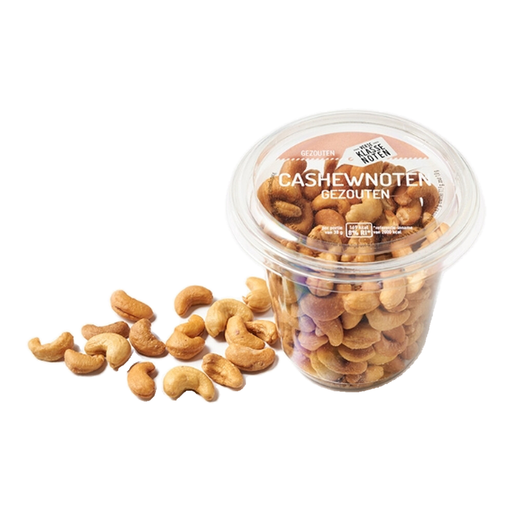 Image unavailable
Suitable if you’re looking for a salted cashew snack; check the oil and salt content on the packaging.
The nutrition table lists 48 g of fat and 2555 kJ per 100 g. The ingredients include sunflower oil and 1% salt.
The pack contains 150 g.
 Image unavailable
Suitable if you’re looking for roasted, unsalted cashew nuts; ‘unsalted’ doesn’t mean they contain less fat.
The nutrition table lists 46.67 g of fat, 596 kcal and 0.067 g of salt per 100 g.
The pack contains 200 g. The product information lists cashew nuts and other tree nuts.
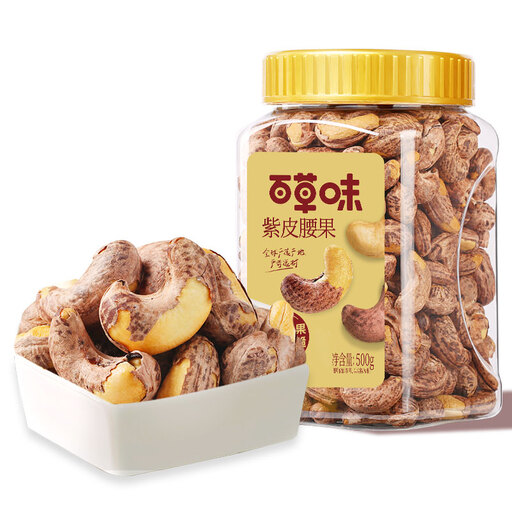 Image unavailable
Suitable if you’re looking for cashew nuts with their skins on in a larger pack to share.
The nutrition table lists 60.1 g of fat, 679 kcal and 1.2 g of salt per 100 g. The ingredients are cashew kernels and salt.
The pack contains 500 g.
No. According to the Netherlands Nutrition Centre, ‘reduced fat’ means at least 30% less fat than in a comparable standard product. For the ‘low fat’ claim on solid foods, the European Commission sets a limit of 3 g of fat per 100 g. So, a product with reduced fat is not automatically low fat.
No, a smaller portion doesn’t change the fat content per 100 g. You do eat fewer cashew nuts per snack, though; weigh your portion and use the nutritional information on the exact pack.
According to the Netherlands Food and Consumer Product Safety Authority, allergen information for unpackaged products can be given verbally, but it must be clearly indicated that customers can ask for it. The information must be available before purchase. For pre-packed products, it appears on the label.
Not necessarily: the product pages for Albert Heijn, PLUS and Duyvis warn that young children may choke on nuts. Bear this warning in mind when choosing snacks for a group.
Follow the advice for the specific variety. Albert Heijn recommends sealing the pack securely and storing it in a cool, dark and dry place. Duyvis recommends storing it in a cool, dry place and putting an opened bag in an airtight, light-proof container.