Only choose cashew nuts if the person eating them can tolerate cashew; a gluten-free or lactose-free label does not mean they are free from allergens. If you’re looking for an everyday snack for yourself, unsalted varieties are a sensible starting point, but check the ingredients and warnings on the current packaging. Don’t give whole nuts to children under four, and assess whether they’re suitable for children separately.
Who might find this buying guide useful?
Parents following a free-from diet
If you avoid a particular ingredient, check the ingredients, the specific dietary claim and any warnings about the possible presence of other allergens. ‘Allergen-free’ is not a general description for cashew nuts. The Netherlands Food and Consumer Product Safety Authority (NVWA) explains what allergen information must appear on prepacked products.
Parents who snack on unsalted nuts every day
If you regularly eat cashew nuts yourself, the difference between unsalted and seasoned varieties, or between cashews on their own and cashews with oil, may matter. The Dutch Nutrition Centre includes unsalted nuts in its Wheel of Five; also check that the ingredients suit your diet.
Parents choosing snacks for their child too
A snack that’s suitable for you isn’t automatically suitable for a young child. The Dutch Nutrition Centre advises against giving whole nuts to children under four; age, form and individual allergy advice all need to be considered separately.
What should you look for in cashew nuts?
First, decide which ingredient you want to avoid and who the snack is for. Then check the exact ingredients, allergen information and product form.
| Point to consider |
What should you check? |
Who is this important for? |
| Individual allergy advice |
Check that cashew itself and any warnings about other allergens are consistent with the advice you’ve been given. |
If you have a diagnosed cashew allergy, this category isn’t suitable for you; warnings about peanuts or other nuts may also be important. Around 29% of consumers put allergen suitability first. |
| Specific free-from claim |
Check the claim, ingredients and allergen information for the exact variety you’re buying. |
If you want to avoid a particular ingredient, look for a claim that specifically relates to it, once you’ve confirmed that cashew itself is suitable. Around 23% of consumers prioritise a specific free-from claim. |
| Everyday snacking |
Read the ingredients and salt information; don’t assume a product is unsalted or oil-free based only on how it’s prepared. |
If you’re mainly looking for a snack to fit into your everyday diet, unsalted nuts may suit you better than seasoned varieties. Around 18% of consumers prioritise unsalted snacks. |
| A child sharing your snack |
Check the child’s age and the form in which you’ll serve the nuts; follow individual allergy advice. |
If you’re also buying for a young child, assess the form and allergen suitability separately from your own snack choice. Around 18% of consumers prioritise suitability for children. |
| Packaging and storage |
Compare the net weight with how much you’ll use, and follow the storage instructions on the exact packaging. |
If quantity and everyday convenience are your main considerations, pack size may influence your choice. Around 12% of consumers prioritise packaging and convenience. |
Common mistakes
-
Assuming a free-from claim means a product is allergen-free
A gluten-free or lactose-free claim on a particular variety doesn’t mean it contains no cashew or is suitable for someone with a peanut or other nut allergy. Lactose-free and suitable for someone with a milk allergy are also two different things.
First identify the ingredient you need to avoid, then check the ingredients and allergen information for the exact variety.
-
Giving a young child your snack without adapting it
Whole nuts can pose a choking risk for young children. The Dutch Nutrition Centre advises against giving whole nuts to children under four.
For a child, assess their age and the form of the food separately. Advice about the form doesn’t prove that a product is safe for someone with an allergy.
-
Confusing oven-roasted or no added oil with unsalted
Duyvis describes Cashews Original as oven-roasted with no added oil, while the ingredients list includes salt and flavourings.
Check the preparation method, ingredients and dietary claims separately; one characteristic doesn’t prove another.
-
Applying a safety warning to every pack from a retailer
On 20 May 2026, the NVWA issued a warning about Trader Joe’s unsalted cashew nuts, 170 g, barcode 2003020120930, with a best-before date of 23-09-2026, due to the possible presence of metal fragments. This specific pack is not the same as the 250 g ALDI variety that was investigated.
If you still have the exact pack named in the warning, don’t eat it. Check the brand, weight, barcode and date before applying a warning to a product.
Relevant brands and varieties
Albert Heijn
The AH Unsalted Cashew Nuts variety reviewed is 170 g.
- Albert Heijn labels this variety ‘gluten-free’ and ‘lactose-free’.
- The ingredients are 96% cashew nuts and sunflower oil. The seller’s information warns that it may contain peanuts and several other nuts. This information doesn’t automatically apply to other AH varieties.
PLUS
The unsalted, unroasted variety reviewed comes in a 200 g bag.
- The ingredients list names cashew nuts only.
- PLUS states that the product may contain peanuts. Cashew as the only ingredient is not a general allergen-free declaration or a separate gluten-free certification.
Jumbo
The varieties reviewed are Unsalted Cashew Nuts, 200 g, and Unroasted Cashew Nuts, 140 g.
- The ingredients list for the 140 g unroasted variety names cashew nuts only.
- The 200 g unsalted variety contains 99% cashew nuts and sunflower oil. Jumbo warns that both varieties may contain nuts and peanuts.
Duyvis
Cashews Original is a seasoned snack variety; Duyvis describes it as oven-roasted with no added oil.
- The manufacturer provides information about how this specific variety is prepared.
- The ingredients include salt and flavourings. Duyvis warns that the product may contain wheat, peanuts and several types of nuts. The preparation method is not a general free-from claim.
Lidl
The Dutch Lidl website lists Way To Go! Unsalted Cashew Nuts as a variety.
- The product name makes it clear that this is an unsalted cashew variety.
- The ‘unsalted’ label alone doesn’t provide information about allergens or a specific free-from profile.
ALDI
The ALDI variety reviewed is TRADER JOE’S Roasted Unsalted Cashew Nuts, 250 g.
- The product page gives the preparation method, unsalted description and pack size.
- The product name alone doesn’t provide a specific free-from profile. Don’t confuse the 250 g pack with the separate 170 g pack warned about by the NVWA.
Cashew nuts at Joybuy
These products are cashew nuts for snacking: one variety made with 100% cashew kernels, one roasted and unsalted variety, and one variety with salt. None of these product characteristics, by itself, proves that a product is free from a specific allergen; check the information on the exact packaging.
 Image unavailable
Jiazhouyuanye cashew nuts, Original Flavour, large, 160 g
May be suitable if you can tolerate cashew and are looking for a product with cashew as its only ingredient; avoid it if you have a cashew allergy.
The product information lists 100% cashew kernels. The product name describes large, whole nuts; according to the Dutch Nutrition Centre, don’t give whole nuts to children under four.
View at Joybuy
 Image unavailable
g'woon cashew nuts, roasted and unsalted, 200 g
Suits anyone who can tolerate cashew and is specifically looking for a roasted, unsalted snack.
The product name states that it’s roasted and unsalted, and that it weighs 200 g. The product information lists cashew nuts as an ingredient; check the current allergen information on the packaging.
View at Joybuy
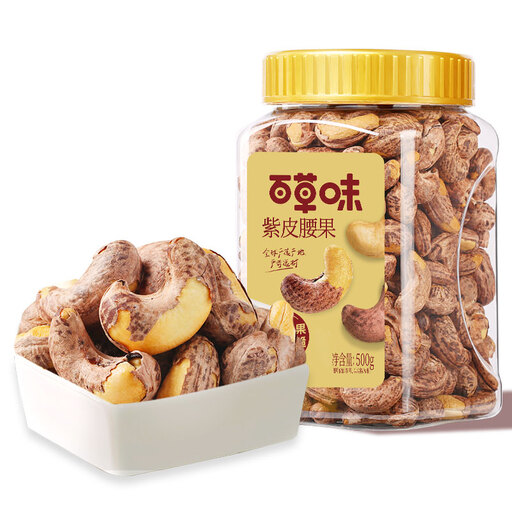 Image unavailable
Be&Cheery cashew nuts with purple skin, 180 grade, 500 g
May be suitable if cashew and salt fit your diet; this is not an unsalted variety.
The product name states purple skin, 180 grade and 500 g. The product information lists cashew and salt as ingredients; check the allergen information on the packaging.
View at Joybuy
Frequently asked questions
Does lactose-free mean a product is also suitable for someone with a milk allergy?
No. Lactose intolerance affects the digestion of milk sugar, while a milk allergy is a reaction to milk proteins. The Food Allergy Foundation (Stichting Voedselallergie) explains the difference. If you have a milk allergy, check the ingredients and allergen information rather than relying only on a lactose-free claim.
Can you eat cashew nuts as usual while breastfeeding?
Breastfeeding in itself doesn’t mean you need a free-from snack. The Dutch Nutrition Centre recommends eating a varied diet based on the Wheel of Five while breastfeeding; a diet prescribed for you personally is a separate matter.
Can a child under four eat whole cashew nuts?
No. The Dutch Nutrition Centre advises against giving whole nuts to children under four. Serving them in another form doesn’t remove the risk of an allergy, so assess allergen suitability separately.
What do warnings such as ‘may contain’ mean on cashew nuts?
They warn of the possible unintended presence of an allergen, rather than an ingredient that has been deliberately added. New rules for cross-contamination warnings came into force in the Netherlands on 1 January 2026. The NVWA states that such a warning must be supported by a risk assessment and gives the wording ‘May contain X’ and ‘Not suitable for people with an X allergy’ as examples.
What allergen information must appear on a prepacked product?
According to the NVWA, allergen information for prepacked products must appear on the label. Nuts are among the allergen groups that consumers must be informed about under Regulation (EU) 1169/2011. This requirement doesn’t automatically make a product suitable for everyone; check the information on the exact packaging.


