What should you look for when buying?
First decide whether you’re looking for a particular product feature or simply want to serve less. Then check the salt content, cooking method and pack size separately.
| What to consider |
What to look for |
Who should pay particular attention? |
| Fat claim or portion |
Compare the fat per 100 g on the label of the exact variety. For the claim ‘low fat’, the European Commission sets a maximum of 3 g of fat per 100 g for solid foods; don’t use this absolute limit as proof of a reduced-fat claim. |
If you specifically want to eat less fat, you’ll want to know whether this is about the product’s composition or a smaller portion. Around 36% of consumers make demonstrable fat reduction their main priority. |
| Amount eaten at each occasion |
Weigh your portion and use the nutritional information per 100 g on your pack to work out the amount. For a 25 g handful of unsalted cashew nuts, the Netherlands Nutrition Centre lists 12.2 g of fat. This is general nutritional information, not a measurement of a specific branded product. |
If your main aim is to limit how much you eat at each drinks occasion, weighing out a portion helps you keep track. Around 28% of consumers focus primarily on portion size and energy. |
| Salt and cooking method |
Check the product name, ingredients and salt content separately. ‘Unsalted’, ‘unroasted’ and ‘made without added oil’ describe different features. |
If you’re mainly choosing based on salt or cooking method for your drinks spread, you’ll want to assess these features separately from the fat content. Around 18% of consumers prioritise salt or the recipe. |
| Pack size |
Compare the net weight with the amount you need and check the storage instructions on the pack. A smaller bag isn’t automatically one portion. |
If you’re looking for the right amount for a gift or drinks spread, it’s also worth considering how much you can store afterwards. Around 18% of consumers choose mainly based on quantity and avoiding leftovers. |
Brands and varieties to consider
The examples below can help you distinguish between product features. They aren’t a ranking and don’t prove that any variety contains less fat.
Duyvis
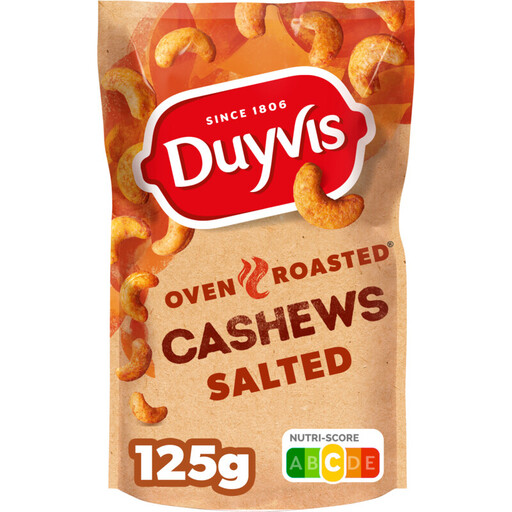
Duyvis describes Cashews Original as oven-roasted without added oil, in a 125 g pack.
- The manufacturer specifies the cooking method for Cashews Original.
- This isn’t independent evidence of reduced fat. Nutritional information for a separate shop listing of Duyvis Oven Roasted Salted Cashew Nuts shouldn’t be attributed to Cashews Original without first checking that they’re the same product.
Albert Heijn
AH Unsalted Cashew Nuts are an option if you’re specifically looking for an unsalted variety.
- The product name specifies that they’re unsalted.
- Being unsalted doesn’t in itself mean they contain less fat; Albert Heijn advises checking the packaging.
Jumbo
Jumbo Unsalted Cashew Nuts 130 g may suit you if you’re looking for a pack of that size.
- The product page gives the weight and advises storing them in a cool, dry, dark place.
- 130 g isn’t automatically one portion, and being unsalted doesn’t prove that they contain less fat.
Lidl
Lidl describes its Way To Go cashew nuts in the Alesto range as Fairtrade.
- The retailer’s product description lists Fairtrade as a product feature.
- Fairtrade isn’t a nutrition claim about fat and doesn’t tell you how the fat content compares with that of other cashew nuts.
ALDI
ALDI describes a roasted, unsalted variety in a 250 g pack.
- The product page specifies the cooking method, that they’re unsalted and the pack size.
- An NVWA warning concerns a separate 170 g Trader Joe’s pack, not automatically the 250 g variety or the entire range.
PLUS
PLUS Unsalted Unroasted Cashew Nuts 200 g may suit you if you’re looking for both features.
- The product name specifies that they’re unsalted and unroasted, and gives the pack size as 200 g.
- Being unroasted doesn’t in itself prove that they contain less total fat; check the nutritional information on the exact pack.
Joybuy products
This selection includes plain, roasted, unsalted and salted cashew nuts in a range of pack sizes. Use the product details to compare labels and portions; the listed features and fat values don’t in themselves make a product demonstrably reduced-fat.
 No image available
Jiazhouyuanye Original Flavour Large Cashew Nuts 160 g
A good choice if you want to weigh out plain cashew nuts for each snack occasion. The product information lists 100% cashew kernels, 47.7 g of fat per 100 g and a 160 g pack; contains cashew nuts.
View product at Joybuy
 No image available
Duyvis Dry Roasted Cashews 125 g
A good choice if you’re looking for roasted cashew nuts made without added oil. The product information lists 43 g of fat per 100 g and 4–5 servings per pack; the ingredients description includes sea salt and salt. This cooking method doesn’t prove that they contain less fat.
View product at Joybuy
 No image available
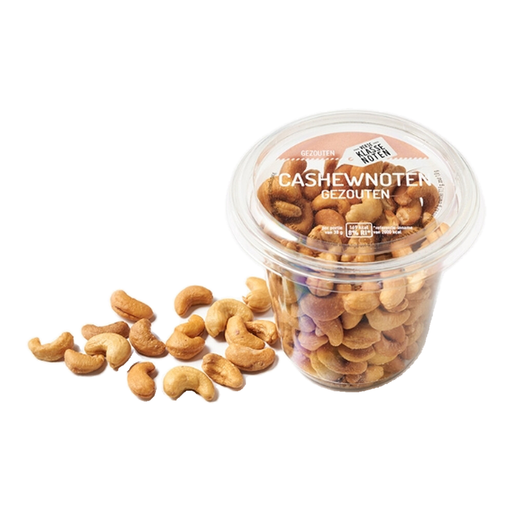
Verse Klassenoten Salted Cashew Nuts 150 g
A good choice if you want to weigh out a portion of salted cashews for a snack. The product information lists 98% cashew nuts, sunflower oil and salt, with 48 g of fat per 100 g. Reseal the pack after opening, as instructed in the description.
View product at Joybuy
 No image available
g'woon Cashew Nuts Roasted & Unsalted 200 g
A good choice if you’re looking for roasted cashew nuts with no added salt. The product title specifies that they’re roasted and unsalted; the product information lists 46.67 g of fat per 100 g and advises keeping the pack tightly closed after opening.
View product at Joybuy
 No image available
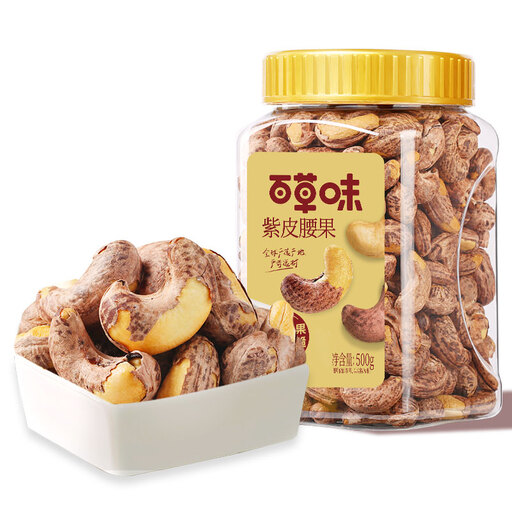
Be&Cheery Cashews with Purple Skin 180 grade 500 g
A good choice if you want to weigh out cashew nuts for each snack occasion or are also considering using them in cooking and baking. The product information lists 60.1 g of fat per 100 g and salt; the pack is 500 g.
View product at Joybuy
Frequently asked questions
Do ‘low fat’ and ‘reduced fat’ mean the same thing?
No. The claims are assessed using different criteria. For the ‘low fat’ claim on solid foods, the European Commission sets a maximum of 3 g of fat per 100 g; don’t use this absolute limit as proof that a product meets the criteria for a reduced-fat claim.
How do I work out the nutritional information for my portion?
Multiply the value per 100 g by the weight of your portion, then divide by 100. The Flink listing for Duyvis Oven Roasted Salted Cashew Nuts 125g gives 49 g of fat and 604 kcal per 100 g. For a 25 g portion used for calculation, that works out at 12.25 g of fat and 151 kcal. This is a calculation based on that retailer’s listing, not personalised portion advice.
What should I check if the recipient has a food allergy?
Read the allergen information on the exact pack and check that it’s suitable for the recipient’s known allergy. The NVWA requires allergens to be clearly identifiable and distinguishable from other ingredients in an ingredients list.
Can young children eat whole cashew nuts?
Don’t assume they can: Jumbo’s product page warns that young children can choke on nuts. Bear this warning in mind if you’re putting out a bowl at a gathering where young children are present.
Which cashew nuts are covered by the NVWA warning?
According to the NVWA on 20 May 2026, the warning concerns Trader Joe’s Unsalted Cashews, 170 g, with barcode 2003020120930 and best-before date 23-09-2026. Don’t eat a pack with those identifying details; the warning doesn’t automatically apply to other varieties.


