
Portion-conscious Easter planners
You want to hand out cashew nuts during an Easter egg hunt and work out the energy in each portion. A small portion doesn’t make the product itself low in calories.


If you’re serving cashew nuts, compare the energy per 100 grams and weigh the amount you hand out. The product listings we checked do not qualify for a ‘low calorie’ claim. Choose unsalted if you want to avoid added salt, but assess energy separately and check first whether whole nuts are suitable for everyone taking part.
You want to hand out cashew nuts during an Easter egg hunt and work out the energy in each portion. A small portion doesn’t make the product itself low in calories.
You’re organising an event for a group that may include children or people with food allergies. Check that nuts are suitable for everyone taking part, and read the information on the packaging.
You’re looking for an unsalted option and want to distinguish between unroasted and roasted nuts. The preparation method or the word ‘unsalted’ doesn’t, in itself, tell you anything about the calorie content.
Compare energy and salt per 100 grams, then weigh the portion you plan to hand out. You can calculate the values for the same portion size using: kcal per 100 grams × portion weight in grams ÷ 100.
| What to consider | What to look for | Who should consider this? |
|---|---|---|
| Energy per portion | Compare kcal per 100 grams and weigh the amount you hand out. | If you want to calculate the energy in the portions you hand out, check both the nutritional information and the weight. Around 36% of consumers put energy per portion at the top of their buying priorities. |
| Suitability for participants | Consider who will be eating the nuts and read the allergen information on the exact packaging. | If children or people with food allergies are taking part, you’ll want to check first whether cashew nuts are suitable for them. Around 29% of consumers put participants’ safety first. |
| Salt and ingredients | Read the ingredients and compare the grams of salt per 100 grams alongside the energy value. | If you want to avoid added salt or choose a simple recipe, the ingredients list matters more than the preparation description alone. Around 21% of consumers put salt and ingredients at the top of their buying priorities. |
| Packaging and supplies | Match the pack size to the portions you’ve planned and follow the storage instructions once opened. | If you’re buying for a group, you’ll want enough without ending up with too much left over. Around 14% of consumers put planning portions and supplies first. |
The nutritional tables from PLUS, Albert Heijn and Jumbo show why it’s helpful to compare products per 100 grams: unsalted cashew nuts can still be high in energy. Unsalted, unroasted and roasted describe different product characteristics; none of them means low in calories.
The product listings we checked from PLUS, Albert Heijn and Jumbo range from 586 to 622 kcal per 100 grams for the varieties discussed. That’s above the 40 kcal per 100 grams limit for a ‘low calorie’ claim on solid foods, as set out by the European Commission.
Compare energy, salt and ingredients separately. A smaller portion doesn’t change the nutritional values per 100 grams.
The weight of a portion tells you nothing about allergies or the risk of choking. Albert Heijn and Jumbo’s product pages warn that young children can choke on nuts.
First check whether cashew nuts are suitable for the person who will be eating them. Use a calculated portion only to compare nutritional values on the same basis.
The NVWA warning dated 20 May 2026 concerns a specific product: Trader Joe’s unsalted cashew nuts, 170 grams, barcode 2003020120930, with a best-before date of 23-09-2026. The warning mentions possible metal fragments and says the affected cashew nuts must not be eaten.
If there’s a warning, check the product name, barcode and best-before date together. This notice applies to that specific pack, not all ALDI cashew nuts.
Relevant for Original and the separate roasted or sea salt varieties.
The product listing we checked is for AH Unsalted Cashew Nuts in a 170-gram pack.
Relevant for unsalted cashew nuts in 200- and 500-gram packs.
The Dutch product listing is for unsalted cashew nuts.
The product listing is for Trader Joe’s roasted, unsalted cashew nuts in a 250-gram pack.
Relevant for unroasted, unsalted cashew nuts and specific Duyvis varieties.
These Joybuy products are cashew varieties to compare for portion planning, ingredients, salt and pack size. If anyone has an allergy, always check the information on the exact packaging too.
 Image unavailable
If you want to weigh out a portion, the nutritional value per 100 grams gives you a basis for calculating the energy in that portion.
The product information lists 100% cashew kernels, 604 kcal and 0.028 g of salt per 100 grams. Contains cashew; not suitable for participants with a cashew allergy.
 Image unavailable
If you’re considering a savoury cashew variety, compare the nutritional information with your portion and check the packaging before serving.
The product information lists 586 kcal per 100 grams. Check the ingredients and allergen information on the exact pack, including whether it mentions cashew, peanuts, gluten and wheat.
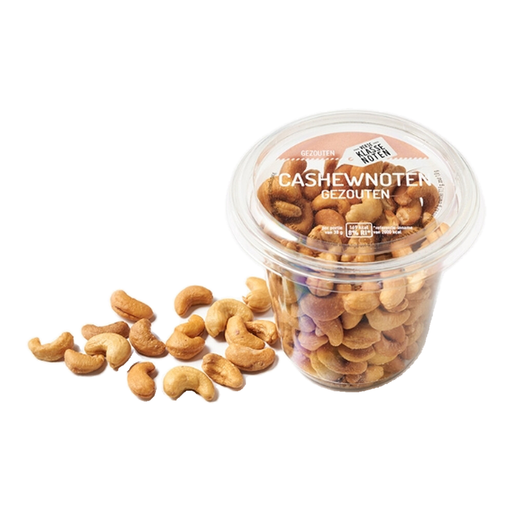 Image unavailable
If you choose a salted variety, weigh your portion and take the salt listed in the product information into account.
The ingredients list states 98% cashew and sunflower oil; the table lists 2555 kJ per 100 grams and the ingredients list gives 1% salt. Contains cashew; not suitable for participants with a cashew allergy.
 Image unavailable
If you’re looking for roasted cashew nuts with no added salt, compare the nutritional information and check whether the ingredients suit your preferences.
The product information lists cashew nuts as the only ingredient, with 596 kcal and 0.067 g of salt per 100 grams. Contains cashew and tree nuts; not suitable for participants with a cashew or tree nut allergy.
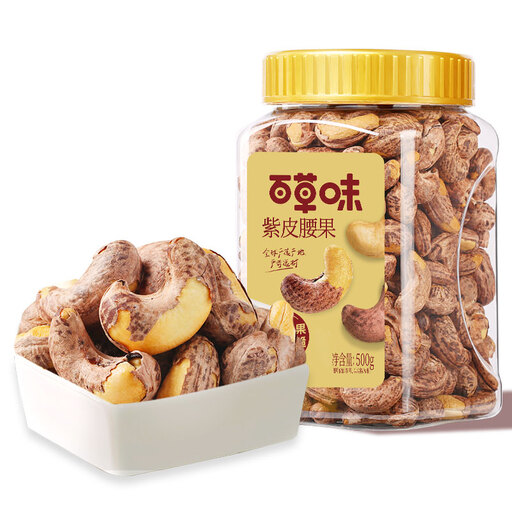 Image unavailable
If you’re considering a larger pack, match its size to the portions you’ve planned and follow the storage instructions once opened.
The product information lists 679 kcal and 1.2 g of salt per 100 grams. Contains cashew; not suitable for participants with a cashew allergy.
No, a small portion isn’t enough to justify that claim. For a ‘low calorie’ or equivalent claim on solid foods, the limit is 40 kcal (170 kJ) per 100 grams, according to the European Commission. You can, however, state the portion weight and the calculated energy in that portion.
No. The product pages we checked from Albert Heijn and Jumbo warn that young children can choke on nuts. Don’t automatically choose whole cashew nuts for young participants, and don’t turn mindful snacking into weight-loss advice for children.
Read the ingredients and allergen warnings on the exact pack. Cashew is itself an allergen; some varieties also mention peanuts, other nuts or wheat. From 2026, the NVWA will oversee rules on warnings about the unintended presence of allergens, but this doesn’t guarantee that a product is suitable for every participant with an allergy.
Follow the instructions on the packaging. Albert Heijn recommends storing the cashew nuts mentioned in a cool, dark and dry place and closing the pack securely; the Netherlands Nutrition Centre advises keeping nuts well sealed and dry. Don’t let general storage advice override a specific safety warning.
The NVWA warning dated 20 May 2026 concerns Trader Joe’s unsalted cashew nuts, 170 grams, barcode 2003020120930, with a best-before date of 23-09-2026, due to possible metal fragments. Do not eat the affected pack. The best-before date has passed, but that doesn’t cancel the warning; the notice doesn’t apply to all ALDI cashew nuts.