What should you look for when choosing?
When comparing cashew nuts for diabetes-aware snacking and portion control, use the same basis: check the label per 100 g, then work out the figures for the amount you actually weigh out.
Unroasted and unsalted
Choose this when: you want a simple ingredients list; the PLUS variant examined lists cashew nuts as its only ingredient.
The trade-off: PLUS lists 598 kcal and 22.5 g of carbohydrates per 100 g, so portion control still matters with this variant.
Unsalted and fried in oil
Choose this when: you’re looking for a fried, unsalted variant; the Jumbo and AH products examined contain sunflower oil.
The trade-off: the Jumbo and Albert Heijn product pages both list 622 kcal per 100 g. In this case, unsalted doesn’t mean no oil has been used.
Dry-roasted with a savoury flavour
Choose this when: you specifically want a savoury, seasoned snack and its ingredients fit your personal eating plan.
The trade-off: the AH product page lists 586 kcal, 30 g of carbohydrates and 0.92 g of salt per 100 g for Duyvis Oven roasted cashews salted. The seasoning mix includes sugar and dextrose; Duyvis says the nuts are roasted without added oil.
| What to consider |
What to look for |
Who it matters to |
| Energy and portion size |
Compare kcal per 100 g, then weigh out the amount you plan to eat. |
If you want to keep eating cashew nuts while managing the energy in each snack, portion size is key; around 34% of consumers prioritise this need. |
| Total carbohydrates |
Compare carbohydrates per portion, using the same portion weight for every variant. |
If you want to fit total carbohydrates into your eating plan, compare them for the portion you eat; around 33% of consumers prioritise this need. |
| Ingredients and salt |
Check the ingredients, any added salt or sugar, and the amount of salt per 100 g. |
If you’re mainly looking for simple ingredients, with no added sugar and no salt, the ingredients are the deciding factor; around 20% of consumers prioritise this preference. |
| Packaging and storage |
Check the weight of each pack, the contents of any multipack and the storage instructions. |
If you want to plan portions and stock around your snacking routine, pack size and storage matter; around 13% of consumers prioritise these practical needs. |
Cashew nuts at Joybuy
These Joybuy products include cashew nuts prepared in different ways. Compare the nutritional information per 100 g, the ingredients and the pack size, and weigh out your own portion.
 Image unavailable
Jiazhouyuanye Original Flavour Large Cashew Nuts, 160 g
An option if you want to compare carbohydrates per portion and are looking for a product with an ingredients list containing only cashew kernels.
The product information lists 604 kcal and 22.6 g of carbohydrates per 100 g, a pack size of 160 g and 100% cashew kernels.
Joybuy
 Image unavailable
g'woon roasted and unsalted cashew nuts, 200 g
An option if you’re looking for roasted, unsalted cashews and want to compare the figures for the same portion size.
The product information lists 596 kcal and 22.67 g of carbohydrates per 100 g. The pack contains 200 g.
Joybuy
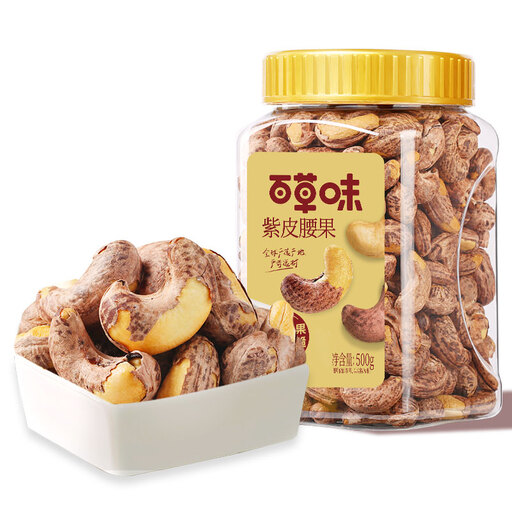 Image unavailable
Be&Cheery Cashews with Purple Skin 180 Grade, 500 g
An option if you want to compare carbohydrates and take the ingredients list of a salted variant into account when choosing.
The product information lists 679 kcal and 19.8 g of carbohydrates per 100 g. The ingredients list names cashew kernels and salt; the pack contains 500 g.
Joybuy
 Image unavailable
Duyvis Dry Roasted Cashews, 125 g
An option if you’re specifically looking for dry-roasted, savoury-seasoned cashews and want to check how they fit your eating plan.
The product information lists 586 kcal, 30 g of carbohydrates and 0.92 g of salt per 100 g. The seasoning mix contains salt, caramelised sugar and dextrose; according to the product information, the nuts are roasted without added oil.
Joybuy
Frequently asked questions
Are these cashew nuts really low in calories?
No. The four labels examined in full list 586–622 kcal per 100 g. According to the European Commission, solid foods can contain no more than 40 kcal (170 kJ) per 100 g to carry a low-calorie claim or one with the same meaning. So don’t describe a smaller weighed portion as a low-calorie product.
Is 25 g the right amount for everyone with diabetes?
No, 25 g is not a universal recommendation. You can use that amount to compare products, but Diakonessenhuis also describes personalised dietary advice that may take medication, body weight and activity levels into account. Use your own eating plan as your guide.
Should I only look at ‘of which sugars’?
No, compare the total carbohydrates per portion you eat as well. ‘Of which sugars’ is part of the total carbohydrate figure; use the same portion weight for every variant.
How should I store an opened pack of cashew nuts?
Keep nuts in a tightly sealed container in a dry place and follow the instructions on the packaging. The Netherlands Nutrition Centre recommends storing nuts in a dry place; for the cup examined, Albert Heijn advises storing it in a cool, dark, dry place and closing the pack securely after use.
What allergen information can I find on packaging in the Netherlands?
The NVWA says allergen information for pre-packed products must appear on the label; for unpackaged products, the seller must provide this information in another way. Check the warnings on the specific pack, including for possible traces of other nuts or peanuts.
Which ALDI cashew nuts were included in the safety warning?
The NVWA warning issued on 20 May 2026 names Trader Joe’s unsalted cashew nuts, 170 g, barcode 2003020120930 and best-before date 23-09-2026, due to possible metal fragments. As at 12 October 2026, that best-before date has passed; the warning concerns the pack specified and does not, by itself, say anything about other ALDI variants.


