
If you want to weigh your portion
You want cashew nuts with your coffee on the go, but above all, you want to keep track of how much you eat. The energy content of a weighed portion is more relevant than a product name that sounds healthy or light.


If you’re keeping an eye on your energy intake when having coffee on the go, it’s a good idea to weigh your portion and compare the nutritional information for the exact product. The Netherlands Nutrition Centre lists 154 kcal per 25 g of unsalted cashew nuts. Unsalted or oven-roasted doesn’t automatically mean low in energy, so assess the portion, label and preparation method separately.
You want cashew nuts with your coffee on the go, but above all, you want to keep track of how much you eat. The energy content of a weighed portion is more relevant than a product name that sounds healthy or light.
You’re looking for a snack to enjoy regularly and want to make a conscious choice to go for an unsalted variety. You consider the salt content separately from how much energy the cashew nuts provide.
You’d rather take a weighed portion with you than eat from a whole bag while you’re out. A multi-serving pack could work if you can portion it out at home and store the rest properly.
First decide how much you want to take with you, then compare the nutritional information for the exact variety. Next, check the salt content, preparation method and pack size separately.
| What to consider | What should you look for? | Who is this most relevant to? |
|---|---|---|
| Energy per portion | Check the kcal per 100 g on the exact pack and weigh your own portion. | If I want to know how much I’m eating with my coffee, I’d rather weigh a portion than rely on the product name. Around 39% of consumers prioritise portion size and energy content. |
| Salt and preparation | Check that it says unsalted and read the ingredients; roasted doesn’t necessarily tell you whether oil has been used. | If you’re mainly looking for an unsalted variety, you’ll want to keep the salt content separate from the energy content. Around 23% of consumers are primarily concerned with the unsalted ingredients. |
| Taking them with you and storing them | Distinguish the pack weight from your portion and seal the rest properly; store cashew nuts in a dry place. | If I prepare a snack to take with me in advance, I want to know how much I’m taking and how to store the rest. Around 23% of consumers prioritise convenience. |
| Cost per portion | Compare the price per kilogram of the same variety and calculate the cost for the same portion size. | If you want to compare the cost of a regular snack, it’s better to look at the same quantity rather than just the price of the bag. Around 15% of consumers focus mainly on the cost per portion eaten. |
These descriptions refer to the salt content or preparation method. They don’t prove that a product meets the criteria for a low-energy nutrition claim.
Assess the energy per 100 g and your weighed portion separately from the salt content and use of oil. For solid foods, the European Commission sets a maximum of 40 kcal (170 kJ) per 100 g for a low-energy claim.
Jumbo lists a 125 g pack of Duyvis cashews. That makes five 25 g portions if you weigh out 25 g each time. The pack weight doesn’t determine how much you eat with one coffee.
Weigh out how much you want to take with you in advance and seal the remaining cashew nuts properly.
Jumbo lists 586 kcal and 0.92 g of salt per 100 g for Duyvis Oven Roasted Gezouten Cashews. Flink lists 604 kcal and 1.5 g of salt per 100 g for a similarly named Duyvis product. Don’t assume these listings refer to exactly the same recipe.
Compare the full product details with the label on the pack you’re buying.
The Netherlands Food and Consumer Product Safety Authority (NVWA) warning of 20 May 2026 concerned 170 g packs of TRADER JOE'S unsalted cashew nuts with barcode 2003020120930 and best-before date 23-09-2026, due to possible metal fragments. This identification does not automatically apply to other packs.
If you have the exact pack mentioned, don’t eat it. Always check the product details specified in a warning.
Duyvis describes its Cashews Original as oven-roasted with no added oil.
Albert Heijn lists an AH Cashewnoten variety labelled as unsalted.
Jumbo lists a 500 g value pack of unsalted cashew nuts.
Lidl lists unsalted cashew nuts as one of its options.
The Dutch ALDI product page lists TRADER JOE'S roasted, unsalted cashew nuts in a 250 g pack.
PLUS lists 200 g bags of unsalted, unroasted cashew nuts.
This selection includes cashew nuts with different salt and preparation labels. Compare the energy content on the same basis and adjust your weighed portion to suit what you’re taking with you.
 No image available
Ideal for weighing out your own portion to take with you; the product information lists 100% cashew kernels and 604 kcal per 100 g.
Pack size: 160 g. The allergen information lists cashew.
 No image available
A roasted variety for anyone looking for this preparation method; the product information lists 586 kcal and 0.92 g of salt per 100 g.
Pack size: 125 g. The allergen information lists cashew, gluten, wheat and peanuts. Check the pack if allergens are relevant to you.
 No image available
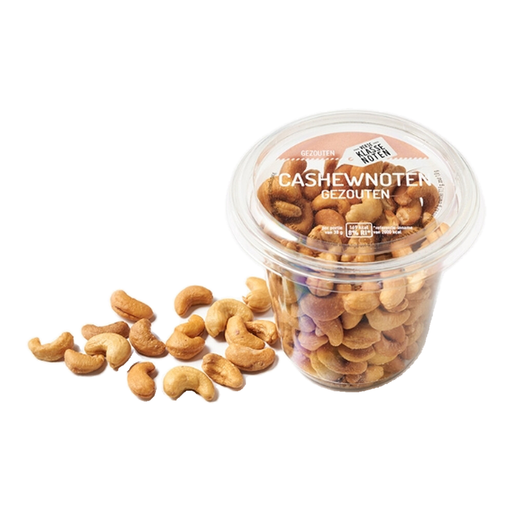
For anyone looking for a salted variety and wanting to choose their own portion size; the product information lists 2555 kJ and 1.0 g of salt per 100 g.
Pack size: 150 g.
 No image available
For anyone looking for roasted cashew nuts with no added salt; the product information lists 596 kcal per 100 g.
Pack size: 200 g. The title specifies that the variety is roasted and unsalted.
 No image available
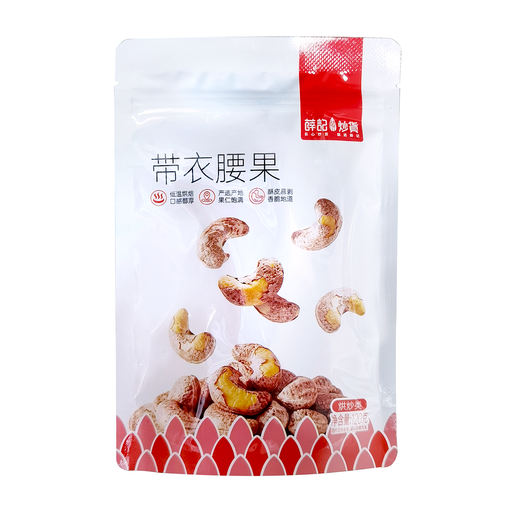
A salted cashew variety in a pack described in the product information as sealed and portable; the information lists 596 kcal per 100 g.
Pack size: 120 g.
For solid foods, the European Commission sets a maximum of 40 kcal (170 kJ) per 100 g for a low-energy claim. The Netherlands Nutrition Centre lists 154 kcal per 25 g of unsalted cashew nuts, which works out at 616 kcal per 100 g. A smaller portion doesn’t change the nutritional value per 100 g.
No. An energy-reduced claim has separate requirements, including at least a 30% reduction in energy and a statement explaining what causes the reduction, as outlined by the European Commission. Eating fewer grams of the same product doesn’t make its recipe energy-reduced.
Multiply the kcal per 100 g by the number of grams you’ve weighed out, then divide by 100. Based on the 154 kcal per 25 g listed by the Netherlands Nutrition Centre, 15 g comes to around 92 kcal. This is a calculation example for unsalted cashew nuts, not a brand-specific value.
Check the label on the pack you’re buying. According to the Netherlands Food and Consumer Product Safety Authority, allergen information must appear on the label of prepacked foods. Ingredients and possible cross-contamination can vary between products.
Store cashew nuts in a dry place in a properly sealed container; the Netherlands Nutrition Centre recommends keeping them cool if possible. Also follow the instructions on your pack.