Who is this buying guide for?

Parents who want to serve treats safely

You’re organising a party for children of different ages and want to check whether whole nuts and the allergens listed on the label are suitable for your guests. Amsterdam UMC advises giving children under 4 nut butter rather than whole nuts; the Netherlands Nutrition Centre stresses the importance of sitting calmly while eating.

Parents keeping an eye on protein and salt

You want to compare the protein in a portion and look at unsalted options, without assuming that children need food for sports recovery. The product information and the label for the exact variant are important.

Organisers buying for a group

You’re looking for a pack size that suits the number of guests and want to decide in advance what to do with any leftovers. Once opened, follow the storage instructions on the relevant pack.

What should you look for when choosing?

What to consider What to look for Who is this important for?
Age and allergens Agree how the nuts will be served and check for allergies with parents; check the ingredients and warnings. When I’m buying for young guests, I want to know before serving whether the form and ingredients are suitable. Around 33% of consumers prioritise age-appropriate and allergy-conscious shopping.
Protein per portion Compare protein per 100 g and calculate how much the portion you’ll actually serve contributes. If I want to know what a portion contributes, I look beyond the amount per 100 g. Around 27% of consumers prioritise protein content as their first selection criterion.
Salt and ingredients Check the salt per 100 g and separately look for oil, added salt and flavourings. If I’m looking for an unsalted option, I check the full ingredients list rather than relying on the product’s preparation description. Around 20% of consumers put salt and ingredients at the top of their list.
Pack size Choose an amount that suits the number of guests who can eat it, and follow the storage instructions after opening. When buying for a group, I want enough without having too much left over. For around 13% of consumers, choosing the right amount for the group comes first.
Flavour and preparation Check the exact flavour variant and its ingredients. Once safety and allergies have been taken into account, a familiar savoury flavour may help you decide. Around 7% of consumers put flavour first when choosing.

Common mistakes

  • Putting sports-focused protein claims before safe serving

    Whole nuts can be a choking hazard for young children, and nut butter does not make cashews safe for someone with a cashew allergy.

    First, choose a way of serving them that’s appropriate for the children’s ages, and discuss allergies with their parents. Amsterdam UMC advises giving children under 4 nut butter rather than whole nuts.

  • Assuming ‘no added oil’ means ‘unsalted’

    These are different qualities. Duyvis describes Cashews Original as oven-roasted without added oil; a separate Albert Heijn listing for salted Duyvis cashews states that they contain 0.92 g of salt per 100 g.

    Check the preparation method, ingredients and salt separately on the pack of the variant you’re buying.

  • Assuming a larger pack has the same nutritional values

    Jumbo listings for 200 g and 500 g packs of unsalted cashews state that they contain 21.5 g and 21.0 g of protein per 100 g respectively.

    Check the information on the exact pack and choose an amount that suits what your group will use.

  • Ignoring a specific safety warning

    The NVWA warning of 20 May 2026 concerned 170 g packs of Trader Joe’s unsalted cashews with barcode 2003020120930 and best-before date 23-09-2026. The warning applied to those specific packs because of possible metal fragments, not to all cashews from the brand.

    Check the brand, pack size, barcode and best-before date against the warning. Do not eat the affected product; the fact that its best-before date has passed does not make the pack safe.

Brands to compare

Duyvis

The range includes products with natural-sounding names as well as savoury, oven-roasted varieties; always check the exact variant.

  • Duyvis describes Cashews Original as oven-roasted without added oil.
  • The Oven roasted cashews salted listed by Albert Heijn are salted. So the brand’s description ‘without added oil’ does not mean ‘unsalted’.

Albert Heijn

The listed AH Unsalted Cashews are a supermarket own-brand option made with roasted cashews.

  • For this variant, Albert Heijn lists 96% cashews, sunflower oil and 0 g of added salt.
  • The product information says that it may contain other nuts and peanuts; check the current pack.

Jumbo

Jumbo lists unsalted own-brand cashews in 200 g and 500 g packs.

  • The product listings state that both pack sizes contain 99% cashews and sunflower oil.
  • The stated protein values differ: 21.5 g per 100 g for the 200 g pack and 21.0 g per 100 g for the 500 g pack. Check the pack you choose.

Lidl

Lidl lists Way To Go cashews as unsalted and also sells savoury varieties.

  • Lidl highlights the processing of Way To Go cashews in Tanzania as a feature of its supply chain.
  • This supply-chain feature is not evidence of a higher protein content or suitability for children; check the ingredients and label for the specific variant.

ALDI

ALDI lists Trader Joe’s roasted, unsalted cashews in a 250 g pack; Trader Joe’s is the product brand.

  • The product page confirms the roasting method and the 250 g pack size.
  • The NVWA warning for a 170 g pack with a specific barcode and best-before date does not automatically apply to all cashews from ALDI or Trader Joe’s.

PLUS

PLUS lists unsalted, unroasted cashews with a simple ingredients list.

  • The product page lists cashews as the only ingredient.
  • The page warns that the product may contain peanuts. Unroasted describes how the nuts are prepared; on its own, it does not prove a higher protein content or health benefit.

Cashew nuts at Joybuy

These cashew options at Joybuy can be compared by their stated protein and salt content, ingredients and pack size. Whole nuts are not suitable for every age or allergy.

Jiazhouyuanye Original Flavour Large Cashew Nuts, 160 g

Jiazhouyuanye Original Flavour Large Cashew Nuts, 160 g

A good option if you’re looking for cashews to eat as they are and want to compare the protein and salt content per 100 g.

Joybuy product information states that this product contains 19.8 g of protein and 0.028 g of salt per 100 g, comes in a 160 g pack and has cashew kernels as its only ingredient.

Contains cashews. Amsterdam UMC advises giving children under 4 nut butter rather than whole nuts.

View at Joybuy

g’woon roasted, unsalted cashews, 200 g

g’woon roasted, unsalted cashews, 200 g

An option to compare if you’re looking for a roasted snack listed as an unsalted variant.

Joybuy product information states that this product contains 18.67 g of protein and 0.067 g of salt per 100 g, comes in a 200 g pack and contains cashews.

Contains cashews. Amsterdam UMC advises giving children under 4 nut butter rather than whole nuts.

View at Joybuy
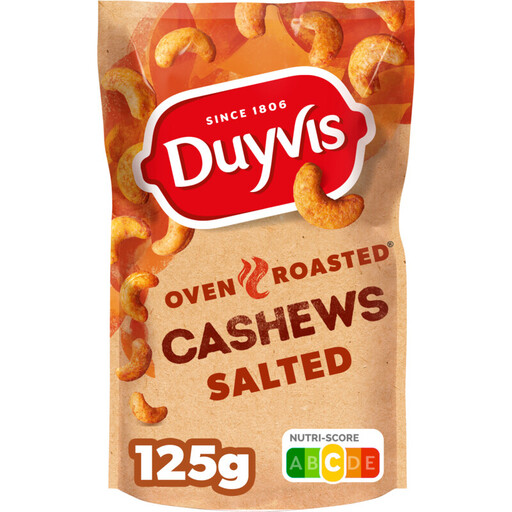
Duyvis Dry Roasted Cashews, 125 g

Duyvis Dry Roasted Cashews, 125 g

A good option if you’re considering a savoury, oven-roasted cashew variety and want to take the salt content on the label into account.

Joybuy product information states that this product contains 18 g of protein and 0.92 g of salt per 100 g, and lists cashews, wheat and peanuts as ingredients.

Check the listed allergens with the parents. For children under 4, Amsterdam UMC advises giving nut butter rather than whole nuts.

View at Joybuy
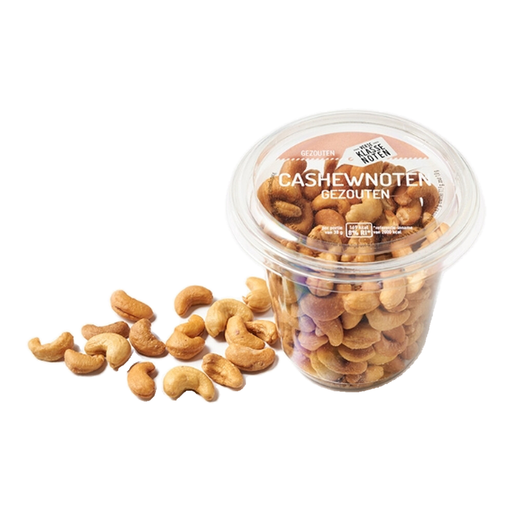
Verse Klassenoten salted cashews, 150 g

Verse Klassenoten salted cashews, 150 g

A savoury option to compare if you also want to take the salt content into account.

Joybuy product information states that this product contains 21.0 g of protein and 1.0 g of salt per 100 g, is made with 98% cashews, sunflower oil and 1% salt, and comes in a 150 g pack.

Contains cashews and added salt. Check allergies with the parents and agree on the preferred salt content.

View at Joybuy
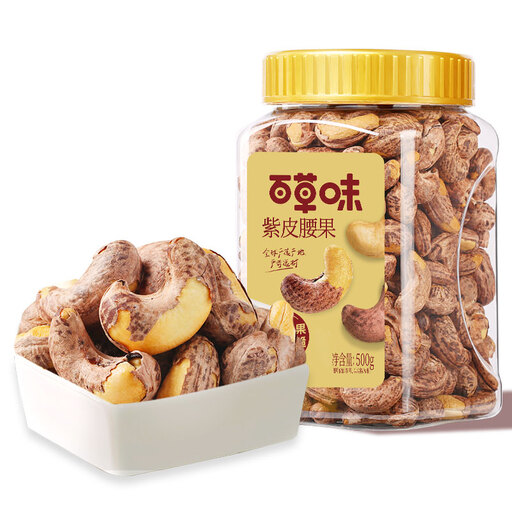
Be&Cheery cashews with purple skin, 180 grade, 500 g

Be&Cheery cashews with purple skin, 180 grade, 500 g

The larger pack may be worth comparing if you’re buying for a group; choose an amount that suits the guests.

Joybuy product information states that this product contains 16.4 g of protein and 1.2 g of salt per 100 g, comes in a 500 g pack and contains added salt.

Contains cashews and added salt. Plan how much you need and follow the storage instructions after opening.

View at Joybuy

Frequently asked questions

Can you give whole cashews to all children?

No. Whole nuts are not suitable for every age. Amsterdam UMC advises giving children under 4 nut butter with no added sugar or salt rather than whole nuts. For older children, too, consider their ability to chew, make sure they sit calmly and supervise them.

Are unsalted cashews also free from other allergens?

Not necessarily. As well as checking for cashews, check the ingredients and warnings for possible peanuts, other nuts or wheat. The NVWA explains the mandatory allergen information on labels; speak to parents before the party about which information is relevant.

Do you need special recovery food for a sporty children’s party?

An active party is not in itself a reason to apply adult sports nutrition goals to children. The Netherlands Nutrition Centre says recreational athletes do not need special protein products; this information is not advice on recovery food for children.

How should you store leftover cashews?

Follow the storage instructions on the pack of the variant you’ve chosen. Albert Heijn advises storing its unsalted cashews in a cool, dark, dry place and closing the pack securely after use.

Does the ALDI warning apply to all unsalted cashews?

No. The NVWA warning of 20 May 2026 concerned 170 g packs of Trader Joe’s unsalted cashews, barcode 2003020120930 and best-before date 23-09-2026, because of possible metal fragments. Do not eat the affected product; the warning was not extended to all packs from this brand.
