
Mindful snackers watching their portions
You want to know how much energy you’re getting from your snack. Weigh your portion and use the kcal per 100 g shown on the packaging; don’t mistake a small portion for a low-calorie product.


To snack more mindfully on cashew nuts, pay attention to the weight of your portion and the nutritional values of the specific variety; unsalted or unroasted doesn’t mean low in calories. The Netherlands Nutrition Centre lists 154 kcal for a reference portion of 25 g of unsalted cashew nuts, while the European Commission allows a maximum of 40 kcal per 100 g for solid foods to carry the ‘low energy’ claim. Also compare the ingredients, preparation method and packaging with what you’re looking for.
You want to know how much energy you’re getting from your snack. Weigh your portion and use the kcal per 100 g shown on the packaging; don’t mistake a small portion for a low-calorie product.
You’re looking for cashew nuts to snack on or add to a dish, and want to check whether the ingredients list contains just nuts or also includes oil, salt or herbs and spices.
You enjoy a savoury cashew snack, but also want to keep an eye on the salt and how much you eat from the pack.
First check the nutritional values per 100 g, then weigh your own portion. Consider the ingredients, salt and pack size as separate factors.
| What to consider | What to look for | Who is this important to? |
|---|---|---|
| Energy per portion | Check the kcal per 100 g on the label and weigh your portion. Calculate kcal per portion as kcal per 100 g × weight in grams ÷ 100. | If I want to know how much energy my snack portion contains, I weigh the nuts and use the label; around 36% of consumers prioritise the energy in the portion they eat. |
| Ingredients and preparation | Check the full ingredients list, the preparation description and the salt per 100 g. | If you’re mainly looking for a simple ingredients list, compare whether oil, salt or herbs and spices have been added; around 29% of consumers prioritise this. |
| Packaging and storage | Compare the pack weight in grams with the number of portions you want to make for yourself. Follow the storage instructions and seal the pack well after use. | If I want to choose a supply I can use in time and store appropriately, I check the net weight; around 21% of consumers prioritise pack size and having a supply they can use. |
| Savoury flavour and salt | Check the herbs and spices and other ingredients, the salt per 100 g, and the portion you plan to eat. | If you’re looking for a savoury cashew snack, also check how much salt your chosen variety contains; around 14% of consumers prioritise this flavour preference. |
The cashew varieties reviewed are still high in energy, even when unsalted or roasted without added oil.
Check the kcal per 100 g and weigh the amount you actually eat. Consider the salt and ingredients separately too.
The 100 g AH pack reviewed lists four 25 g portions, so the whole pack does not count as one portion according to the label.
Decide in advance how many grams you want to eat and calculate using that weight, rather than judging by the apparent size of the pack.
Pack weights can vary, and opened nuts need to be stored appropriately.
Compare the net weight and choose an amount you can use. Store cashew nuts in a dry place in a tightly sealed container, following the instructions on the packaging.
On 20 May 2026, the NVWA warned that Trader Joe’s Unsalted Cashew Nuts, 170 g, with barcode 2003020120930 and best-before date 23-09-2026, might contain metal fragments. The warning applies to that pack; do not eat it, even if the best-before date has passed.
If you have an old pack, check the product name, weight, barcode and best-before date. Do not eat any pack covered by the warning.
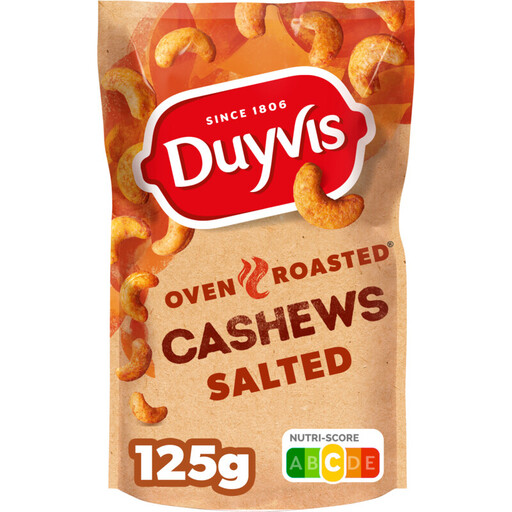
The Original variety reviewed is an oven-roasted cashew snack in a 125 g pack.
The varieties reviewed are AH Terra Unroasted Cashew Nuts, 200 g, and AH Unsalted Cashew Nuts, 100 g.
Jumbo Unsalted Cashew Nuts 200 g is a variety reviewed for anyone looking for unsalted cashew nuts.
Lidl Netherlands lists unsalted and spicy roasted cashew nuts, available in store only.
The Dutch product page reviewed lists Trader Joe’s Roasted and Unsalted Cashew Nuts in a 250 g pack.
PLUS Unsalted Unroasted Cashew Nuts 200 g is a variety reviewed that lists cashew nuts as its only ingredient.
This selection includes cashew nuts for a measured snack portion, a simple ingredients list or a savoury snack. Check the details for the specific variety, especially if you’re keeping an eye on energy, salt or allergens.
 No image available
The product information suggests enjoying these as a snack or adding them to yoghurt, muesli or baked goods.
The stated energy is 604 kcal per 100 g. The ingredients list contains only cashew kernels, and the pack contains 160 g.
 No image available
The product description presents these oven-roasted cashew nuts as a snack and says no oil is added.
The label states 586 kcal and 0.92 g of salt per 100 g. The pack is described as containing 4–5 portions; the ingredients and allergen information mentions gluten, wheat and peanuts.
 No image available
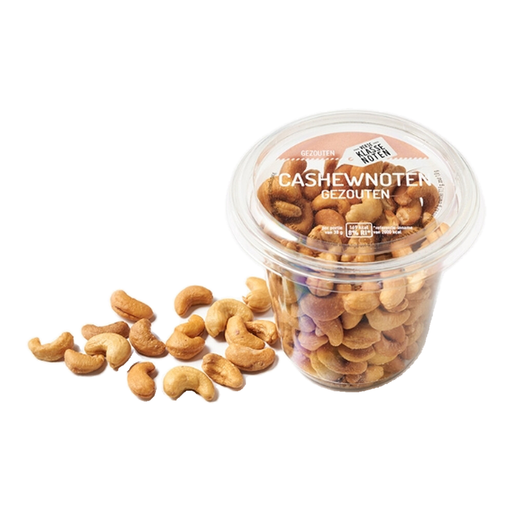
The product name indicates that these cashew nuts contain salt; check the variety details if you’re watching your salt intake.
The product information states 596 kcal per 100 g and a pack size of 150 g.
 No image available
The product information describes roasted, unsalted cashew nuts; the ingredients list contains only cashew nuts.
The label states 596 kcal and 0.067 g of salt per 100 g. The pack contains 200 g.
 No image available
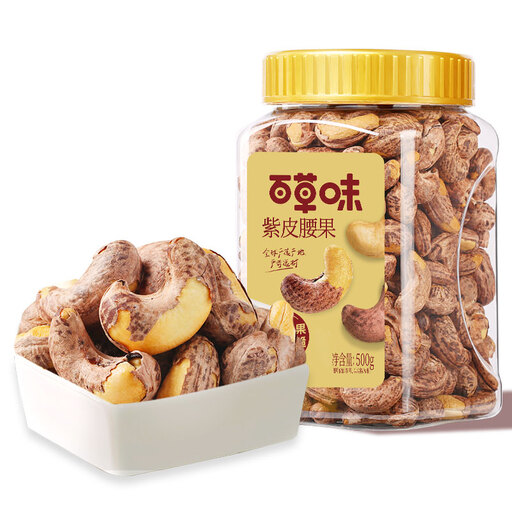
The product information suggests enjoying these cashew nuts as a snack or using them in baking or cooking.
The label states 679 kcal and 1.2 g of salt per 100 g. The ingredients list contains cashew kernels and salt; the pack contains 500 g.
Multiply the kcal per 100 g on the label by the number of grams you eat, then divide by 100. For example, 25 g at 598 kcal per 100 g works out at 149.5 kcal. This is a calculation based on the label value, not personalised nutrition advice.
Not just because the portion is small. For solid foods, the ‘low energy’ claim is limited to a maximum of 40 kcal per 100 g. The European Commission sets out this requirement; eating fewer grams lowers the calculated energy in your portion, not the product’s energy per 100 g.
No, these terms don’t tell you on their own whether oil has been added. Check the ingredients list for the specific variety: for example, the AH and Jumbo varieties reviewed contain sunflower oil despite being unsalted, while the AH Terra variety reviewed lists only cashew nuts.
Allergen information must be available for non-prepacked food. Under the Dutch Warenwetregeling allergeneninformatie niet-voorverpakte levensmiddelen (Commodities Act Regulation on Allergen Information for Non-prepacked Foods), this information may be provided verbally under certain conditions. It must be accurate and readily available before purchase, and kept in written or electronic form for staff and the NVWA. Ask about the specific type of nut and any possible allergens.
No. The NVWA warning issued on 20 May 2026 concerns Trader Joe’s Unsalted Cashew Nuts, 170 g, with barcode 2003020120930 and best-before date 23-09-2026, due to possible metal fragments. Do not eat that pack, even if the best-before date has passed; the warning does not automatically apply to other packs or batches.