What should you look for when buying?
First check that the cashew nuts are suitable for your allergies. Then compare the fat per 100 g, portion size and ingredients; these are separate considerations.
| What to consider |
What should you check? |
Who is this important for? |
| Allergens |
Read the ingredients and allergen warnings on the exact packaging. Check this information against your specific allergies. |
If I’m buying for someone with a food allergy, I first want to know whether cashew or another allergen is listed on the packaging. Around 36% of consumers prioritise avoiding relevant allergens. |
| Fat per 100 g |
Compare the nutrition table for the exact variant. For solid foods, the European Commission sets a maximum of 3 g of fat per 100 g for a ‘low fat’ claim. |
If I’m looking for a product with less fat, I check the nutritional information rather than relying on ‘unsalted’ or ‘no added oil’. Around 29% of consumers prioritise a demonstrably lower fat content in the product. |
| Portion size |
Compare portion sizes in grams and use the nutritional information on the packaging you buy. A stated portion size doesn’t automatically apply to another product. |
If I want to keep eating cashew nuts but have less fat per snack, I pay attention to how many grams I eat. Around 21% of consumers make portion control their main consideration. |
| Ingredients |
Check the oil, flavourings and allergen information for each variant. Unroasted, roasted and seasoned varieties may have different ingredients lists. |
If I want to limit additives, I compare the full ingredients list and check the allergen information too. Around 14% of consumers prioritise a simple ingredient list. |
For a 25 g handful of unsalted cashew nuts, the European Commission gives a general nutritional value of 12,2 g of fat. This isn’t a product specification for every brand, so use the nutritional information on the packaging you choose to work out the values for your own portion.
Cashew products at Joybuy
This selection includes cashew variants to check for ingredients and allergens. Compare the nutrition table for the exact variant; oven-roasting without added oil doesn’t prove that a product is low in fat.
 Image unavailable
Jiazhouyuanye Original Flavour Large Cashew Nuts, 160 g
Only consider this if you can eat cashew; this product isn’t a suitable snack if you have a confirmed cashew allergy.
The product information lists 100% cashew kernels as the ingredient and suggests using them in yoghurt, muesli and baking.
View at Joybuy
 Image unavailable
g'woon Cashew Nuts Roasted & Unsalted, 200 g
Only consider this if you can eat cashew; check the allergen information for your circumstances.
The title describes roasted, unsalted cashew nuts. The product information lists cashew and tree nuts; check the nutritional information per 100 g on the packaging too.
View at Joybuy
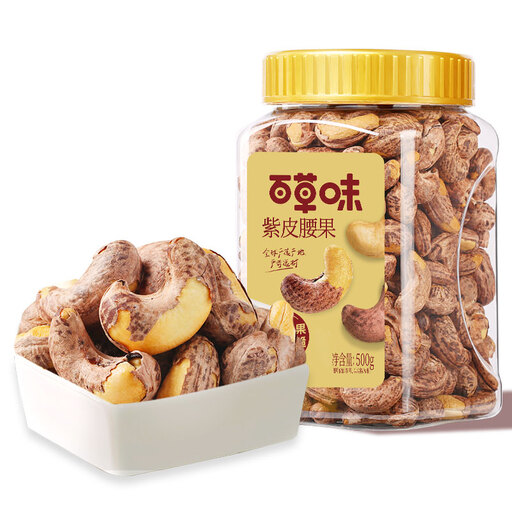 Image unavailable
Be&Cheery cashews with purple skin, 180 grade, 500 g
Only consider this if you can eat cashew; this product isn’t a suitable snack if you have a confirmed cashew allergy.
The product information lists cashew kernels and salt, and describes the cashew nuts as lightly salted and ready to eat.
View at Joybuy
 Image unavailable
Duyvis Dry Roasted Cashews, 125 g
Only consider this if you can eat cashew. Check the product information for additional allergens before choosing.
The description lists 98% cashews, oven-roasted without added oil or fat, a savoury flavour mix and a stabiliser. Gluten, wheat and peanuts are also listed as allergens; the preparation method doesn’t prove that the product is low in fat.
View at Joybuy
Frequently asked questions
Are lower-fat cashew nuts suitable if you have a cashew allergy?
No. If you have a confirmed cashew allergy, a product containing cashew isn’t a suitable snack, regardless of its fat content or how it’s prepared. Stichting Voedselallergie says the allergen remains stable when heated.
When can a solid food be described as low in fat?
For solid foods, the European Commission sets a maximum of 3 g of fat per 100 g for a ‘low fat’ claim. The unsalted cashew nuts from PLUS, Jumbo and Albert Heijn reviewed are above this limit, at 46,5 g, 48,6 g and 50 g per 100 g respectively.
What do cross-contamination warnings on packaging mean?
They indicate a risk that has been assessed during production; check the warning against your specific allergy. According to the NVWA, new rules for cross-contamination warnings have applied since 1 January 2026. The absence of a warning isn’t a universal guarantee for every individual allergy.
What should I do if the online product information differs from the packaging?
Use the information on the exact packaging of the product you intend to eat, and check the ingredients, allergens and nutritional values again. Albert Heijn and PLUS say that product information may change; if you have any questions, contact the relevant retailer’s customer service team.
How should I store cashew nuts after opening?
Follow the storage advice on your packaging. For the AH Cashewnoten ongezouten product reviewed, Albert Heijn recommends storing it in a cool, dark and dry place and closing the pack after use. For the Duyvis listing at AH, an airtight, lightproof container is recommended after opening.


