Who is this buying guide for?

Gluten-free snack shoppers

You’re looking for cashew nuts to fit a gluten-free diet and want to distinguish an explicit gluten-free claim from the ingredients and warnings on the packaging. The Netherlands Nutrition Centre recommends looking for a ‘gluten-free’ claim.

Shoppers mindful of lactose

You’re looking for a product suitable for lactose intolerance and don’t want to confuse this with suitability for a cow’s milk allergy. The Netherlands Nutrition Centre distinguishes between lactose and milk proteins.

Shoppers who need to avoid allergens

You’re buying for yourself or someone else with a food allergy and want to know first whether cashew itself is safe to eat. Then you can check for other allergens and possible cross-contamination, including when buying loose nuts. The Netherlands Food and Consumer Product Safety Authority explains allergen information requirements for packaged and unpackaged foods.

What should you look for when buying?

First, establish which ingredient you need to avoid. Only then should you compare varieties by taste and packaging. Don’t buy cashew nuts if you need to avoid cashew, whatever other ‘free from’ claims they carry.

What to consider What should you look for? Who does this affect?
Cashew and other allergens Check whether cashew is listed as an ingredient and read the warnings for other allergens. If buying loose nuts, ask for product information before you buy. If I need to avoid cashew, I want to know first whether the product contains it and which other allergens are listed; for around 36% of consumers, allergen safety is their top buying priority.
Gluten-free Look for a gluten-free claim on the packaging of the exact variety you’re buying, and read the ingredients and warnings too. If gluten is my key dietary restriction, I want a clear claim on the exact packaging; around 29% of consumers prioritise gluten-free products.
Lactose or milk protein Work out whether you need to avoid lactose or milk protein, then check the relevant product claim and allergen information. If I’m lactose intolerant or need to avoid milk protein, I want to take that distinction into account when choosing; around 21% of consumers have this as their top buying priority.
Quantity and storage Compare the net weight and follow the storage instructions for the packaging you choose. Once I’ve checked that the dietary requirements are met, I want a quantity that suits how I’ll use the product and packaging that I can store properly once opened; around 14% of consumers prioritise quantity and storage.

Common buying mistakes

  • Assuming ‘free from’ means free from all allergens

    A gluten-free or lactose-free claim doesn’t make a product containing cashew suitable if you need to avoid cashew.

    Identify the ingredient you need to avoid and check for it separately. Don’t choose cashew nuts if you have a cashew allergy.

  • Assuming plain, unsalted or roasted means allergen-safe

    The way a product is prepared doesn’t, by itself, determine whether it’s suitable for someone with an allergy. Varieties we looked at may carry warnings for peanuts, other nuts or wheat.

    Read the ingredients and warnings for the exact variety; don’t assume it’s free from something based on the product name.

  • Confusing lactose-free with milk-protein-free

    Lactose intolerance and cow’s milk allergy are different conditions. A lactose-free claim doesn’t automatically tell you whether a product is suitable for someone with a milk allergy.

    If you have a milk allergy, check whether milk is listed as an allergen. Don’t rely on the words ‘lactose-free’ alone.

  • Asking only about ingredients when buying loose nuts

    The ingredients and the risk of cross-contamination are separate things to consider, for example when nuts are sold from shared bins or scooped with shared utensils.

    Ask about allergen information before you buy, and check whether shared equipment or preparation methods are relevant to your choice.

Brands and cashew nut varieties reviewed

Duyvis

The varieties reviewed differ in preparation and recipe: Cashews Original 125 g and Noten cashews zeezout 125 g.

  • Duyvis describes Original as oven-roasted with no added oil.
  • The sea salt variety contains 94% cashew and carries warnings for wheat, peanuts and various nuts. The roasting method used for Original doesn’t prove it’s allergen-free.

Albert Heijn

The shop page for AH Cashewnoten ongezouten 170 g lists the product as gluten-free and lactose-free.

  • The product page also describes this variety as vegan.
  • The cashew nuts contain cashew and may contain peanuts and other nuts. This claim applies to this variety and not automatically to every product from the brand.

Jumbo

Jumbo Cashewnoten Ongezouten 200 g is a plain variety containing cashew nuts and sunflower oil.

  • The shop page lists the ingredients and allergens for this specific variety.
  • The warning mentions nuts and peanuts. A short ingredients list isn’t a general ‘free from’ guarantee.

Lidl

The product page describes unsalted cashew nuts in a 500 g pack and says they’re sold in store.

  • The pack size listed can help you compare different pack formats.
  • Unsalted doesn’t automatically mean gluten-free, milk-free or suitable for someone with a food allergy. Check the packaging for the restriction that applies to you.

ALDI

ALDI describes Trader Joe’s roasted, unsalted cashew nuts in a 250 g pack.

  • Roasted and unsalted are product features of this variety.
  • These features don’t guarantee that the product is allergen-free. Check the ingredients and warnings on the exact packaging.

PLUS

PLUS Cashewnoten ongezouten ongebrand 200 g is a plain variety whose product page lists cashew nuts as an ingredient.

  • The shop page mentions that the product may contain peanuts.
  • Unroasted and vegan don’t prove that a variety is free from gluten or milk. Check the exact product information.

Cashew nuts at Joybuy

These Joybuy products are cashew varieties for people who can eat cashew. Check the product information for the restriction that applies to you.

Jiazhouyuanye Original Flavour Large Cashew Nuts 160 g

Jiazhouyuanye Original Flavour Large Cashew Nuts 160 g

The product title names the 160 g Original Flavour Large variety. It contains cashew, so it isn’t suitable if you need to avoid cashew.

View at Joybuy

g'woon roasted and unsalted cashew nuts 200 g

g'woon roasted and unsalted cashew nuts 200 g

The title describes 200 g of roasted, unsalted cashew nuts. They contain cashew, so don’t choose this product if you need to avoid cashew.

View at Joybuy
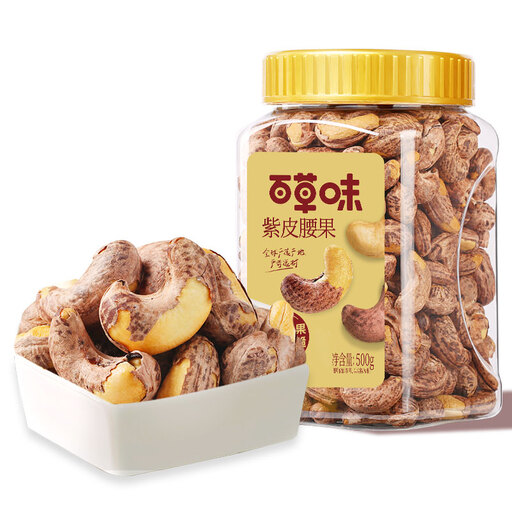
Be&Cheery cashew nuts with purple skin, 180 grade, 500 g

Be&Cheery cashew nuts with purple skin, 180 grade, 500 g

The product title describes cashew nuts with purple skin, 180 grade, in a 500 g pack. They contain cashew, so they aren’t suitable if you need to avoid cashew.

View at Joybuy

Frequently asked questions

Are cashew nuts an allergen-free snack?

No, cashew is an allergen in its own right. A gluten-free, lactose-free or vegan claim doesn’t make cashew nuts suitable if you need to avoid cashew.

What should a market stall tell you about loose nuts?

The seller must tell you about the allergens present before you buy. According to the Netherlands Food and Consumer Product Safety Authority, this information can be given verbally for unpackaged products, as long as it’s clearly stated that you can ask for it. If possible cross-contamination from shared bins or scoops is relevant to you, ask about that too.

Does ‘may contain’ mean the allergen is definitely present?

No, ‘may contain’ warns that an allergen could be present unintentionally; it isn’t the same as listing it as an ingredient. Consider the warning alongside the ingredients list and your specific dietary restriction.

Is lactose-free the same as suitable for someone with a cow’s milk allergy?

No. Lactose intolerance relates to milk sugar, while cow’s milk allergy relates to milk proteins. If you have a milk allergy, don’t use a lactose-free claim as your only buying criterion.

Which ALDI cashew nuts were affected by the safety warning?

On 20 May 2026, the Netherlands Food and Consumer Product Safety Authority issued a warning about Trader Joe’s unsalted cashew nuts, 170 g, with barcode 2003020120930 and best-before date 23-09-2026, due to possible metal fragments. Don’t eat products from this specific batch; the warning doesn’t automatically apply to other pack sizes or batches.
