
Households that portion snacks themselves
You want a supply that matches how much you use at home and on the go. Compare the pack size with your usual consumption and portion out the cashew nuts yourself for your gym bag.


Choose a pack size based on how many cashew nuts you actually use at home and for your gym bag. A bulk bag is most practical if you can portion it out and store it properly. The Netherlands Nutrition Centre advises against eating a large portion just before exercising, and recommends avoiding foods high in fat, protein or fibre at that time.
You want a supply that matches how much you use at home and on the go. Compare the pack size with your usual consumption and portion out the cashew nuts yourself for your gym bag.
You want to take a manageable amount of unsalted cashew nuts with you, but you don’t eat them every day. A smaller pack may suit your needs better; at home, follow the storage instructions on the pack.
You think about more than just what to take with you: portion size and when you eat matter too. Timing may be more important to your choice than the size of the bag.
First, work out how much you’ll actually use and whether you can portion out and store the rest at home. Then check how the nuts have been prepared and choose an eating time that works with your training.
| What to consider | What to look for | Who is this important for? |
|---|---|---|
| Pack size | Compare the net weight with how much you actually use at home and on the go. | I want a bag that suits how much I eat, rather than a supply that goes unused; around 36% of consumers prioritise finding the right pack size. |
| Portioning and storage | Decide on your own portion size and follow the storage instructions on the pack. As a simple calculation, 200, 250 and 500 g make 8, 10 and 20 portions respectively, if each portion is 25 g. | When I prepare snacks in advance, I want to be able to portion them out and store the rest at home. This is the main concern for around 29% of consumers. |
| Ingredients and preparation | Read the ingredients and check separately whether the nuts are unroasted, unsalted or prepared with salt. | I want to choose a product that suits my preferences for ingredients and taste; around 21% of consumers prioritise the ingredients and preparation. |
| When to eat around training | Bear portion size in mind, along with the Netherlands Nutrition Centre’s advice for the period just before exercise. | I want to time my snack around my training; around 14% of consumers consider when they eat to be the most important factor. |
A larger bag contains more cashew nuts, but that doesn’t mean the amount suits how much you actually use.
Decide in advance how much you want to take with you and whether you can portion out and store the rest at home.
The amount in the bag and the amount you want to eat in one sitting are two different things.
Use 25 g only as an example to help you portion out the bag; it isn’t a personal recommendation.
These terms describe different qualities. According to the manufacturer, Duyvis Cashews Original contains salt, although no oil is added. The unsalted fairtrade version from PLUS contains sunflower oil.
Check the preparation method and ingredients separately on the pack of the product you choose.
The Netherlands Nutrition Centre says opened, unsalted cashew nuts can be kept in a kitchen cupboard for six months. This doesn’t guarantee they’ll keep in a warm or damp gym bag.
Take only the amount you need with you and store the rest at home according to the pack instructions.
Duyvis Cashews Original is a savoury, seasoned, oven-roasted variety in a 125 g pack.
AH Terra unroasted cashew nuts are available in a 500 g pack.
Jumbo’s unsalted cashew nuts are listed as a 500 g value pack.
Lidl’s Alesto nut range also includes Way To Go cashew nuts.
ALDI’s Dutch product listings include roasted, unsalted Trader Joe's cashew nuts and a separate 500 g listing.
PLUS lists unroasted, unsalted cashew nuts and a separate unsalted fairtrade variety, both in 200 g packs.
This Joybuy selection includes cashew nuts in a range of pack sizes, including products explicitly labelled as salted and unsalted.
 Image unavailable
The 160 g pack is a set amount that you can portion out yourself. The product description suggests enjoying the nuts as a snack or adding them to yoghurt, muesli or other dishes.
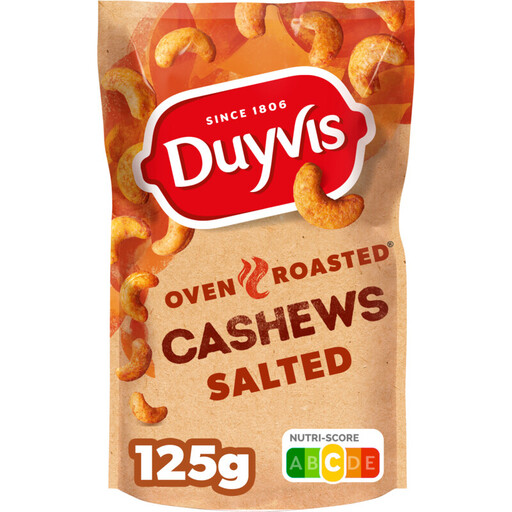 Image unavailable
This smaller pack is easy to take with you or portion out yourself. The product information describes dry-roasted cashew nuts with salt and 0.92 g of salt per 100 g.
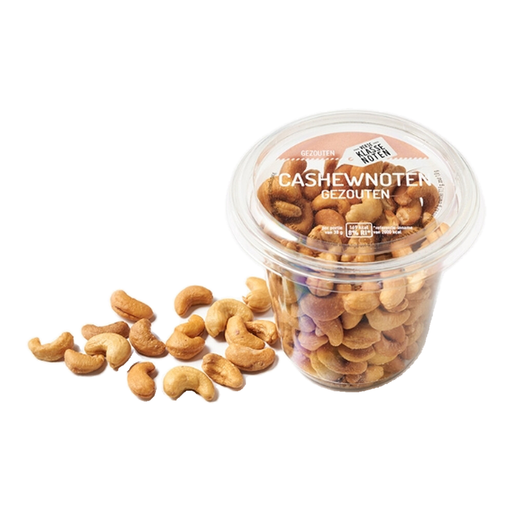 Image unavailable
The 150 g pack can be portioned out for different snack times; the product name specifies salted cashew nuts.
 Image unavailable
This pack contains 200 g of roasted, unsalted cashew nuts. The product description suggests enjoying them as a snack or using them in cooking or baking.
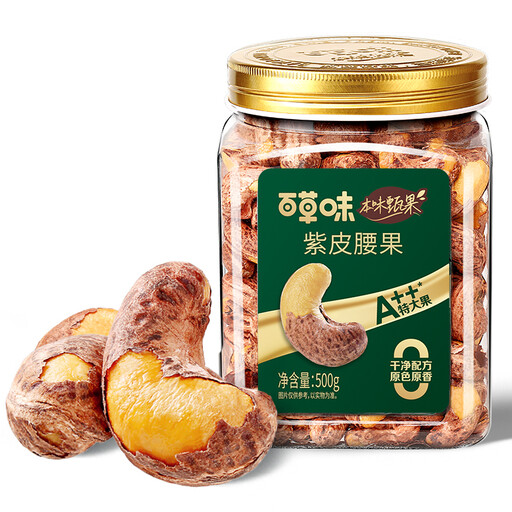 Image unavailable
At 500 g, this is a larger pack to portion out at home; the product name distinguishes this variety by its purple-skinned cashew nuts.
It depends on the portion size you choose. As a simple calculation, 500 g makes twenty 25 g portions. Portion the amount to suit your needs and follow the storage instructions on the pack when you get home.
The Netherlands Nutrition Centre’s general advice for opened, unsalted cashew nuts is six months in a kitchen cupboard, not a gym bag. Take only the amount you need and store the rest at home according to the pack instructions.
Not as a matter of course. The Netherlands Nutrition Centre advises against eating a large portion or foods high in fat, protein or fibre just before exercising, as they stay in the stomach for a long time and may cause discomfort.
Check the allergen information on the exact pack. According to the Netherlands Food and Consumer Product Safety Authority, this information must appear on prepacked foods. A short ingredients list doesn’t guarantee that a product is suitable for someone with a food allergy.
No. On 20 May 2026, the Netherlands Food and Consumer Product Safety Authority issued a warning about 170 g packs of Trader Joe's unsalted cashew nuts with barcode 2003020120930 and best-before date 23-09-2026, due to the possible presence of metal particles. Do not eat a pack that matches these batch details; the best-before date passing does not cancel the warning.