What should you look for when buying?
Multipack of whole cashews
Suitable when: the intended eater and use are appropriate for whole nuts, and the childcare setting allows them.
Bear in mind: having several bags does not make whole nuts a suitable lunch portion for a child under 4.
Bulk bag for cooking
Suitable when: an adult is buying cashews for a recipe that complies with the food and allergy arrangements.
Bear in mind: buying ingredients also means making arrangements for preparation, portioning and hygiene.
No cashews at this mealtime
Suitable when: cashews are not allowed under the individual arrangements or the policy for the group concerned.
Bear in mind: agree on another lunch option; don’t automatically replace cashews with a different nut.
First decide whether you’re buying the product to serve as it is or to cook or bake with. Then compare the form of food, the exact variety and the pack contents.
| What to consider |
What to check when buying |
Which consumers does this affect? |
| Form of food and age |
Decide whether you’ll serve the product as it is or use it as an ingredient. For children under 4, Amsterdam UMC recommends nut butter instead of whole nuts. |
I first want to know whether the form of food is suitable for the young child whose lunch I’m organising. Around 31% of consumers put a suitable form of food at the top of their list. |
| Allergy arrangements |
Check the current packaging and the arrangements for the child and the group; if in doubt, speak to the parents and childcare setting. |
For a shared mealtime, I want to know which ingredients and procedures are suitable under the individual arrangements. Around 25% of consumers prioritise these arrangements. |
| Packaging and portioning |
Check the number of bags and the contents of each bag. Albert Heijn lists an unsalted 3-pack; Foods & Goods lists Duyvis Sea Salt as 10 × 125 g. |
If I’m organising supplies for agreed mealtimes, I want to know how many units I’m actually buying. Around 25% of consumers make packaging and organisation their main priority. |
| Variety ingredients |
Read the ingredients list for the exact variety and check, among other things, whether it’s unsalted or contains sea salt. |
I want the ingredients to suit the agreed recipe rather than relying on the packaging alone. Around 19% of consumers put the ingredients first. |
Joybuy products
This selection includes individually packed nut mixes and bulk packs of cashews. A pack size is not a portion recommendation; before using a product at a childcare setting, check the form of food, ingredients and individual arrangements.
 No image available
ChaCha Daily Nuts 115g (23g x 5)
The product description lists five separate 23 g packs; this describes how the product is packaged, not an age-specific portion recommendation.
According to the product description, the mix includes cashews, walnuts, almonds, hazelnuts and sweetened cranberries, among other ingredients.
The product description also mentions a desiccant sachet, which is not for consumption.
View at Joybuy
 No image available
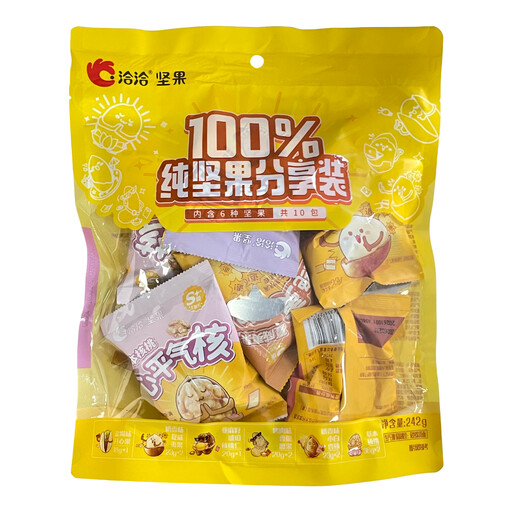
ChaCha Assorted Nuts Mega Pack 242g
The product description mentions individually packed nuts to take with you or share; cashews are one of the ingredients in the mix.
The description lists a mix of six types of nuts, with ingredients including salt, sugar and wheat flour.
The product information also lists wheat/gluten, sesame and milk. Check the current packaging and the arrangements for the group concerned.
View at Joybuy
 No image available
Three Squirrels Purple-Shell Cashews 500g
This bulk pack is intended for an agreed recipe; the product description lists whole roasted cashews.
The ingredients list states 99% cashews and salt; the product description says the cashews are lightly salted.
For children under 4, Amsterdam UMC recommends nut butter instead of whole nuts.
View at Joybuy
 No image available
g'woon Cashew Nuts Roasted & Unsalted - 200g
The product description says this 200 g bag is for cooking and baking, making it suitable as a supply for an agreed recipe.
The product name and description specify roasted, unsalted cashews.
The product description identifies cashew as an allergen; check the current packaging and the arrangements for the childcare setting.
View at Joybuy
Frequently asked questions
Can I give a child under 4 a small bag of whole cashews?
Don’t base your decision on the small bag size. For children under 4, Amsterdam UMC recommends nut butter without added sugar or salt instead of whole nuts, because of the risk of choking and suffocation. The cited recommendation appears in information about food enriched with energy and protein; only the explicit age-related advice about the form of food applies here.
Does ground cashew automatically make a product suitable for someone with a cashew allergy?
No. Consider whether cashew is present separately from the form of the food. Follow the individual allergy arrangements and check the packaging; VieCuri advises not serving a product if you’re unsure, and recommends discussing it with the parents.
How should you organise preparation and portioning at a childcare setting?
Follow the hygiene code that applies to the childcare setting, as well as the arrangements with parents about allergies. RIVM-KIDDI refers to the Hygiene Code for Small Institutions or another approved hygiene code; if there is an allergy, make sure the protocol also covers utensils and food remnants.
What allergen information is needed when food is served unpackaged?
According to the NVWA, information must be available about any allergens present; for nuts, it must be clear which nuts are involved. This information requirement doesn’t mean the product can be given to every child: you should also follow the individual arrangements and the childcare setting’s policy.
Does the warning about Trader Joe’s 170 g cashews also apply to an old pack?
The NVWA warning of 20 May 2026 concerns the 170 g unsalted pack with barcode 2003020120930 and best-before date 23-09-2026, due to possible metal particles. Do not eat the affected pack mentioned in the warning; the passed best-before date doesn’t cancel the warning. It applies to that specific product identity, not all packs from the brand.


