Choose a compact camera if its fixed lens can capture your ornaments at a large enough size and you want a straightforward setup. Choose a system camera if you want to change lenses and can put together a suitable macro lens. With either option, assess the lens or close-up mode, the space left for lighting and how sharp the image is across the relief. Test the white balance and check for any flickering bands under the lights you actually use.
Who is this choice relevant to?
Photographers capturing fine carving details
You want to fill the frame with small grooves and textures, so you compare the lens magnification or close-up mode rather than just the camera body. Canon UK and Nikon UK lens specifications offer examples of features to check.
Creators using fixed indoor lighting
You take repeatable product photos and want to assess and adjust colour casts, shadows and any bands caused by artificial light. Canon Europe explains how artificial light can affect colour reproduction; test the settings under your own lights.
Photographers capturing deep relief
You want details at different depths to be clear and are checking whether your chosen camera supports an approach using multiple focus planes. Canon Europe describes focus stacking as a series of shots taken at different focus planes.
What should you look for when buying?
Compact camera with close-up mode
A good fit if: you want a fixed lens and take both overview shots and close-ups, provided the smallest ornament appears large enough in the frame.
Trade-off: a fixed lens limits your choice of magnification and shooting distance; taking photos from very close up can make it harder to position your lights.
APS-C system camera with macro lens
A good fit if: you photograph ornaments both as a whole and in finer detail, and want to be able to change lenses. Nikon lists the Z50II and NIKKOR Z DX MC 35mm f/1.7 as one possible combination.
Trade-off: check whether the macro lens is included and whether there is room for your lights at the chosen shooting distance.
RF system camera with macro lens
A good fit if: filling the frame with very fine carving details is important and you want to build a setup with a separate macro lens, for example with the Canon EOS R50.
Trade-off: the body and lens do not automatically come as a bundle; greater magnification does not make it easier to focus across deep relief.
| What to consider |
What to look for |
Who should pay particular attention? |
| Capturing small details |
Compare the magnification of the exact lens or close-up mode and check whether you can achieve the framing you want. |
If I want to fill the frame with fine carving details, I look at lens magnification and the space available for my lights; around 33% of shoppers prioritise magnifying details. |
| Colour and lighting |
Check the white balance and take test shots with the lights and shutter speed you plan to use. |
With fixed indoor lighting, I want to assess colour and relief under my own lights; around 27% of shoppers give control over colour and lighting top priority. |
| Sharpness across the relief |
Decide whether one focus plane is enough; if necessary, check the focus bracketing or focus stacking capabilities of the exact model. |
If my ornament needs to be clear from front to back, I check how to get different depths in focus; around 20% of shoppers prioritise depth of field. |
| Complete camera kit |
Check which lens and mount are included, and whether the camera, subject and lighting will all fit into your setup. |
If I want to get started without buying anything separately, I check what the complete kit includes and whether the lens is fixed or interchangeable; around 20% of shoppers give ease of use top priority. |
Common buying mistakes
-
Comparing camera bodies on megapixels alone
How large your subject appears also depends on the optics. An offer for a body only does not mean it includes a suitable macro lens.
Before buying, check the exact kit contents, lens mount and magnification of the lens supplied.
-
Assuming a fast lens guarantees sharpness across the entire relief
With close-ups, only a narrow area may be in focus; a wider aperture will not automatically give you the depth of field you need.
Decide how much of the ornament needs to be sharp and check whether the exact model supports focus bracketing or focus stacking.
-
Not testing the lighting with a compact close-up setup
When the camera and subject are close together, it can be harder to get the light you want on grooves and edges.
Frame a test shot from the planned distance and check where you can position the lights in your setup.
Camera brands to consider
Canon
Canon offers RF system cameras such as the EOS R50, along with separate RF and RF-S lenses.
- Canon UK specifies a maximum magnification of 1.4x for the RF 100mm F2.8L Macro IS USM.
- Check the body and lens as a complete kit: Canon says the EOS R50 does not have in-body image stabilisation. These specifications do not prove better performance under every type of artificial light.
Nikon
Nikon offers Z system cameras such as the Z50II and the NIKKOR Z DX MC 35mm f/1.7 DX macro lens.
- Nikon UK specifies a maximum reproduction ratio of 0.67x on DX for this lens.
- That figure is not the same as a 1:1 reproduction ratio on the DX sensor. Also check whether the lens is included and whether there is room for your lighting.
OM SYSTEM
The Tough TG-7 is a compact camera with a fixed lens and macro photography modes described by the manufacturer.
- OM SYSTEM lists RAW shooting and a 12-megapixel sensor for the TG-7.
- A fixed lens gives you less choice of magnification and shooting distance than interchangeable lenses. Check that the smallest ornament appears at a suitable size in the frame.
Sony
Sony offers an E-mount system, including the FE 90 mm F2.8 Macro G OSS lens.
- Sony UK lists this lens as compatible with E-mount cameras in both full-frame and APS-C formats.
- Check compatibility with the exact camera body, what the bundle includes and any flicker settings for your camera model.
Joybuy product selection
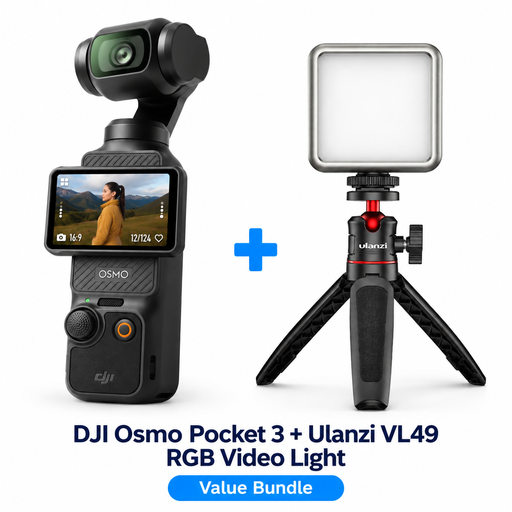
This selection includes a camera and RGB LED light bundle described in the product information as suitable for product photography. Check separately whether the camera can take the close-ups you need of your ornaments.
 No image available
DJI Osmo Pocket 3 + Ulanzi VL49 RGB LED light bundle
According to the product information, this bundle pairs the camera with an RGB LED light for product photography. Check whether the camera meets your needs for close-ups of carved ornaments.
Joybuy
Frequently asked questions
Do I always need a macro lens to photograph an entire ornament?
No, it depends on the ornament and the lens you already have. First check whether the whole ornament fits in the frame; for very fine carving details, the magnification of the specific lens or its close-up mode matters.
What can I do if not every part of the relief is in focus at the same time?
First decide which depth needs to be sharp and try adjusting your camera’s aperture. If the ornament is stationary, a series of shots taken at different focus planes may help; Canon Europe describes this approach as focus stacking. Check that the exact model supports the feature you need.
Why do my photos have a colour cast or horizontal bands under artificial light?
Adjusting the white balance can help correct a colour cast caused by the light source. If you see bands, Sony Support recommends adjusting the shutter speed; the result depends on the light, camera and shooting settings. Also test any flicker settings on the exact camera model.
What should I check if my camera needs servicing or develops a fault?
Keep your proof of purchase and model details, and follow the care instructions for your camera and lens. In the Netherlands, consumer goods that are faulty are covered by a legal guarantee; according to the Dutch government, the seller is your point of contact for a solution.
Do online camera purchases in the Netherlands always come with a 14-day cooling-off period and a two-year legal guarantee?
No, these time limits are not a general rule for every purchase. According to the Dutch government, many distance purchases from a business come with a 14-day cooling-off period, subject to exceptions; buying from a private seller is different. The Netherlands does not have a fixed two-year legal guarantee period, according to the Dutch government: you are entitled to a product that meets what you can reasonably expect.


