
Storing raw vegetables in an existing fridge
You mainly need a suitable place for cut carrots after class and want to check that your current fridge is cold enough.


Use your existing fridge first if there’s room and you can check that the temperature is 4 °C; you don’t necessarily need an extra appliance just for carrot sticks. If you also need more chilled storage for other groceries, compare a compact model without a freezer compartment with one that has a freezer compartment, looking at fridge capacity, external dimensions, annual energy consumption and noise. Keep cut carrots in a sealed container in the fridge; the Netherlands Nutrition Centre recommends keeping opened, pre-cut vegetables for up to two days.
You mainly need a suitable place for cut carrots after class and want to check that your current fridge is cold enough.
You need more chilled storage, but have to fit in an under-counter model and decide whether a freezer compartment is worth sacrificing fridge space for.
Your fridge will be close to somewhere you spend time or sleep, so its stated noise level and energy consumption are important factors in your choice.
| Key consideration | What to check before buying | Who should consider this? |
|---|---|---|
| Storage temperature | Set the fridge to 4 °C and check the temperature with a thermometer on the bottom shelf. | If I want to store cut carrots safely, I need to know how cold it actually is where I keep the container. Around 31% of consumers prioritise a storage temperature they can check. |
| Fit and fridge capacity | Measure the available space and check the external dimensions, door clearance and fridge capacity separately. | With limited kitchen space, I need to know whether the appliance will fit and still leave enough room for my container and other groceries. Around 25% of consumers prioritise fit and usable fridge space. |
| Annual energy consumption | Compare the kWh per year figures for the exact models; don’t use the energy label rating as a substitute for that figure. | If my fridge is on all the time, I want to take its stated energy consumption into account before choosing an extra appliance. Around 19% of consumers give annual energy consumption top priority. |
| Evening noise levels | Compare the stated dB(A) figures and check the installation instructions for the exact models. | If the fridge is close to my living or sleeping area, I want to be able to take its stated noise level into account. Noise is the main consideration for around 13% of consumers. |
| With or without a freezer compartment | Check the fridge and freezer capacities separately; choose a freezer compartment only if you’ll use it. | If I want to freeze products as well as keep fresh carrots chilled, a freezer compartment can be useful, as long as enough fridge space remains. Around 12% of consumers prioritise having this extra freezer space. |
According to Inventum, the Inventum KV550 has a total capacity of 113 litres, made up of 97 litres of fridge space and 16 litres of freezer space. Inventum’s 2026 brochure gives this model an annual energy consumption of 114 kWh, compared with 72 kWh per year for the KK550 without a freezer compartment.
Compare the fridge and freezer capacities separately, and choose freezer space only if you’ll use it for other products.
A freezer compartment leaves less room for chilled groceries; the stated annual energy consumption also differs between these two models.
The Netherlands Nutrition Centre says that the temperature can vary from one part of the fridge to another.
Place a fridge thermometer in the recommended spot on the bottom shelf, leave it there for half a day or overnight, then adjust the fridge if necessary.
An extra fridge uses electricity for as long as it’s switched on. Milieu Centraal advises checking whether one suitable appliance will be enough.
First check whether your existing fridge has room and can be set to 4 °C.
An extra appliance also uses electricity for as long as it’s switched on.
The KK550 without a freezer compartment and the KV550 with one show two different layouts for compact fridges.
The KKV956WIT model reviewed is an under-counter fridge without a freezer compartment, worth comparing if fridge space is your priority.
The TSE1285N is a freestanding under-counter model to compare if a width of 54 cm is important to you.
The products below range from mini fridges for small quantities to under-counter models with fridge space and models with a freezer compartment. Check that your sealed container will fit and that the temperature of the appliance you choose is suitable for how you plan to use it.
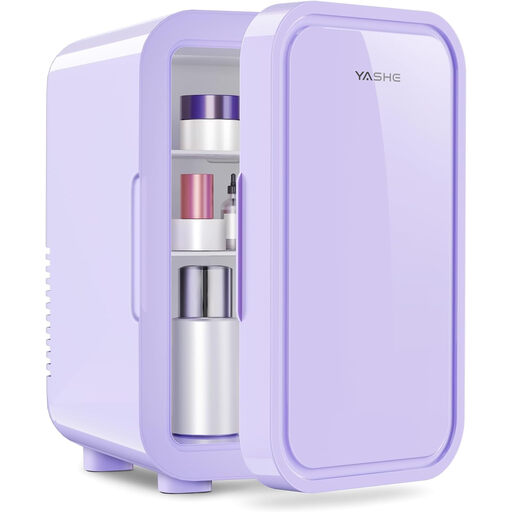 No image available
This compact model is designed for small quantities; check that your sealed container will fit and measure the temperature before storing cut vegetables in it.
The title states that it holds 8 cans and operates on 220–240 V AC/DC. The product description lists cooling and heating modes, with a stated cooling range of 1–2 °C.
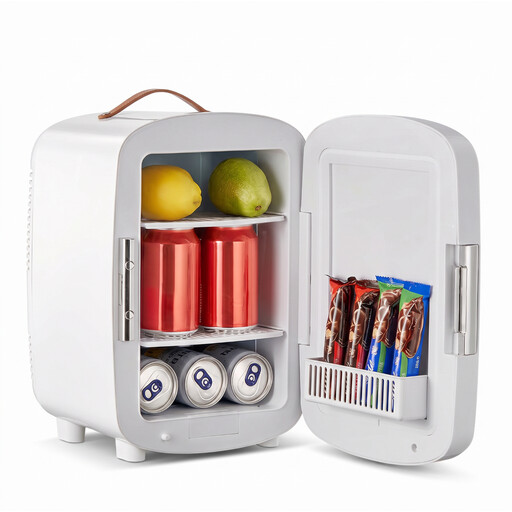 No image available
The description mentions chilled drinks and snacks; check that your container of carrot sticks will fit and that the temperature suits your storage needs.
The description gives a capacity of 10 litres, room for up to 12 cans, a removable shelf and a door compartment. The title states 38 dB and AC/DC.
 No image available
This model without a freezer compartment is worth considering if you’re looking for extra fridge space; measure the available space and check the temperature when it’s in use.
The product information lists 88 litres of fridge capacity, a vegetable drawer and adjustable glass shelves. This model is listed as requiring manual defrosting.
 No image available
This model could suit you if you need freezer space as well as room for chilled groceries; bear in mind that part of its total capacity is taken up by the freezer compartment.
The product information lists 95 litres of fridge space and 14 litres of freezer space, a vegetable drawer and adjustable shelves. The product title gives a total capacity of 109 litres and energy label C.
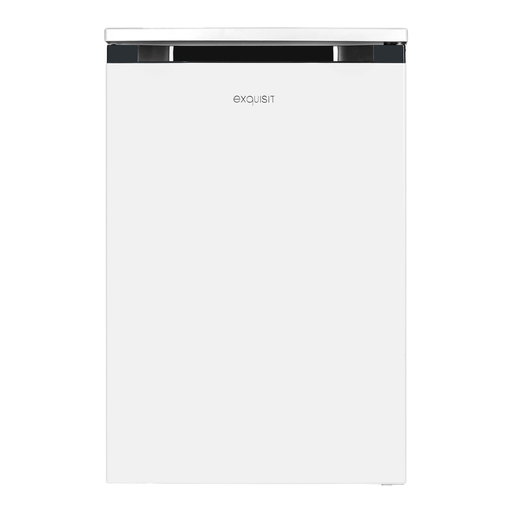 No image available
This under-counter model is an option if you need both fridge space for fresh groceries and a freezer compartment; compare the available fridge capacity with the space you need.
The product information lists 107 litres of fridge space, 13 litres of freezer space, 87 kWh per year and 37 dB. The product title states energy label C.
Keep them in a well-sealed container in the fridge. The Netherlands Nutrition Centre also recommends keeping vegetables you’ve cut yourself chilled, and says opened, pre-cut vegetables can be kept in the fridge for two days. For packaged products, follow the relevant use-by date.
Set the fridge to 4 °C and check the temperature with a fridge thermometer. The Netherlands Nutrition Centre recommends placing the thermometer in the middle of the bottom shelf and leaving it there for half a day or overnight; adjust the setting if the temperature reading is higher.
Check the external dimensions and installation instructions, the separate fridge and any freezer capacities, and the stated energy consumption in kWh per year. Compare only models that suit the available space and the amount of fridge capacity you need.
The relevant EU ecodesign and energy-labelling rules apply to new mains-powered domestic fridges with a volume of more than 10 litres and up to 1,500 litres that are sold on the Dutch market. Under EU rules, the energy label must also be available when products are sold online. Consumers are not required to choose a particular energy rating; check the label for the exact model.
If a product is faulty, the retailer must deal with the problem; according to the Dutch government, your right to a free repair or replacement depends on the circumstances. When you buy a new, similar appliance, the shop must take back the old one free of charge, including for online purchases, using the return method described by the Dutch government.