
Colleague on a short break
Wants to juice carrots quickly and is looking for an appliance they can use and clean up within their break.


The Dutch Consumers' Association says a centrifugal juicer is suitable for hard vegetables and is generally faster. Choose one for juicing carrots during a short break when speed is your priority. A slow juicer is a good fit if you also want to juice other ingredients and are happy to allow more time. If the appliance will be shared, compare how easy the exact model is to clean, its capacity and its noise level: a slow juicer is not automatically quieter.
Wants to juice carrots quickly and is looking for an appliance they can use and clean up within their break.
Wants to make sure the filter, pulp container and worktop are left clean after different colleagues have used the appliance.
Wants to make several servings in a row and is prepared to factor in topping up, emptying the pulp container and cleaning.
A good fit when: you mainly want to juice hard carrots during a short break and speed matters.
Bear in mind: the Dutch Consumers' Association says centrifugal juicers are generally faster, but also more likely to be noisy; some of the pulp and fibre is left behind.
A good fit when: you want to juice other vegetables or fruit as well as carrots, and are happy for the process to take longer.
Bear in mind: the Dutch Consumers' Association describes slow juicers as generally slower; also check how many parts need cleaning after use.
| What to consider | What should you check? | Who should consider this? |
|---|---|---|
| Juicing carrots quickly | Check whether the instruction manual says the appliance can handle carrots, what size pieces are needed and how the feed chute works. | If you want to juice carrots during a short break, you’ll want to keep preparation and juicing time to a minimum; around 29% of consumers put speed first when juicing hard carrots. |
| Cleaning between users | Check how the filter and pulp container come apart, and which parts the instruction manual says are dishwasher-safe. | If you share an appliance with colleagues, you’ll want to be able to remove juice and pulp residue thoroughly after use; around 29% of consumers make ease of cleaning their top priority. |
| Noise in a shared space | If noise is a deciding factor, ask for a measurement for the exact model; don’t compare a general description of a type of juicer with a measurement for a specific model. | If you want to be considerate of colleagues while juicing, think about how much disruption it might cause; around 24% of consumers put noise disturbance first. |
| Making several servings | Check the feed chute, juice and pulp capacities separately, and look for guidance on continuous use. | If you want to make juice for several colleagues in a row, you’ll want fewer breaks to top up the ingredients or empty the pulp container; around 18% of consumers prioritise capacity for groups. |
The Dutch Consumers' Association describes differences between centrifugal and slow juicers, but that doesn’t mean a slow juicer will automatically be quiet. Nor does the association claim that slow juicers offer a general nutritional advantage over centrifugal juicers.
Base your choice on how you’ll use and clean the appliance. If noise is a deciding factor, ask for information about the exact model.
The 3,000 cc hopper that Kuvings specifies for the AUTO10S is for ingredients, not the amount of juice produced. Braun describes the SJ5000BK as having a separate pulp container and says it can make up to 2 litres of juice without needing to be emptied in between.
Compare feed chute, pulp and juice capacities separately, and check exactly what a capacity claim refers to.
A Bear product listing on Joybuy gives model YZJ-F01D6 in the title, while YZJ-D02F5 appears as the model number elsewhere on the page.
Before buying, ask for confirmation of the model number on the rating plate and packaging. Don’t rely on the product title alone for model specifications.
Philips offers centrifugal juicers for anyone who wants to juice hard vegetables quickly. The Dutch product page for the HR1922/21 describes adjustable juice texture.
The MultiJuice 5 SJ5000BK is a centrifugal juicer. Braun lists features relating to its feed chute and pulp handling.
Kuvings offers slow juicers, including the AUTO10S, for anyone who wants to add ingredients to a hopper and is happy to allow more time for juicing.
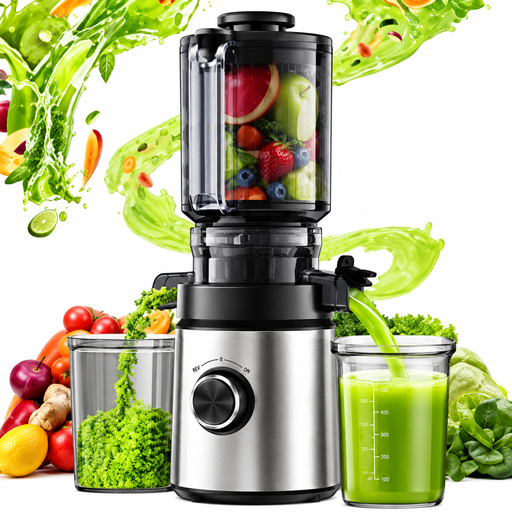
This product pick features a slow juicer with a wide feed chute, for anyone who wants to juice carrots and other vegetables or fruit. Factor in the longer processing time of a slow juicer, and check the instruction manual for the permitted size of the pieces.
 No image available
A good option if a wide feed chute is important to you and you’re happy to allow more time for a slow juicer.
The product name specifies a 130 mm XL feed chute. Check the instruction manual for the permitted size of carrot pieces.
No. A citrus juicer is designed for citrus fruit; you’ll need an appliance that can handle hard vegetables to juice carrots. The Dutch Consumers' Association lists centrifugal juicers as suitable for hard vegetables. Check the instruction manual for each model to make sure it can handle carrots and find out what size pieces are needed.
Clean any parts that have come into contact with juice or pulp according to the instruction manual, and wipe down the worktop too. Wash your hands and the carrots; the Netherlands Nutrition Centre advises washing fruit and vegetables under running water. For the AUTO10S, Kuvings describes separate cleaning steps for the filter, auger and pulp outlet, among other parts.
No. The Netherlands Nutrition Centre doesn’t count vegetable juice towards your daily vegetable intake. When you juice vegetables, some of the fibre is left behind in the pulp; a blender processes the whole vegetable, making a different kind of drink.
The Netherlands Authority for Consumers and Markets (ACM) describes statutory guarantees for sales to consumers. If the purchase is made in the company’s name, don’t assume the same consumer protections apply; ask the seller which contractual and manufacturer’s guarantees cover the purchase and intended use.
That depends on what the organisation does. The Netherlands Food and Consumer Product Safety Authority (NVWA) describes food safety plans or hygiene codes for certain businesses that prepare, process or sell food in the hospitality, craft and retail sectors. This doesn’t mean that colleagues making juice solely for their own use automatically need such a plan. If the office serves or sells juice to others, assess the activity using the NVWA guidelines.