If you want to make several glasses of carrot juice quickly for your guests, start by looking for a centrifugal juicer with a suitable feed chute, juice jug and strainer that are easy to clean. A slow juicer may be a better fit if the way ingredients are fed in or the texture of the juice matters more to you. According to the Consumentenbond, it won’t automatically produce more juice.
Who is this relevant for?
Host who wants to make several glasses quickly
You want to juice the carrots shortly before your guests arrive without having to keep emptying the jug. So look at the feed chute, jug capacity and how easy it is to empty the pulp. Bosch NL lists a 1,500 ml juice container for the MES4000.
Cook who wants less washing up
After serving, you don’t want to spend ages cleaning a strainer and separate parts. Check how the parts of the exact model should be cleaned; Bosch says the MES4010 has dishwasher-safe parts.
Juice-maker with a preference for a particular texture
You have a clear preference for juice that’s either smoother or has a different texture. Compare the settings and descriptions for the specific model, without assuming that one type of juicer is always more nutritious.
What should you look for in a juicer for guests?
First, think about how many glasses you want to make in one go, and how much preparation and cleaning you’re happy to do. The right choice also depends on the juice texture you and your guests prefer.
| What to consider |
What should you look for? |
Who is this important for? |
| Making several glasses |
Compare the juice jug’s capacity with the number of portions you want. The jug capacity isn’t the same as the amount of juice you’ll get from the carrots. |
If I want to pour several glasses for guests one after another, I look at the jug capacity and how often I’ll need to empty it. Around 36% of consumers prioritise preparing juice for a group. |
| Cleaning after serving |
Check which parts can be removed and what cleaning instructions apply to each one. |
After juicing, I want to be able to clean the strainer and separate parts quickly. Around 29% of consumers put ease of cleaning first. |
| Juice texture |
Check how the model describes the texture and whether it has settings to adjust it. A lot of the fibre can remain in the pulp. |
If I want a particular texture for my guests, that matters more to me than capacity or washing up. Around 21% of consumers choose texture as their top priority. |
| Juicing other ingredients too |
Check whether the model is designed for the ingredients you want to use later, and how the manual says to feed them in. |
I want to use the juicer for other ingredients after my guests have left, so I factor that into my choice. Around 14% of consumers prioritise future use. |
Common pitfalls
-
Assuming ‘slow’ means more juice or vitamins
The Consumentenbond points out that juice yield depends on the appliance. A slow juicer won’t automatically produce more juice.
Compare models for the way you plan to use them, rather than basing your choice solely on general claims about juice yield or nutrients.
-
Confusing hopper capacity with the amount of juice
The 2 l hopper listed by Hurom for the H320N and the 1,500 ml juice container specified by Bosch for the MES4000 are different parts. They don’t tell you the same thing about how much juice you can pour.
Compare the feed chute, juice container and pulp container separately before estimating how many portions you can make in one go.
Getting this wrong could mean extra juicing or pouring during your visit.
-
Assuming a commercial warranty covers all your statutory rights
ACM ConsuWijzer distinguishes between a manufacturer’s or seller’s warranty and the statutory guarantee that the seller is responsible for.
Check exactly what any additional warranty covers and compare it with your statutory rights before paying for it.
Without making that comparison, you could pay for extra cover that doesn’t suit your needs.
Brands to consider
Bosch
The VitaJuice MES4000 and MES4010 models each have specifications worth considering if you’re making several glasses or factoring in cleaning.
- Bosch lists a 1,500 ml juice container and an extra-large filling tube for the MES4000. According to Bosch, the MES4010 has three speed settings and dishwasher-safe parts.
- These specifications aren’t an independent measurement of carrot juice yield. Also check which parts the manual says are dishwasher-safe.
Philips
The FiberBoost feature is part of the Philips HR1922/21 and is worth considering if you want to compare different juice textures.
- Philips says the HR1922/21 lets you choose between smoother and thicker juice.
- The product description isn’t proof that juice has the same nutritional value as a whole carrot.
Hurom
The H320N is a slow juicer to consider if you want to factor in how ingredients are fed in and the juice texture described by the manufacturer.
- Hurom lists a 2 l hopper for the H320N and describes it as a model for juice with little pulp.
- The hopper capacity isn’t the same as a guaranteed quantity of finished juice.
Kuvings
The REVO830 is a slow juicer to consider if you want to compare the feed openings for other ingredients too.
- Kuvings lists two feed chutes and an automatic cutting function for long vegetables.
- The advertised higher juice yield is a brand claim, not the result of an independent comparison.
Joybuy products for carrot juice
This selection of Joybuy products includes both centrifugal juicers and slow juicers for making carrot juice for guests. Compare the feed chute, container capacity, cleaning requirements and any usage restrictions in particular.
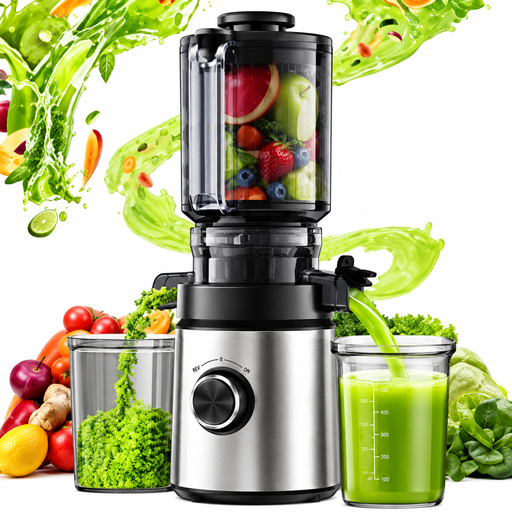 Image unavailable
Slow juicer with 130 mm XL feed chute
The 130 mm feed chute can reduce the need to pre-cut ingredients that fit through it.
The product name states that two glasses are included.
View at Joybuy
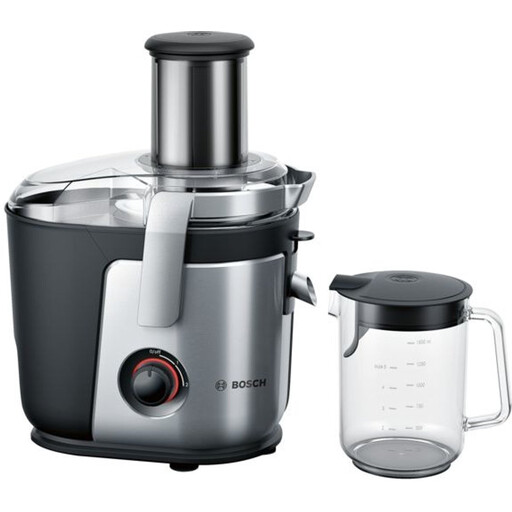 Image unavailable
Bosch MES4000 centrifugal juicer, 1.5 l
For hard carrots and making several glasses, the stated juice jug capacity may be worth considering. The final yield depends on the appliance and the ingredients.
The product information lists 1,000 W, a ceramic blade and a 1.5 l juice jug.
The description mentions an 84 mm feed chute, a 3 l pulp container and dishwasher-safe, removable parts.
View at Joybuy
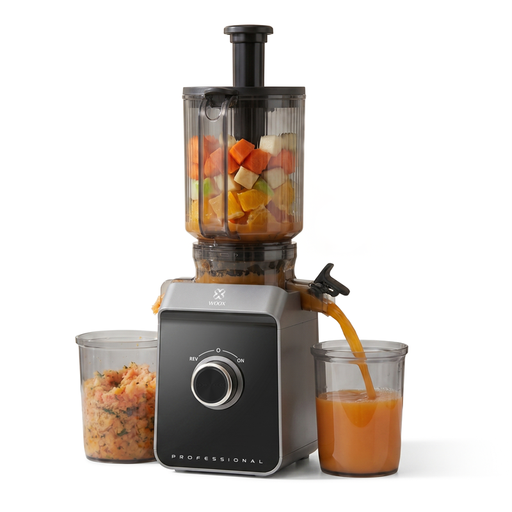 Image unavailable
WOOX MX0289 slow juicer, 150 W
The 130 mm feed chute can reduce the need to pre-cut ingredients that fit through it.
The product name lists a 150 W motor, a 600 ml juice cup and an 836 ml pulp container.
According to the usage information, the juicer can be used continuously for up to 10 minutes, followed by 20 minutes of rest. This could interrupt preparation if you’re making several glasses.
View at Joybuy
Frequently asked questions
Should I wash carrots before making juice for friends?
Yes. The Voedingscentrum advises washing raw fruit and vegetables thoroughly under running water and keeping kitchen utensils clean, even if you’re going to juice the carrots afterwards.
Is a slow juicer automatically more nutritious, or will it always produce more carrot juice?
No. According to the Consumentenbond, a slow juicer doesn’t automatically produce more juice; comparisons depend on the appliance. Treat manufacturers’ nutrition statements as claims and compare specific models.
What can I do if my juicer breaks sooner than might reasonably be expected?
According to ACM ConsuWijzer, you’re entitled to a statutory guarantee if, under normal use, the product doesn’t do what you could reasonably expect. The seller is responsible for this; any manufacturer’s warranty doesn’t replace that right.
Which Dutch safety rules are relevant to an electric juicer?
The NVWA outlines rules for electrical equipment within the relevant scope, including the stated limits of 50 to 1,000 V AC; CE marking is required for such equipment. For a specific appliance, check which rules apply to that model and whether the required marking is present.


