Which juicer is right for you?

Family short on time at breakfast

You want to make several portions of carrot juice without lots of chopping, so processing speed, the feeding chute and the collection jug matter. The Consumers’ Association describes centrifugal juicers as suitable for hard fruit and vegetables.

Daily juicer who wants quick clean-up

You consider cleaning after every breakfast a deciding factor, so compare the filter, removable parts and cleaning instructions for the exact model. Bosch, for example, lists dishwasher-safe parts for the MES4010.

Family that likes to vary ingredients and texture

You sometimes want to juice leafy greens or try a different juice texture, and are happy to follow a different preparation routine. If you want to keep the pulp in your drink, you could also make a smoothie. The Netherlands Nutrition Centre recommends eating vegetables and fruit rather than drinking them.

What should you look for when buying?

Centrifugal juicer

A good fit if: you mainly want to process hard carrots quickly in the morning.

The trade-off: according to the Consumers’ Association, this type is generally faster, but often noisier and less suited to leafy greens.

Slow juicer

A good fit if: you regularly want to juice other ingredients, such as leafy greens, as well as carrots.

The trade-off: the Consumers’ Association describes this type as generally slower, with more chopping and cleaning involved.

Blender for smoothies

A good fit if: you want to keep the pulp in your drink and would prefer a smoothie to strained carrot juice.

The trade-off: a smoothie is not the same as clear juice. The Netherlands Nutrition Centre says that smoothies do not replace eating vegetables and fruit either.

What to consider What to look for when buying Who is this important for?
Making several portions quickly Check that the juicer is suitable for hard carrots, and look at the feeding chute and jug capacity. The Bosch MES4010’s 1.5-litre jug does not guarantee a particular amount of juice. If I want to make several glasses for the family before the morning routine continues, speed matters a lot. Around 33% of consumers put quick family-sized portions first.
Cleaning after use Check which parts are removable and dishwasher-safe, and follow the instructions for the exact model. For daily use, I want to know how much work the filter and juicing parts take after every breakfast. Around 27% of consumers put daily cleaning first.
Variety of ingredients and textures Decide whether you want strained juice or a smoothie, then check which ingredients and texture settings the model supports. Philips describes FiberBoost on the HR1922/21 as offering a choice between clearer and thicker juice. If my family wants different ingredients or juice textures, that choice matters more than simply juicing carrots quickly. Around 20% of consumers put variety first.
Purchase price and use Compare the price of the exact version with the features you will actually use. The Consumers’ Association says slow juicers are often more expensive. I don’t want to pay for extra features that don’t suit what we regularly juice at home. Around 20% of consumers put the purchase price first.

Common buying mistakes

  • Assuming a slow juicer is automatically healthier or makes better use of carrots

    According to the Consumers’ Association, a slow juicer does not automatically produce more juice or nutrients than a centrifugal juicer.

    Choose based on how you will use it, the ingredients and the features of the exact model—not just the juicing method or nutrition claims.

    A slow juicer generally takes more preparation and cleaning; the Consumers’ Association also says this type is often more expensive.

  • Confusing the capacity of a feeding hopper with juice yield

    According to Hurom, the Hurom H320N has a 2-litre feeding hopper. This figure refers to the space for ingredients, not the amount of juice made in one go.

    Compare the juice jug capacity separately with the number of glasses you want to pour.

  • Assuming a similar model number means it’s the same product

    The Bosch MES4000 and MES4010 have different model numbers, as do the Philips HR1919/70 and HR1922/21. A similar brand or model range does not mean the features and specification are the same.

    Before buying, check the full model number and version on the product details page, then compare them with the manufacturer’s information.

Brands to compare

Bosch

The MES4010 is a centrifugal juicer for those who consider family-sized portions and easy-to-clean parts.

  • Bosch lists a 1.5-litre collection jug, three speeds and dishwasher-safe parts for this model.
  • The jug capacity does not indicate how much carrot juice a given quantity of carrots will produce. These are model specifications, not the results of a comparative performance test.

Philips

The HR1922/21 is a centrifugal juicer that lets you choose the texture of your juice.

  • According to Philips, FiberBoost lets you choose between clearer and thicker juice.
  • Philips claims up to 50% more fibre in the thicker setting. This is a brand claim and does not prove that juice contains as much fibre as whole carrots.

Braun

The J 500 BK is a centrifugal juicer for those who look at the feeding chute, foam separator and drip-stop feature.

  • Braun lists a 900-watt motor, a large feeding chute and an anti-drip feature for the J 500 BK.
  • Braun’s claim that it juices in 15 seconds is not an independent measurement of a full batch of carrot juice for a family.

Hurom

The H320N is a slow juicer for those who want to load ingredients into a spacious hopper in advance and are happy with a longer preparation time.

  • Hurom lists a 2-litre feeding hopper.
  • The hopper capacity is not the amount of juice produced. Brand claims about nutrients do not prove a general advantage over a centrifugal juicer.

Kuvings

The AUTO10S is a slow juicer where pre-filling and warranty terms may be worth considering.

  • Kuvings lists a 15-year motor warranty and a 2-year warranty on other parts.
  • Check the manufacturer’s warranty terms for the exact version.

Joybuy products for carrot juice

The Joybuy products below are slow juicers for those who want to juice other vegetables and fruit as well as carrots. Bear in mind that they generally involve more preparation and cleaning than a centrifugal juicer.
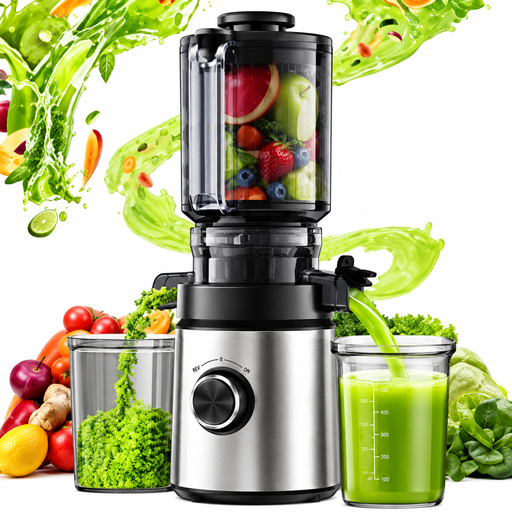
Slow juicer with 130 mm XL feeding chute and two glasses

Slow juicer with 130 mm XL feeding chute, 2 glasses

Suitable for those who want to juice carrots and other vegetables or fruit, and use the two included glasses.

The title lists a 130 mm XL feeding chute and 2 glasses.

Joybuy

WOOX MX0289 slow juicer

WOOX MX0289 slow juicer, 150 W

Suitable for those who want to juice carrots and other vegetables and collect the juice separately.

The product information lists a 150 W motor, a 600 ml juice jug and an 836 ml pulp container.

According to the product information, it is designed for up to 10 minutes of continuous use, followed by 20 minutes of rest.

Joybuy

Frequently asked questions

Does carrot juice replace vegetables at breakfast?

No. The Netherlands Nutrition Centre recommends eating vegetables and fruit rather than drinking them. Juicing also leaves behind much of the fibre-rich pulp. For children aged 4 to 12, the Netherlands Nutrition Centre advises offering juice and other sugary drinks no more than once a week. This advice is specific to that age group.

How should I prepare carrots hygienically?

Wash raw carrots under running water and use clean kitchen utensils. The Netherlands Nutrition Centre recommends washing vegetables and fruit under running water. Also follow the instructions for the exact juicer model when assembling, using and cleaning it.

If something breaks, do I have to contact the manufacturer only?

No. According to the Dutch government, if a product is faulty in the Netherlands, the retailer is your point of contact for your legal guarantee. There is no set statutory time limit; a manufacturer’s warranty is in addition to this.

Does a CE marking mean the government has approved this juicer?

No. According to the European Commission, by applying the CE marking, the manufacturer declares that a product meets the relevant EU requirements. The requirements that apply to a specific version must be assessed separately.
