
Vandaag of morgen in huis

Kwaliteit gegarandeerd

Welkomstaanbiedingen ontgrendelen: GRATIS bezorging | Tot 80% korting | Gratis 30 dagen JoyPlus-proefperiode
Download de app
A flat battery often strikes at the worst possible time: before you leave for work, during a holiday or after a cold night. With a car jump starter, you can sometimes start a 12V vehicle yourself, without another car or traditional jump leads. But not every portable jump starter is right for every car.
Many buyers focus on the highest amp figure on the packaging. That’s one of the biggest pitfalls. A large battery capacity, a long list of features or an attractive discount doesn’t automatically mean a car battery booster is suitable for your vehicle.
A product might list 2,000A or 4,000A, but you should also check the stated engine capacity for petrol and diesel. Diesel and larger engines usually have different requirements from a small petrol engine. Also check whether the device is designed exclusively for 12V systems. A 12V jump starter is not suitable for vehicles with a 24V system.
Capacity, measured in mAh, tells you how much energy the internal battery can store, but it doesn’t tell you on its own how powerful the starting function is. A jump starter with a power bank might charge a phone several times, yet still not deliver enough starting current for a large diesel engine. So compare starting current and peak current separately.
Pay attention to the testing method, too. Brands may measure their stated figures under different conditions. Treat any claim as a manufacturer’s product specification, and always check the manual and vehicle compatibility.
A car jump starter should offer protection against issues such as reverse polarity, short circuits, overheating and overloading. Check which features are actually listed. A CE mark indicates conformity; it isn’t an independent quality rating.
A lithium jump starter will also gradually lose charge if left unused in your car. A flat device won’t help if you break down. Check the charge level regularly and follow the manufacturer’s maintenance instructions.
A lower-capacity model may be enough for a compact car or motorbike. Drivers of an SUV, motorhome, van, boat or diesel car often benefit from having more headroom. Check the following:
A model listed as suitable for petrol engines up to 6L isn’t automatically suitable for a 6L diesel engine.
The clamps should fit securely on the battery terminals, and the cables should be long enough to let you position the jump starter safely beside the engine bay. Useful safety features include short-circuit protection, overload protection, overheat protection, spark protection and reverse-polarity protection.
Always follow the instructions for your chosen model. In many cases, you connect the red clamp to the positive terminal and the black clamp to a suitable earth point. Don’t make repeated, prolonged starting attempts, and remove the clamps as soon as the engine starts.
A compact car jump starter is easier to store, while a larger model may offer more connections and a higher-capacity battery. Look out for:
A portable battery charger with a USB function is handy, but the power bank feature shouldn’t be the main reason you choose a model if its starting capacity isn’t suitable for your vehicle.
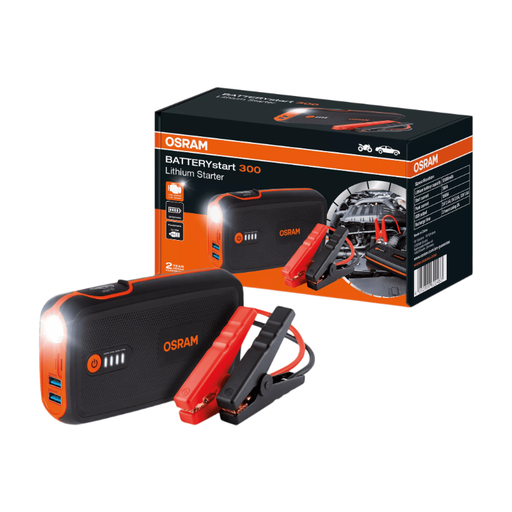
Why it suits this profile: According to the product information, this compact model delivers 1.500A peak current and is designed for petrol engines up to 6L and diesel engines up to 3L. That makes it suitable for many everyday cars and motorbikes.
The stated engine limits make it easier to compare than relying on a peak-current figure alone. Just check that your diesel engine is within the stated 3L limit.
13.000mAh lithium-ion battery, two USB ports, built-in LED light and a stated weight of 706 grams.
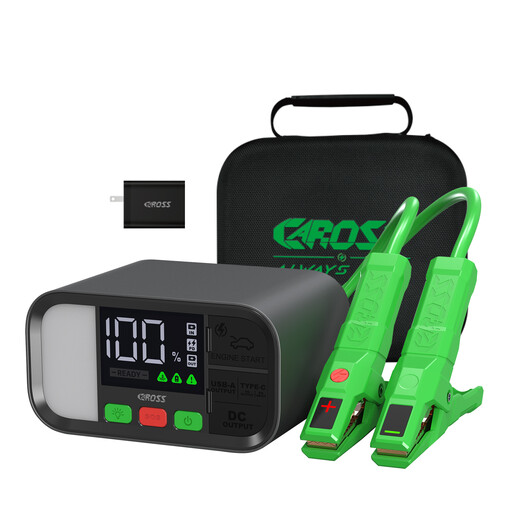
Why it suits this profile: According to the product description, this model is aimed at users who value straightforward operation and extra charging options. It’s suitable for 12V vehicles, with stated limits of around 6L for petrol and 4L for diesel engines.
According to the manufacturer, the 3-inch screen displays the product status, while the Smart Connect clamps are designed to help prevent incorrect connections. Read the manual before use.
16.000mAh lithium-ion battery, 65W PD output for compatible devices and a sturdy carry case.
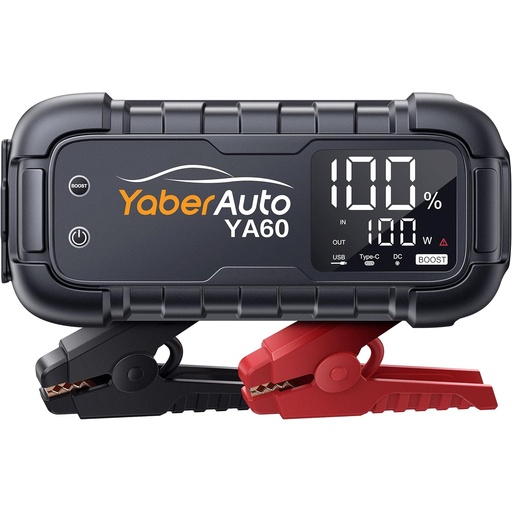
Why it suits this profile: According to the product information, this model is designed for larger 12V vehicles and users who want to charge laptops, phones or 12V equipment as well as start their vehicle.
The product description lists separate limits for petrol and diesel engines, as well as ten safety features. Before buying, check that your vehicle falls within these specifications.
26.800mAh lithium-polymer battery, 65W two-way charging, 150W DC output and 600-lumen LED lighting, according to the product specifications.
We’ve put together a comprehensive, up-to-date list of products that meet these strict selection criteria and the applicable European safety requirements.
Don’t use a car jump starter with a damaged, leaking or swollen battery. If you’re unsure about the connections or battery type, it’s safer to call for roadside assistance.
No. Always check 12V compatibility, the battery type and the stated engine capacity for petrol and diesel. A model for cars isn’t automatically suitable for a heavy diesel van, motorhome or boat.
It depends on the model and its storage recommendations. Check the charge level every few months and recharge the device after use. Follow the manual if the manufacturer specifies a particular maintenance interval.
The electricity used to charge it usually costs very little. The main costs are the purchase price, any replacement of the internal battery and the lifespan of the device. A model with a power bank, LED light and several connections may also replace extra features that you’d otherwise buy separately.
