
Vandaag of morgen in huis

Kwaliteit gegarandeerd

Welkomstaanbiedingen ontgrendelen: GRATIS bezorging | Tot 80% korting | Gratis 30 dagen JoyPlus-proefperiode
Download de app
A flat battery often strikes at the worst possible time: on a cold morning, at the campsite or when you’re ready to head home after a long day at work. With a car jump starter, you can try to start a 12V vehicle yourself, without relying on another car or traditional jump leads.
However, not every portable jump starter is suitable for every car. High amp ratings on the packaging don’t tell the whole story. As Joybuy Product Recommendation Officer, I focus on specifications you can check, such as engine compatibility, safety features, charging options and size.
A figure such as 2000A or 4000A sounds impressive, but peak current isn’t the same as the normal starting current. Check which engine sizes the car jump starter is designed for, according to the product description. A petrol engine generally needs different support from a diesel engine.
Also check the difference between a 12V jump starter and a device for 24V systems. A 12V jump starter isn’t automatically suitable for heavy lorries or buses.
A product with 20.000mAh doesn’t necessarily provide twenty thousand usable milliamp hours at every output. Manufacturers may state capacity at a different internal voltage. So, as well as mAh, check the Wh, rated capacity and charging outputs.
A larger battery often provides more reserve for jump starting and charging phones, but it can also make the device heavier. For use in a passenger car, a compact portable battery starter is often more practical than a large model designed mainly for heavy vehicles.
Smart cables should offer clear protection against reverse polarity, short circuits, overcurrent and overheating, among other hazards. Check which safety features are actually listed in the product information.
A safety system doesn’t mean you can ignore the instructions. Connect red to the positive terminal and black to the negative terminal or a suitable unpainted metal earth point, as specified by the manufacturer. Don’t try to start the engine repeatedly for long periods, and recharge the jump starter after use.
Start with the type of vehicle and its engine size. A small petrol car, diesel van, SUV and campervan don’t all have the same requirements. Product information often gives a maximum engine size, such as 6,0 litres for petrol or 4,0 litres for diesel.
The figures shown come from the brand’s specifications or claims. According to GOOLOO’s product description, for example, the GP4000 is designed for petrol and diesel engines up to 10,0 litres. Always check whether your vehicle uses a conventional 12V lead-acid battery, and consult the owner’s manual if you’re unsure.
You need to be able to reach your car jump starter when you need it. Check:
Don’t store a lithium battery starter in direct sunlight or in an extremely hot car for long periods. Some models specify an operating temperature range, but that doesn’t mean you should leave them in a hot boot indefinitely.
A jump starter with a power bank can charge phones, tablets, cameras or sat navs. Check the number of USB ports and whether fast charging is supported. A 5V/2,4A output is different from USB-C Power Delivery.
A jump starter with a compressor is useful for a tyre that’s slowly losing air. Check the maximum pressure, airflow, included nozzles and automatic shut-off. A compressor is designed to top up tyres, not permanently repair a damaged or punctured tyre.
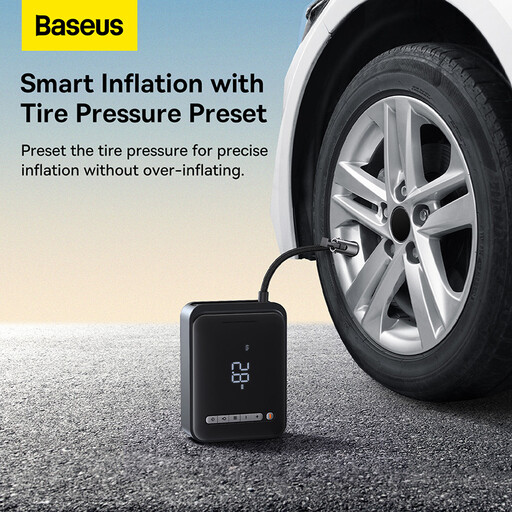
Why it suits this profile: This model combines a car jump starter with a compressor, making it a good choice for drivers who want one device to handle several roadside emergencies.
As well as a 1000A peak current, the specifications list a pressure gauge range of 5–150 psi and a stated inflation time of 7–9 minutes for an R195 tyre.
8000mAh/3,7V battery, two USB outputs and an integrated 54W pump. The specifications give its weight as approximately 1360 grams.
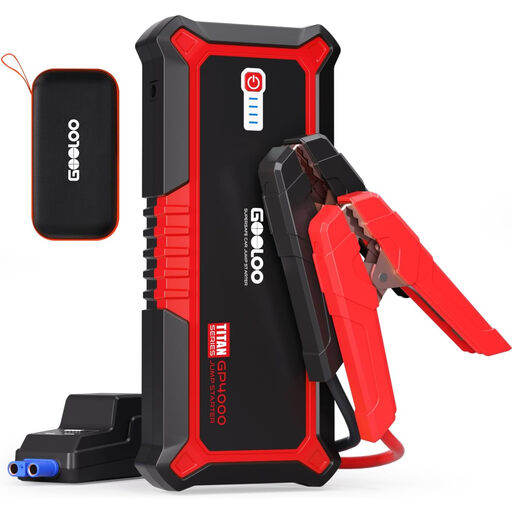
Why it suits this profile: Its high stated starting capacity makes it a good fit for owners of SUVs, campervans, vans and other vehicles with larger petrol or diesel engines.
As well as a 4000A peak current, the product description lists a BOOST function and ten safety features, including short-circuit and reverse-polarity protection.
According to the product specifications, it’s suitable for petrol engines up to 10,0 litres and diesel engines up to 10,0 litres, with USB and USB-C connections.
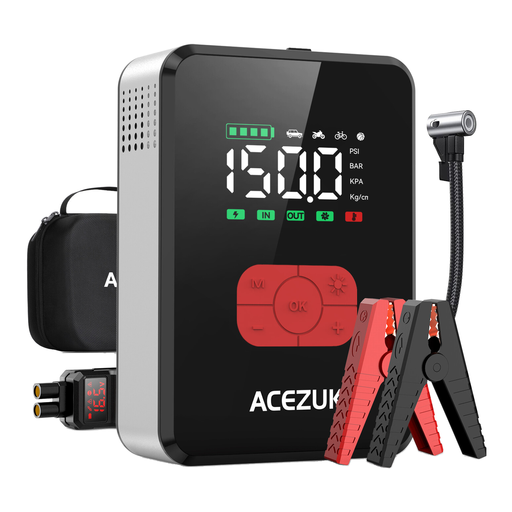
Why it suits this profile: This model is aimed at people who want to inflate tyres, bicycle tyres or sports balls on the go, as well as jump starting a car in an emergency.
According to the product description, the compressor has a digital pressure gauge, automatic shut-off and four adjustable modes. Let the pump cool down between uses.
26800mAh capacity, a stated peak current of 7000A, a maximum pressure of 150 psi and a display on the smart clamp, according to the product information.
We’ve put together a complete, up-to-date list of products that meet these strict selection criteria and the applicable European safety regulations.
A lithium jump starter slowly loses charge even while in storage. It’s therefore practical to check it every two to three months. Always follow the instructions for your specific model.
Only if the manufacturer lists both engine types and your engine size. A jump starter for petrol and diesel must also be suitable for your vehicle’s 12V system. A high peak current alone doesn’t guarantee compatibility.
Its lifespan depends on storage temperature, charging frequency and use. Don’t leave the device charging in direct sunlight for long periods, and store it somewhere dry. Models may specify different numbers of charging cycles or standby times; compare those figures rather than looking only at the mAh rating.
A jump starter costs more to buy than basic jump leads, but it works without a second car. If you travel regularly, go camping or drive a car with an older battery, being able to start it yourself can be useful. Just make sure you choose a model that suits your vehicle; otherwise, you’ll be paying for power you can’t use.
