
Vandaag of morgen in huis

Kwaliteit gegarandeerd

Welkomstaanbiedingen ontgrendelen: GRATIS bezorging | Tot 80% korting | Gratis 30 dagen JoyPlus-proefperiode
Download de app
A flat car battery rarely happens at a convenient time. With a car jump starter, you can sometimes start a 12V vehicle yourself, without waiting for another car or breakdown assistance. Some models also work as a portable power bank, tyre inflator and emergency light.
However, not every car jump starter is suitable for every vehicle. A high amp rating on the packaging doesn’t tell the whole story. Read on to find out which specifications matter, which marketing claims to treat with caution, and which models suit different needs.
A figure such as 3000A or 8000A sounds impressive, but peak current isn’t the same as normal starting current. Performance also depends on the battery’s condition, the cables, the temperature and the type of engine.
So always check:
Lorries and some motorhomes may also use a 24V system. A 12V jump starter isn’t automatically suitable for these vehicles.
A jump starter with an inflator is handy when your tyres are underinflated, but a compact casing can build up heat. Check the maximum pressure, airflow and recommended operating time. A rating of 150 PSI doesn’t mean a car tyre will be inflated at that rate continuously.
Automatic shut-off once the set pressure is reached is useful. Also check whether the right valve adapters are included and whether pressure can be read in bar, PSI or kPa.
A battery starter left unused in a warm car for months may lose capacity. Most lithium products need to be recharged regularly. Depending on the product manual, this could be every two to six months.
Also look for:
Most cars, motorbikes and smaller motorhomes use 12V. Compare the stated engine limit with your vehicle. According to the product description, the EAFC 2000A supports petrol engines up to 6,0 litres and diesel engines up to 4,0 litres. The GOOLOO GP4000 is listed in the product information as suitable for petrol engines up to 10,0 litres and diesel engines up to 10,0 litres.
These are manufacturer specifications and don’t guarantee that every start will work in all conditions. Don’t try to start a damaged, leaking or frozen battery with a jump starter.
Connect the red clamp to the positive terminal (+) and the black clamp to the negative terminal or a suitable unpainted metal earth point, as instructed in the manual. Smart jump leads can alert you to an incorrect connection. This is useful when you’re working in the dark or under time pressure.
Look for clearly stated features such as:
The number of safety features only matters if the manual explains how to interpret the signals.
A car power bank can charge phones, tablets and other USB devices. Check the output power if fast charging is important to you. An LED light with a steady beam, flashing mode and SOS mode can help if you break down on a dark road.
If you often go on long drives, camp or travel in a motorhome, a jump starter with an inflator can be a practical combination. Bear in mind that using the inflator will drain the available battery capacity faster than a short starting attempt alone.

Why it suits this type of user: A compact option for drivers and motorcyclists looking for an emergency car jump starter, without an inflator.
The product information lists both a peak current of 1200A and a starting current of 600A, so you can see more than just a marketing figure.
12800mAh battery, LCD display, 10W USB output and a weight of around 330 gram, according to the product description.
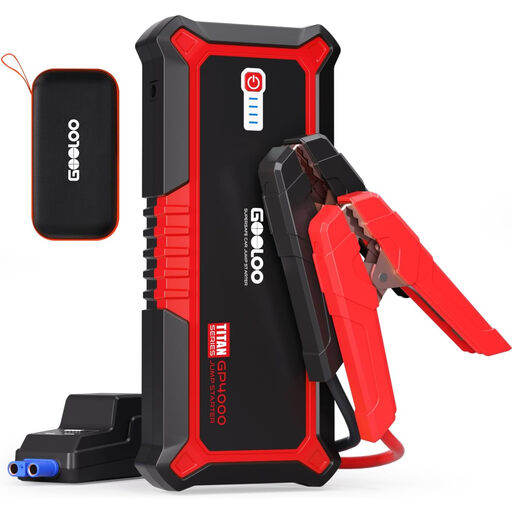
Why it suits this type of user: A good fit for drivers of larger cars, motorhomes, vans and vehicles that need a higher stated engine limit.
The manufacturer lists 12V compatibility, a peak current of 4000A and support for diesel engines up to 10,0 litres. Always check these figures against your vehicle’s specifications.
Two USB ports, USB-C, metal clamps, an LED light and a stated operating temperature range of -20 °C to 60 °C.
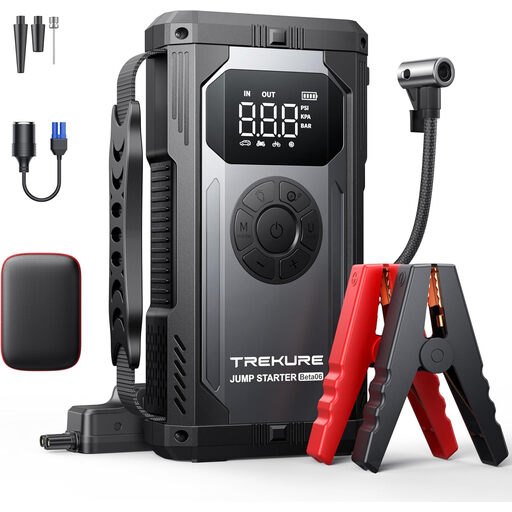
Why it suits this type of user: Designed for motorhome use, road trips, outdoor activities and vehicles where a tyre inflator and jump starter in one can come in handy.
The product information mentions a digital pressure setting and automatic shut-off, and advises against running the inflator continuously for an unlimited period.
According to the manufacturer: 5500A peak current, up to 150 PSI, 23800mAh battery, two USB outputs and a 12V socket.
We’ve put together a complete, up-to-date list of products that meet these strict selection criteria and current European safety regulations.
No. Check the vehicle type, engine size and whether the car uses a 12V battery. A jump starter for petrol and diesel vehicles may support both fuel types, but the maximum engine size varies by model.
Follow the manufacturer’s instructions. Many models recommend charging after use and periodically while in storage, for example every three to six months. Store the device in a cool, dry place, out of direct sunlight.
It depends on how you’ll use it. If you only need a jump start, a compact model without a pump is often enough. If you regularly go on long drives, camp or want to top up the tyres on your car, motorbike or bicycle, a combined car jump starter with a digital pressure gauge and automatic shut-off could be useful.
