
Vandaag of morgen in huis

Kwaliteit gegarandeerd

Welkomstaanbiedingen ontgrendelen: GRATIS bezorging | Tot 80% korting | Gratis 30 dagen JoyPlus-proefperiode
Download de app
A flat car battery often happens at the worst possible moment: before setting off, in a dark car park or during a camping trip. With a car jump starter, you can try to start a 12V vehicle without a second car and without traditional jump leads. However, not every model is suitable for every car.
The highest amp rating on the packaging does not tell the whole story. Also consider vehicle compatibility, safety features, storage and the difference between peak current and actual starting current. Below, we explain what to look for and which portable jump starter is suitable for different situations.
A figure such as 3000A or 4000A sounds impressive, but always check what it refers to. Peak current is a short-term maximum value. The manufacturer may also state a starting current and a maximum engine capacity for petrol and diesel engines.
A small city car generally has different requirements from an SUV, motorhome, van or tractor. Therefore, check:
A jump starter for a 12V system is not automatically suitable for a 24V lorry or the high-voltage battery of an electric car.
A battery capacity in mAh mainly indicates the amount of stored energy and its use as a jump starter power bank. For starting, factors including the output current, cables, clamps and protected switching module are important.
For example, the compact Porbi S306 states a capacity of 12,800mAh, a specified peak current of 1200A and a starting current of 600A. A heavier model may offer more starting reserve, but is often larger and heavier. So do not automatically choose the largest battery.
An LED light, LCD display, USB output or compressor can be useful, but does not automatically make a car battery booster more suitable for your car. A jump starter with compressor is worth considering if you also want to inflate tyres or sports equipment. If you are only looking for a car emergency starter, you may end up paying extra for features that are rarely used.
Also check whether a compressor has automatic shut-off, pressure display and suitable connectors. The stated pumping speed and maximum pressure are product specifications; actual running time depends on the tyre type, tyre size and battery level.
Do not compare amps alone; focus mainly on the stated vehicle support. For everyday use with a passenger car, a model rated for, for example, 4.0 to 6.0 litres may be sufficient according to the product specification. For a large diesel SUV, motorhome or van, it is sensible to have more headroom.
Models with a boost function are designed for situations where the battery voltage is very low. Only use this function as instructed in the manual. A jump starter will not repair a faulty or damaged battery.
A useful battery jump starter should preferably have smart jump leads with protection against, among other things:
These features help reduce the risk of operating errors, but do not replace correct connection. A CE mark is a declaration of conformity by the responsible party and is not a general guarantee that every risk associated with use has been eliminated. Therefore, read the manual and product information carefully.
A mobile battery charger kept permanently in the car must be able to withstand changing temperatures. Lithium batteries should not be stored for long periods in a very hot car or in a damp place.
Consider the weight:
Fully charge the car jump starter before using it for the first time. Check the charge level every few months and recharge the device after attempting a start. The exact maintenance interval varies by brand and model.
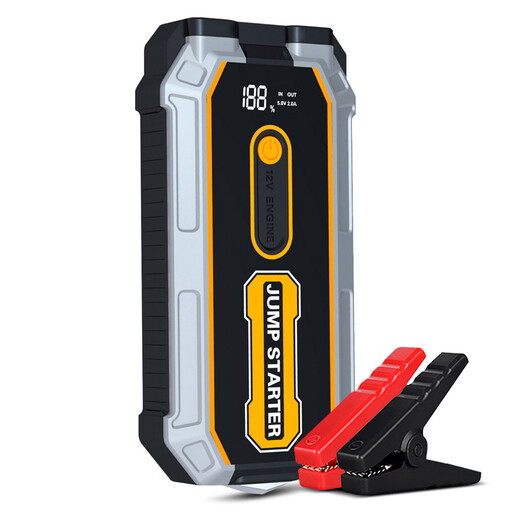
Why it suits this profile: Weighing approximately 330 grams, this compact model is practical for motorists looking for a straightforward emergency solution for a car, SUV or motorbike.
The product information lists a peak current of 1200A and a starting current of 600A separately. This allows you to compare the specifications more meaningfully than by looking only at the largest marketing figure.
12V support, LCD display, 10W USB output and LED lighting with three modes. According to the product listing, the model is intended for petrol and diesel vehicles.
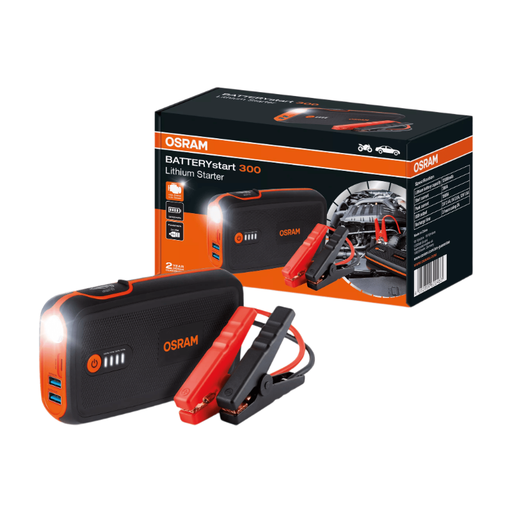
Why it suits this profile: If you are looking for a branded model with additional 12V functionality for a car, motorbike or light commercial vehicle, this model offers a larger housing and greater battery capacity.
The listing states both a 400A nominal starting current and a 2000A peak output, and specifies support for up to 8L petrol and 4L diesel engines. Be sure to check this against your vehicle details.
16800mAh, dual USB ports, a 12V output for accessories and integrated LED lighting. The stated manufacturer’s warranty is 2 years.
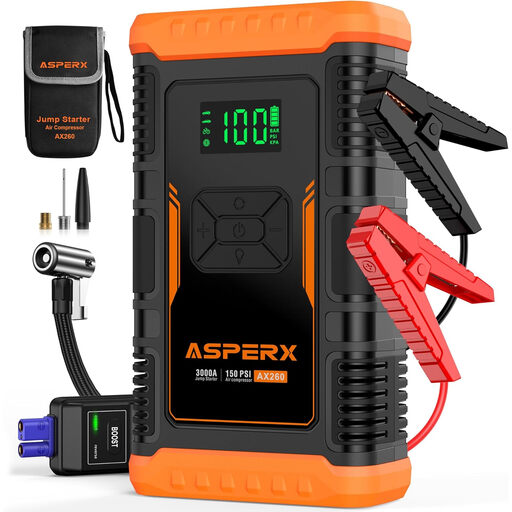
Why it suits this profile: Suitable for drivers of SUVs, motorhomes and vehicles who want to carry not only a battery jump starter, but also a tyre inflator and an additional power supply.
The product description mentions automatic shut-off, an LCD pressure reading and multiple safety features. This makes the additional compressor functions more clearly defined.
3000A peak current according to the product listing, a compressor rated up to 150 PSI, an LED lamp and USB charging function. Check the engine limits and running time in the manual.
We have put together a complete, up-to-date list of products that fully meet these strict selection criteria and the applicable European safety regulations.
Before using the portable jump starter for the first time, read the manual and fully charge it. The usual procedure is:
Do not use an emergency starter with a leaking, frozen or visibly damaged battery. Allow the device to cool down after use, then recharge it.
Its lifespan depends on charging cycles, storage temperature and maintenance. Recharge the device regularly, even when you are not using it. Store it somewhere cool and dry, and follow the manufacturer’s maintenance interval.
This varies by model. Some devices have a boost function for low voltage, but a damaged battery cannot be repaired by a jump starter. Always check the minimum battery voltage and instructions for the specific product.
The electricity used for charging is generally limited, but the exact cost depends on the battery capacity, charging losses and your electricity tariff. More importantly, recharge the jump starter after use so that it remains ready when you break down on the road.
