
Vandaag of morgen in huis

Kwaliteit gegarandeerd

Welkomstaanbiedingen ontgrendelen: GRATIS bezorging | Tot 80% korting | Gratis 30 dagen JoyPlus-proefperiode
Download de app
A flat car battery often happens at the worst possible moment: on a cold morning, during a holiday or in a car park with no help nearby. A car jump starter can act as a portable car battery booster and an alternative to jump leads. However, not every model is suitable for every vehicle or situation.
Pay particular attention to these common pitfalls:
Most portable jump starters are designed for 12V systems. That does not automatically mean that every model is suitable for every car, SUV, van or lorry. Check the following:
A jump starter for diesel and petrol engines must explicitly support both fuel types. Diesel engines generally require more starting power, particularly in low temperatures. For emergency starting assistance for an SUV or lorry, a model with a higher starting capacity makes more sense than a compact battery booster for a small city car.
Peak current is often printed in large figures on the packaging. Only use this figure together with the stated starting current and the vehicle limits.
According to the product information, the Porbi S306 specifies a starting current of 600A and a peak current of 1200A. The lithium battery has a stated capacity of 12,800 mAh, with a stated nominal capacity of 7,200 mAh. This difference shows why nominal or usable capacity matters.
The Porbi S903 specifies a starting current of 800A and a peak current of 2000A, with a battery capacity of 20,000 mAh and a stated nominal capacity of 16,000 mAh. According to the product page, this model is intended for cars, SUVs, vans, pick-ups, motorbikes and boats, among other vehicles.
A good emergency car starter should clearly explain how to connect the clamps. Useful features include:
Do not store a jump starter in direct sunlight for long periods or in a hot, enclosed car. Lithium batteries can deteriorate more quickly when exposed to high temperatures. Check the charge level before setting off and recharge the device after use.
Also look for certification marks. According to the product information for the Porbi models, these products carry CE and RoHS labels. Always check the current product page, the supplied manual and the warranty conditions before buying. A certification mark is no substitute for correct connection or safe use.

Why it suits this profile: Weighing approximately 330 grams, this compact model is suitable for motorists who want to keep a simple 12V battery booster for their car and motorbike in the glove compartment.
The product information lists the 600A starting current and 1200A peak current separately. This makes the figures easier to compare than when only a single peak value is given.
Stated battery capacity of 12,800 mAh, 10W USB output, LCD screen and LED lighting with steady, strobe and SOS modes.
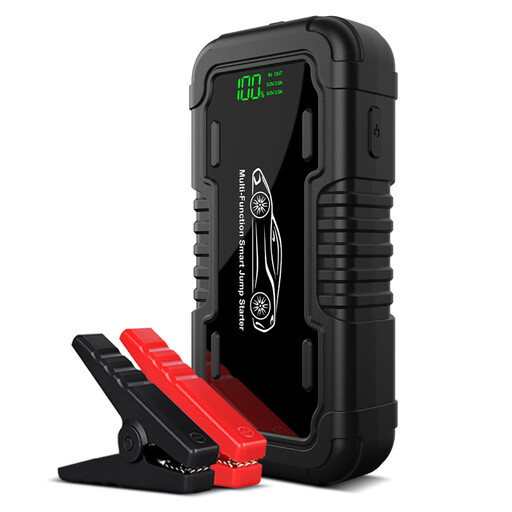
Why it suits this profile: The larger capacity and higher stated starting current suit drivers looking for extra reserve power for SUVs, vans, boats or longer journeys.
As well as a peak current of 2000A, the product page lists a starting current of 800A and a nominal capacity of 16,000 mAh. These additional details help provide a more realistic comparison.
Stated capacity of 20,000 mAh, QC3.0 18W output, LCD screen, LED light and IP44 protection according to the product information.
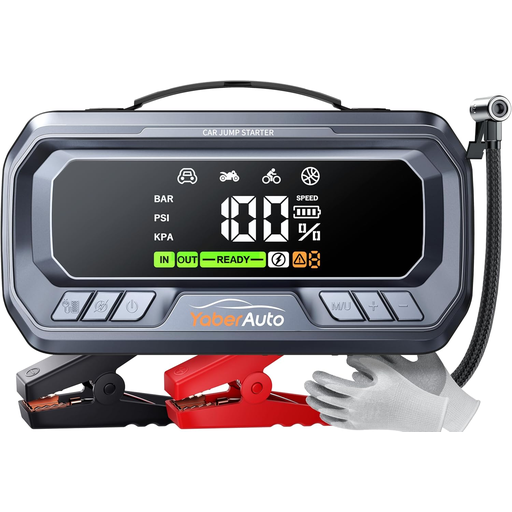
Why it suits this profile: This model is aimed at SUV, lorry and motorhome drivers who want to top up their tyres as well as start their vehicle, and charge devices via USB-C.
The technical information lists several values. The description refers to a 6500A peak current, while the specification table states a 1200A peak current and 600A starting current. Check this discrepancy before buying and base your decision on the current product specifications.
According to the product information: 160 PSI compressor, 3.3-inch LCD screen, 65W bidirectional USB-C, 16,000 mAh battery and LED lighting with four modes.
Only use a forced-start function when the manual permits it and you are certain that the connections are correct. If the battery is damaged, leaking or visibly corroded, professional assistance is the wiser option.
We have put together a complete, up-to-date list of products that fully meet these strict selection criteria and the applicable European safety regulations.
Only if the product information confirms support for both fuel types and your engine size. Also check the starting current, peak current and guidance for low temperatures. A model suitable for a small petrol engine is not automatically suitable for a diesel SUV or lorry.
Its lifespan depends on charging cycles, storage temperature and usage. Store the device in a dry place and do not leave it in a hot car for long periods. Check the charge level regularly and use the supplied or specified cables. An LCD screen helps you see when the device needs recharging, but it does not guarantee how much battery life remains.
That depends on how you intend to use it. For drivers who only need to deal with a flat battery, a compact model without a pump may be enough. A jump starter with compressor is more practical for long journeys, motorhomes, SUVs and outdoor activities, but it is usually heavier. So do not compare the price alone. Also consider the pump pressure, maximum operating time, charging options and dimensions.
