Start with a stable camera positioned directly above your work surface, then choose your lighting. A dimmable ring light can provide a simple starting point for small, matte cards. For shiny details, or when you want to preserve texture, a separately adjustable LED panel gives you more flexibility. Take a test shot to check reflections and exposure: simply increasing the brightness won’t solve these problems.
Who is this setup for?
Card maker with a dark filming surface
You want to keep card colours, light details and your hands clearly in shot without losing sight of the dark background. Adjustable lighting and a test shot help you set the exposure for the card you’re actually using.
Creator filming overhead tutorials
You mainly need a stable camera above your work surface, without a lamp, holder or tripod getting in the way of making cards.
Maker of cards with shiny details
For example, you film reflective embellishments and want to adjust the light and camera angle independently.
What should you look for when buying?
Dimmable ring light beside the camera
Choose this setup if: you’re filming a relatively small, mostly matte work surface and want simple, even lighting to start with.
The trade-off: front lighting can make texture look flatter and reflect off shiny embellishments. A ring light isn’t automatically suitable for positioning a camera directly above the table.
Adjustable LED panel with a separate overhead camera
Choose this setup if: you want to adjust the light angle independently of the camera angle, for example to move reflections or show texture. NEEWER describes LED panels as more adjustable than ring lights.
The trade-off: you’ll need to adjust the positioning and shadows yourself. This isn’t a measured comparison of specific models.
The main things to consider are how the light works with a dark background, whether the camera can film steadily from above, and whether shiny details reflect the light.
| What to consider |
What should you check? |
Who is this important for? |
| Colour and exposure |
Check the dimming and colour settings for the exact model, and take a shot using the card and background you plan to film. Godox lists brightness adjustment from 1–100% and 3000–6000 K for the LR150; Benel lists CRI 95 and 3200–5600 K for the Falcon Eyes DVR-160TW. |
When I film cards against a dark background, I want to assess the light details and background together without losing any colour. Around 36% of consumers rank colour and exposure as their top buying priority. |
| Stable overhead mounting |
Compare the thickness and edge of your table, arm reach, mounting method and the parts included in the box. The 1/4- and 3/8-inch connections listed by Benel for the Falcon Eyes DVR-160TW don’t, on their own, make a complete overhead setup. |
When filming from above, I want both hands free and a stable camera angle over the table. Around 29% of consumers give overhead mounting top priority. |
| Reflections and texture |
Check whether you can move the lamp and camera independently, and test it with a card that has shiny details. Ulanzi recommends checking for reflections in the shot; you may need to change the light angle. |
When I film shiny embellishments or raised details, I want to be able to move reflections and keep the texture visible. Around 21% of consumers prioritise controlling reflections. |
| What’s included in the kit |
Check the listing for the exact model to see which power supply, holder and mounting parts are included. Godox lists a smartphone holder with the LR150, but don’t assume a light stand is included. |
If I want to get started with as few separate parts as possible, I check what’s actually in the box and whether I’ll need an overhead arm. Around 14% of consumers give a simple, complete setup top priority. |
Things to watch out for when buying
-
Confusing a phone holder with an overhead tripod
A holder for a phone or front-facing video won’t automatically position the camera steadily above your work surface. Check the camera angle you need and whether the clamp will fit the edge of your table.
You may also need a suitable desk arm or clamp to film with an unobstructed overhead view.
Bear in mind that an extra arm or mount may need to be bought separately.
-
Assuming a ring light always works for shiny cards
Shiny foil or plastic can reflect the light source. Even lighting won’t automatically prevent reflections or preserve texture.
Take a test shot with your most reflective card. If you can still see the ring in the shot, try a different light angle or a separately adjustable light.
Brands to consider
Godox
The LR150 is a ring light for setups where the camera and light are close together.
- The Godox manual lists stepless brightness adjustment from 1–100%, a colour temperature of 3000–6000 K and a smartphone holder.
- An optional light stand doesn’t automatically provide an overhead mount. Check whether the holder and any arm are suitable for the camera angle you need.
Falcon Eyes
The DVR-160TW offers adjustable ring lighting and connections that let you plan the mounting separately.
- Benel lists CRI 95, 3200–5600 K and 1/4- and 3/8-inch connections for the DVR-160TW.
- The connections don’t prove that an arm for filming directly from above is included. The colour-rendering figures are product specifications, not an independent measurement of card colours.
StudioKing
The LR-650 is a ring light kit with a smartphone holder, for anyone who wants to take the included parts into account.
- Benel lists a colour temperature of 3200–5600 K and an included smartphone holder for the LR-650.
- The product description focuses on selfies and vlogs; check separately whether the kit can position your camera directly above a card.
NEEWER
NEEWER sells both ring lights and adjustable LED panels, so you can compare different lighting setups.
- In its own comparison, NEEWER describes panels as easier to direct, while ring lights are simpler for even, front-facing light.
- This is a general brand comparison, not an independent test for card-making tutorials. The RH8B product page covers several sizes, so check the specifications for the exact model.
Joybuy products for card-making tutorials
This Joybuy selection includes ring lights for filming on a phone. Check separately whether the holder and tripod supplied with your chosen model allow you to film steadily from directly above the card.
 No image available
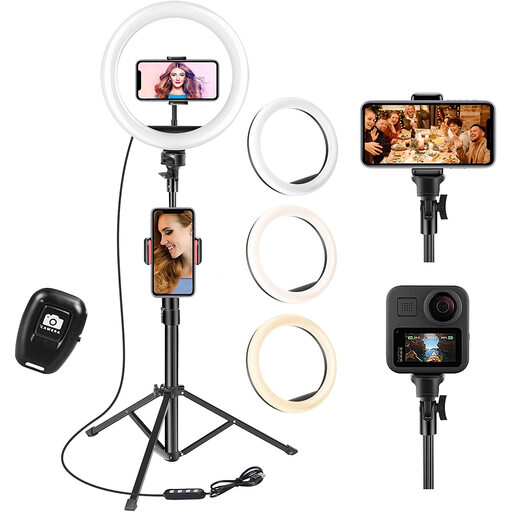
Ring light with tripod, 10-inch
May suit a phone setup if you’re looking for a ring light with a tripod and phone holder; check whether the setup supplied is suitable for filming directly from above.
The product name lists a 10-inch ring light, a 63-inch tripod, a remote control, three colour modes and ten brightness levels.
Joybuy
 No image available
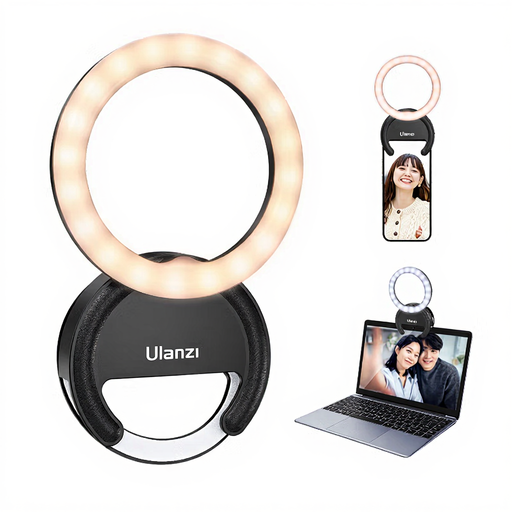
ULANZI 4" Phone Ring Light
May suit you if you’re looking for a compact ring light that clips onto a smartphone; this product description doesn’t confirm that it can mount a camera directly above the card.
The product name lists three colour temperatures from 3000 K–7000 K and five brightness levels.
Joybuy
Frequently asked questions
Does the ring light need to hang directly above the card?
No. First, position the camera steadily above your work surface, then find the right light angle with a test shot. With shiny details, a different light angle can move reflections; also check that a desk arm’s clamp will fit your table.
How can I stop a light-coloured card from being overexposed against the dark background?
Dim the light and check both the light areas of the card and the background on your camera screen. If your camera doesn’t expose unusually light and dark areas well, exposure compensation may help if that setting is available.
Can I clean a ring light with a damp cloth after a tutorial?
Switch off the light and follow the manual for your chosen model. Godox says the LR150 must be kept dry and not used in damp conditions; this instruction doesn’t automatically apply to every ring light.
What are my rights when buying online in the Netherlands?
For a typical online consumer purchase, ACM ConsuWijzer says that you generally have a statutory cooling-off period that ends 14 days after delivery; check which exceptions apply. You also have statutory rights if a product doesn’t meet what you were entitled to expect from it.
Is the CE marking a quality mark for lighting?
No. RVO describes CE as a mark with which the manufacturer declares that a product meets the applicable EU requirements, where CE rules apply to that product. It isn’t a quality mark for lighting or video footage.


