
Vandaag of morgen in huis

Kwaliteit gegarandeerd

Welkomstaanbiedingen ontgrendelen: GRATIS bezorging | Tot 80% korting | Gratis 30 dagen JoyPlus-proefperiode
Download de app
Anyone looking for car tools will quickly come across sets containing dozens or even hundreds of pieces. On its own, that large number tells you very little. A car tool set needs to suit the type of work you carry out, the space available and the fasteners used on your vehicle. Choosing the wrong set often leads to missing sizes, damaged bolts or tools that end up unused in the boot after just a few jobs.
This buying guide helps DIY enthusiasts, car owners, motorcyclists, detailers and garages assess specifications in practical terms.
A 450-piece set may look appealing, but it can contain many duplicate sizes, bits or less relevant accessories. So check exactly which components are included. For routine maintenance, a good socket set, ratchet set, extension bars and a few spanners are often more important than a large number of unfamiliar bits.
A 1/4-inch ratchet is suitable for smaller fasteners and confined spaces. For heavier work around suspension components, wheel bolts or engine parts, a 3/8- or 1/2-inch drive is often more practical. Also check whether the set includes metric sizes. Cars and motorbikes in the UK generally use metric fasteners, so a set containing mainly SAE sizes may be less useful.
A ratchet is designed to tighten or loosen bolts and nuts. For components that require a specified tightening torque, you need a torque wrench. This includes certain engine, brake and wheel components. A standard ratchet does not provide a controlled measurement. With a digital torque wrench, also check the range, accuracy, measurement unit and operating instructions.
Many sets use chrome vanadium steel (Cr-V) for sockets, ratchets and spanners. According to the product descriptions provided by the relevant brands, this material is heat-treated to create a robust construction. This is a verifiable product specification, but it does not guarantee that every component is suitable for every heavy-duty application.
S2 steel is sometimes specified for bits. According to the product information provided by DURATECH and WORKPRO, this material offers greater hardness and resistance to wear and impact than standard bit materials. Also check whether the set has a corrosion-resistant finish, such as matt or polished chrome.
A ratchet with 72 teeth has a smaller return angle than many coarser mechanisms. This can be useful when working in a cramped engine bay. Also look for:
A compact spanner set with short handles can be useful between pipes, bodywork and other obstacles. For brake lines, it is better to use a dedicated flare nut spanner set than a standard open-ended spanner. It grips more of the nut and is specifically designed for pipe connections.
Do not just look at the maximum number of sizes; consider the ranges that are relevant to you. A good car tool set might combine 1/4-, 3/8- and 1/2-inch ratchets, for example. Check whether it includes spark plug sockets, Torx sockets, hex keys, adapters and various extension bars.
A sturdy case with marked positions prevents sockets and bits from becoming mixed up. For mobile use in a car or on a motorbike, a compact bag may sometimes be more convenient than a large case. For professional workshop tools, it is also important how quickly you can find a particular component.
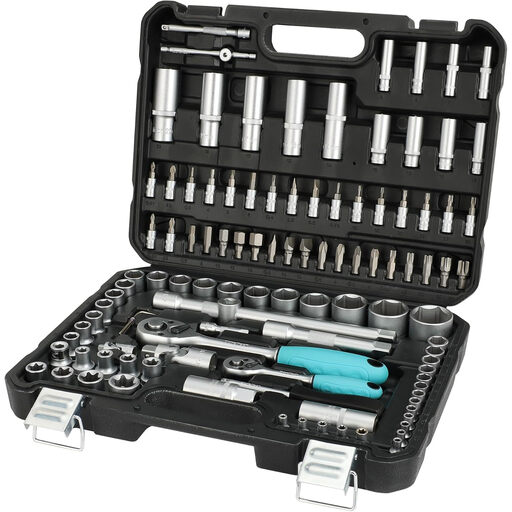
Why it suits this profile: A practical starting point for car owners and DIY enthusiasts carrying out maintenance on a car or motorbike without immediately investing in a full workshop setup.
The set specifies 108 pieces, two drive sizes, clear size markings and a storage case. This makes it easier to check in advance which essential accessories are included.
Cr-V sockets, S2 bits, 1/4- and 1/2-inch ratchets, extension bars and universal joints.
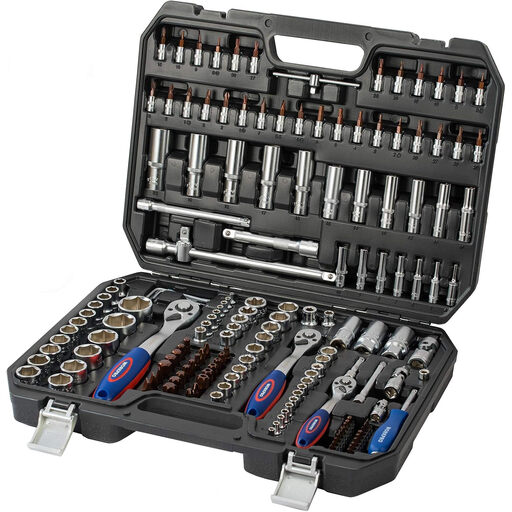
Why it suits this profile: Suitable for users who want to use one comprehensive set for car, motorbike, bicycle and general maintenance jobs.
The product description specifies the three ratchet sizes, socket ranges, Torx sockets, spark plug sockets, bits and extension bars instead of simply stating a total number.
1/4-, 3/8- and 1/2-inch ratchets with 72 teeth, S2 bits and a marked case.
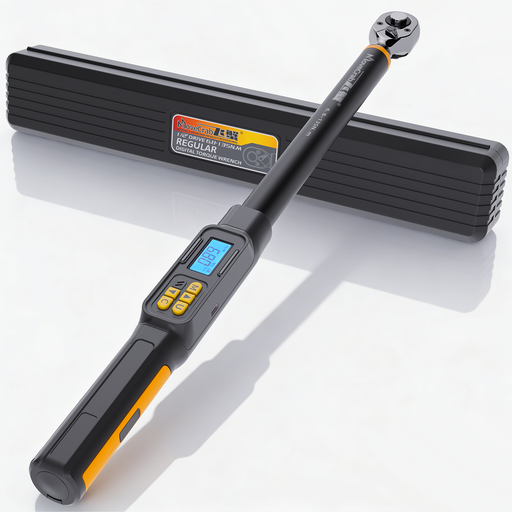
Why it suits this profile: For mechanics, motorcyclists and users who need controlled tightening torques when repairing cars, motorbikes or bicycles.
The specified range is 6,8-135 Nm. The digital settings, warnings and various measurement units allow you to read the selected value directly. Always check the vehicle manufacturer's specified torque.
1/2-inch drive, specified accuracy of ±2%, Nm, ft.lb, in.lb and kgf.cm display.
For bodywork and paintwork maintenance, a car polishing machine is a different type of tool from a ratchet set. Pay attention to the backing plate size, speed range, movement type and battery life. A small machine with 25, 50 or 75 mm plates is designed for details such as headlamps, alloy wheels, badges and narrow bodywork lines.
The BATOCA S4 and S5 specify multiple rotary and random-orbit modes, adjustable speeds and interchangeable batteries. According to BATOCA's own product information, these features are intended for detail polishing. Treat this as a product specification, not a guaranteed result. Use suitable pads, test the machine on an inconspicuous area first and follow the safety instructions.
For small assembly jobs, a compact screwdriver set may be sufficient. An electric screwdriver is particularly useful when dealing with lots of repetitive screws, but it does not replace a torque wrench or impact wrench. An electric impact wrench is designed for quickly loosening and tightening fasteners; afterwards, check whether the final tightening torque needs to be set using suitable tools.
We've put together a complete, up-to-date list of products that fully meet these strict selection criteria and the applicable European safety regulations.
Start with a metric socket set featuring 1/4- and 3/8-inch ratchets, several extension bars, Torx bits, hex keys and a set of combination spanners. Add specialist tools later, such as a torque wrench or brake-line spanner, when you need to carry out those jobs.
Their lifespan depends on the material, workload, maintenance and storage. Keep your tools clean, dry them after use and return them to the case. Do not use a ratchet as a hammer and do not exceed the specified range of a torque wrench.
Not for every job. For occasional maintenance, a well-specified basic set may be sufficient. With daily use, seized fasteners or work involving specified tightening torques, the choice of material, fit and measurement range are more important than the price or the number of pieces alone.
