
Vandaag of morgen in huis

Kwaliteit gegarandeerd

Welkomstaanbiedingen ontgrendelen: GRATIS bezorging | Tot 80% korting | Gratis 30 dagen JoyPlus-proefperiode
Download de app
Buying a basic ratchet set only to discover later that the right socket is missing is a common frustration. A large case containing hundreds of pieces is not automatically suitable for your vehicle either. Some sets include plenty of bits but very few metric sockets. Others look complete, yet the ratchet does not provide enough clearance in a cramped engine bay.
As a Joybuy Product Recommendation Officer, I filter the key product specifications from the marketing copy. This helps you choose a car tool set more deliberately in 2026 for maintenance, repairs and general tasks.
A set with 149, 172 or even 450 pieces may sound appealing. However, check what is actually included. Some of the contents may be small bits, screws or accessories that you will rarely use for car maintenance. Focus in particular on:
A compact socket set with the right sizes can be more practical than a large general-purpose tool set.
There is not always enough room in an engine bay to turn a long wrench through a full rotation. According to product descriptions, a ratchet with 72 or 90 teeth has a small return angle. This can be useful in confined spaces, although the actual performance also depends on the design, how it is used and the space available.
A ratchet set with 1/4", 3/8" and 1/2" drives offers greater flexibility. The smallest size is suitable for light-duty fasteners, 3/8" is the most versatile option and 1/2" is better suited to larger bolts and higher loads.
Chrome vanadium steel, chrome plating and heat treatment are relevant specifications. Nevertheless, proper care remains important. Clean sockets and wrenches after use, remove oil and moisture and store everything in a dry place. Do not use a damaged ratchet or wrench, and never use a hand ratchet as an impact tool.
For cars in the Netherlands, a metric tool set is usually the most logical starting point. Check that the set actually includes sizes such as 8, 10, 13, 15, 17 and 19 mm. A combination of metric and SAE sizes can be useful for older vehicles or general-purpose applications, but it also takes up more space.
Also pay attention to the drive size:
A mechanics tool set with multiple drive sizes is often more versatile than a set with just one ratchet.
A quick-release button makes changing sockets easier. A reversible ratchet should have a clear direction selector for tightening and loosening. DURATECH product descriptions, for example, mention 72-tooth ratchets with a stated 5-degree working angle. Another DURATECH set specifies 90 teeth and a 4-degree working angle. These are verifiable product specifications, but they do not guarantee that every task will be effortless.
A fixed open-ended wrench works well when there is sufficient clearance. For hard-to-reach nuts, a flex-head or offset design may be more practical. A ratcheting wrench set generally combines an open end with a ratcheting ring end. Check that the size is clearly marked on both sides and that the set includes a pouch or case.
For brake lines, a standard open-ended wrench is not always the most suitable choice. A flare-nut wrench set grips a larger section of the nut while the line passes through the opening. Always use the exact size that fits the connection to help prevent damage.
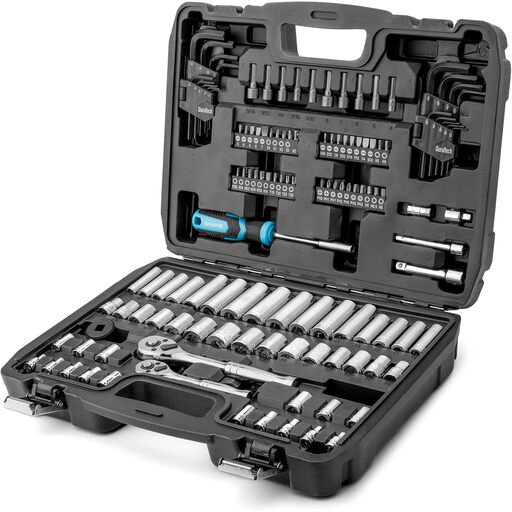
Why it suits this profile: A comprehensive foundation for car owners who also want to work on bicycles, furniture and small household projects.
The product description lists 47 metric and SAE sockets, 1/4" and 3/8" ratchets, bits and Allen keys. Before buying, check that the stated sizes match your vehicle.
The set includes a magnetic screwdriver with 40 bits and comes in a case with dedicated storage slots.
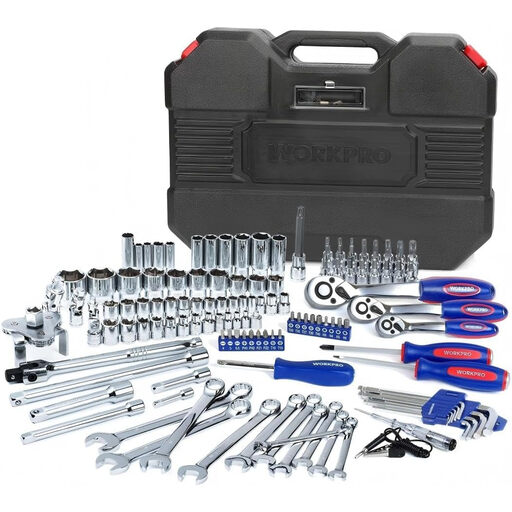
Why it suits this profile: Ideal for anyone who wants to keep a single tool set with a case in the garage or car.
The product information lists three drive sizes, a quick-release ratchet and a case with separate storage positions for the tools.
The selection includes sockets, ratchets, bits, open-ended wrenches and Allen keys for automotive and household use.
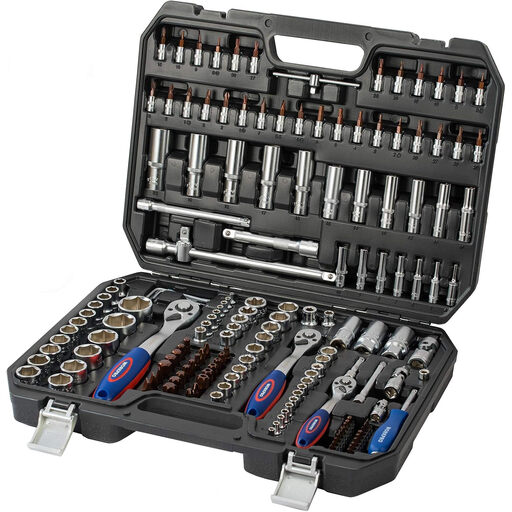
Why it suits this profile: For home mechanics and users who need a broad selection of sockets and accessories.
The product description specifies 1/4", 3/8" and 1/2" ratchets, deep sockets, Torx sockets, spark-plug sockets, extensions and universal joints.
The manufacturer lists 72 teeth, quick-release buttons and clear size markings on the sockets and case.
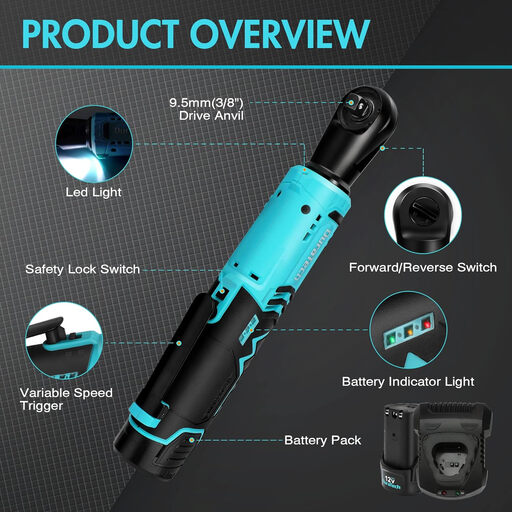
Why it suits this profile: Convenient when you regularly loosen and tighten bolts and want to reduce manual ratcheting.
The product information lists a 3/8" connection, two 2.0 Ah batteries, a charger, an LED light and a storage box. Always check that the torque is suitable for your application.
According to the product description, the stated maximum torque is 65 Nm and eight sockets are included.
Browse a current selection of products and compare the contents, drive sizes and storage options before buying.
For brake lines, a flare-nut wrench set can be useful. According to the product description, the DURATECH 3-piece set includes sizes 10×12, 13×14 and 15×17 mm, with a 15-degree angle and a storage pouch.
For confined spaces, flexible ratcheting wrenches or offset combination wrenches are worth considering. The DURATECH flex-head set covers 8 through 19 mm and, according to the product information, has a 180-degree adjustable head. A torque wrench set is also relevant when the vehicle specifications require a precise tightening torque. Always use the values stated in the vehicle’s manual.
For many basic jobs, metric sizes from approximately 8 to 19 mm are practical. Add 1/4", 3/8" and 1/2" drives if you want to handle both smaller and larger fasteners. Check your car’s specifications in advance.
An electric ratchet wrench speeds up loosening and tightening, but it does not replace a complete socket wrench set. You will still need suitable sockets, extensions and, in some cases, a torque wrench. Use the stated torque as a guide and tighten critical fasteners according to the vehicle manufacturer’s specifications.
Wipe away oil and dirt after use, dry metal parts thoroughly and return each item to the case or pouch. Regularly inspect ratchets, sockets and batteries for damage. Always wear eye protection when working with materials that may release metal particles or dirt.
