
Vandaag of morgen in huis

Kwaliteit gegarandeerd

Welkomstaanbiedingen ontgrendelen: GRATIS bezorging | Tot 80% korting | Gratis 30 dagen JoyPlus-proefperiode
Download de app
A car tool set can save you plenty of time when maintaining a car, motorbike or bicycle. However, a large case is not automatically a good buy. The number of components tells you little if essential sizes are missing, ratchets do not fit properly or the tools are difficult to store after use.
Before buying a set, watch out for these common pitfalls:
Metric sizes are important for many European cars. Check that the set is suitable for your vehicle and the jobs you plan to carry out. A practical combination often includes sockets in several sizes and at least two drive sizes.
A socket set with ratchet is suitable for bolts and nuts that you can reach with a straight turning motion. A 1/4" ratchet is useful for smaller fasteners and confined spaces. A 3/8" ratchet is versatile for general maintenance. A 1/2" ratchet is designed for larger sockets and situations where more force is needed.
Also look at the difference between:
A ratchet spanner set with 72 or 90 teeth can be more comfortable to use in confined spaces because the ratchet requires a smaller return movement. This does not mean that every ratchet mechanism is suitable for heavy-duty applications. Use a torque wrench whenever a specified tightening torque is important.
Much automotive tooling is made from chrome vanadium steel (Cr-V). This is a measurable material specification, but on its own it does not tell you everything about the tool’s lifespan. Also check the heat treatment, finish and shape of the connection.
A polished or chrome-plated finish can make cleaning easier and help to protect against corrosion. Nevertheless, store metal tools in a dry place, particularly in a damp garage. Bits are also often made from S2 steel. Check the product information to see which components are actually made from S2 steel; sometimes this specification applies only to the bits and not to the sockets or ratchets.
A general car repair tool set does not always replace specialist tools. Consider:
When buying a torque wrench set, always check the range, drive size and supplied documentation. According to MoveCrab’s product information, the set in question includes three wrenches with a range of 5 to 220 N·m and states a deviation of ±3%. Treat this as the brand’s product specification and always check the vehicle manufacturer’s specified tightening torque for safety-critical work.
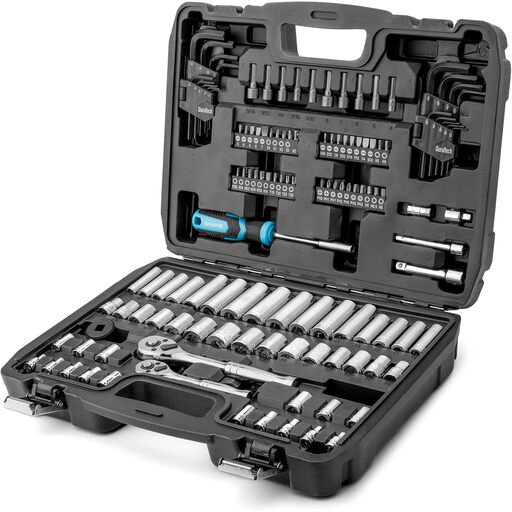
Why it suits this profile: A comprehensive starter set for households and DIY enthusiasts who want to tackle car, motorbike and general assembly jobs with one case.
The contents are clearly specified: 47 metric/SAE sockets, 1/4" and 3/8" drive ratchets, bits, hex keys and a storage box.
Clearly marked sockets, a magnetic screwdriver with 40 bits and a sturdy case with dedicated slots.
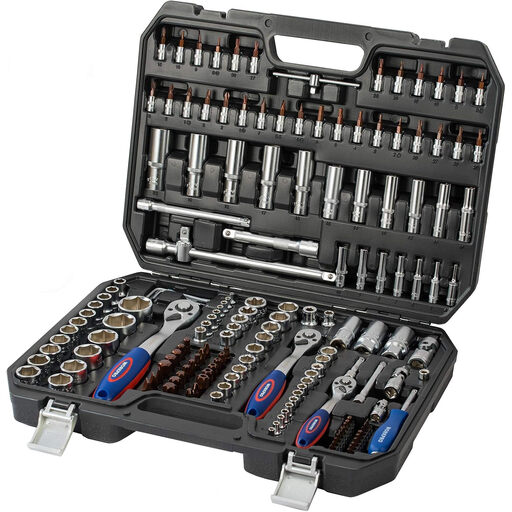
Why it suits this profile: Suitable for users looking for one comprehensive set for cars, motorbikes, bicycles and maintenance around the home.
The three drive sizes are listed separately, and the set includes standard and deep sockets, Torx sockets, spark plug sockets and extensions.
172 components, Cr-V sockets, S2 bits, 72-tooth ratchets and a clearly marked plastic case.
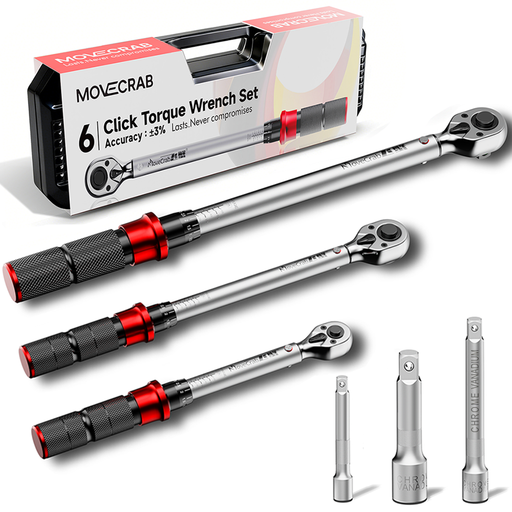
Why it suits this profile: For maintenance technicians, bicycle and motorbike owners, and motorists who need to set different tightening torques.
The range and the three drive extensions are clearly indicated. The product information also states that each wrench comes with a calibration certificate.
Three wrenches covering 5-220 N·m, 1/4", 3/8" and 1/2" extension bars, and easy-to-read scale markings.
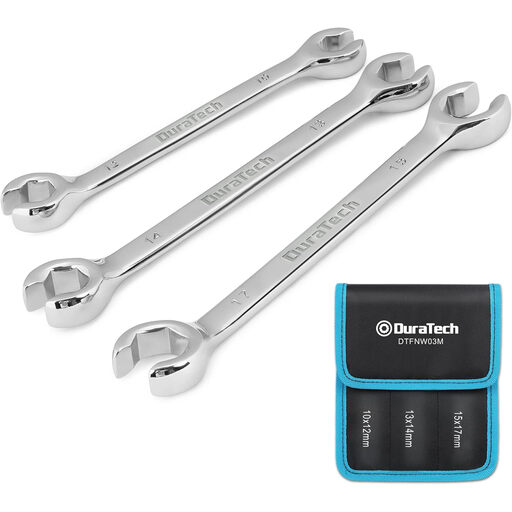
Why it suits this profile: Designed for mechanics and DIY enthusiasts who regularly work on brake pipes or similar pipe connections.
The open ring design is intended for unions on pipes. The three spanners combine sizes 10x12, 13x14 and 15x17 mm.
Heat-treated Cr-V steel, a 15-degree offset and a roll-up bag with size markings.
We have put together a complete, up-to-date list of products that fully meet these strict selection criteria and the applicable European safety regulations.
For basic jobs, a socket set with ratchet, various extensions, screwdrivers, pliers and hex keys are a practical starting point. Check which sizes your car uses beforehand. Additional specialist tools are required for brake pipes, spark plugs or tightening torques.
Not necessarily. A large set can be good value if you carry out many different jobs, but unused components take up space. Above all, compare the useful sizes, drive types, material information and the quality of the storage case. For a single task, a compact open-ended spanner set or brake pipe spanner set may make more sense.
Wipe away oil and dirt after use, dry the tools and return each component to its case or bag. Do not use damaged sockets or ratchets, and reset a torque wrench after use according to the manufacturer’s instructions. Do not store metal tools in a damp boot for extended periods.
