
Vandaag of morgen in huis

Kwaliteit gegarandeerd

Welkomstaanbiedingen ontgrendelen: GRATIS bezorging | Tot 80% korting | Gratis 30 dagen JoyPlus-proefperiode
Download de app
Replacing a damaged seat belt buckle in your car may seem straightforward, but a universal seat belt buckle will not automatically fit every vehicle. The fittings, belt tongue and installation position can vary, particularly in older cars, SUVs, vans and lorries.
If you rely only on claims such as “universal”, “sturdy” or “easy to install”, you risk buying the wrong part. So first check the measurements, the fitting and whether it is legally suitable for use on public roads.
A universal seat belt adapter may be designed for a specific belt tongue, but not for every buckle or seat design. For example, the stated compatibility for the Oxerbog replacement is a belt tongue 2.0 to 2.2 cm wide and an insertion depth of at least 3 cm.
Measure the existing belt tongue before ordering. Also check that the metal mounting bracket under the seat is suitable for the new fitting.
A black seat belt buckle may look neat against your interior, but its colour says nothing about its construction. The materials and fitting are more important. According to the product specifications, this model has an ABS outer casing and a metal interior.
It may be suitable as a replacement part, but that does not remove the need to check certification or vehicle compatibility. If in doubt, ask a garage for advice or check the vehicle manufacturer’s requirements.
A seat belt buckle extender or seat belt accessory must not be used to bypass the seat belt warning signal. Nor should the buckle be inserted unless the occupant is wearing the seat belt correctly.
A seat belt adapter is only suitable if it is designed for the intended vehicle and use. After a collision, the entire seat belt system, including the buckle and fittings, must be checked and replaced if necessary.
Start with the metal tongue on the existing seat belt. Check:
A buckle that is difficult to close, has play or does not release reliably must not be used on the road.
The seat belt buckle described has a 12 mm mounting hole and is recommended for fitting with an M10 bolt. That does not mean every M10 bolt is suitable. The fitting must attach to a strong metal bracket on the seat frame.
Do not fit the buckle to plastic, thin sheet metal or a weak universal bracket. The red release button should face upwards, and the opening should be aligned with the belt tongue. Once secured, check that the buckle does not rattle or twist.
The stated dimensions are 16 × 5 × 3 cm, and the weight is approximately 0.14 kg per item. Its compact size may be convenient in a car, SUV or van, but check in advance that the extended base will not come into contact with the seat rail, centre console or door.
Keep the belt flat and avoid twisting or knotting it. Regularly remove dust and sand from the buckle. Do not use engine oil, grease or other lubricants: combined with dirt, these can interfere with the locking mechanism.
The cards below are based on the available product specifications. As a seat belt buckle is a safety-critical component, you should also check before fitting it that it meets local regulations, vehicle requirements and relevant certification requirements.
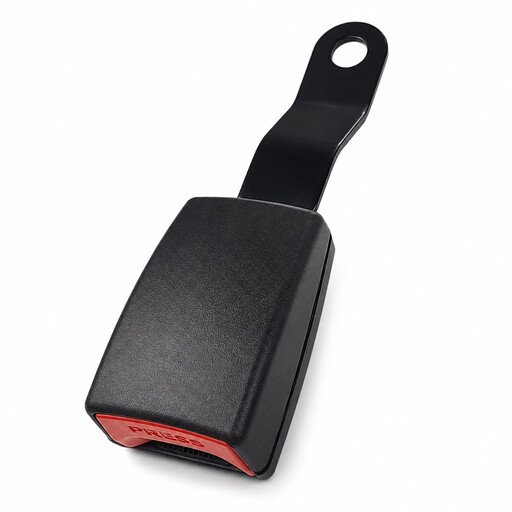
Why it suits this profile: The specifications are clear: a metal interior, ABS casing, a 12 mm mounting hole and a stated fit for belt tongues measuring 2.0–2.2 cm.
The measurements are listed, so you do not have to rely solely on the word “universal”. Even so, check your own belt tongue and mounting point.
ABS and metal construction, compact 16 × 5 × 3 cm size and a matt black finish.
Why it suits this profile: If construction is your main priority, the product description specifies a combination of an ABS outer casing and a metal core. That is easier to verify than a general claim about strength.
The fitting instructions warn against attaching it to plastic or thin sheet metal. This helps prevent a common installation mistake.
Metal core, stated M10 fitting and a red release button.
Why it suits this profile: The product description mentions cars, SUVs, commercial vehicles and lorries. If you use it intensively, you should still check the fit, mounting strength and operation for each vehicle.
The care instructions cover checking for dirt and moisture, and making sure the buckle clicks and releases properly. Do not use the part after a collision without a full inspection.
The product description states that it is splash-resistant; it is lightweight and easy to clean by wiping.
We’ve put together a complete, up-to-date list of products that meet these strict selection criteria and the applicable European safety requirements.
Never fit a car seat belt buckle based solely on a product photo. Follow these steps:
Keep the part’s documentation and check whether the seller provides information about the manufacturer, responsible party and applicable certification. The product information alone is not proof that the part is legally suitable for your specific vehicle.
You should only do so if the fitting, measurements and requirements clearly match. As the buckle is part of a safety system, it is wise to have it checked by a garage. Never fit it to plastic or thin sheet metal.
Its lifespan depends on use, dirt, moisture, wear and any collisions. Check regularly that the buckle clicks properly, does not stick and has no play. After an accident, the entire seat belt system must be assessed and will often need replacing.
The total cost includes the part, any delivery charges and fitting. A DIY solution may seem cheaper, but you may need a garage if the fitting is difficult to access or the certification and vehicle compatibility need to be checked.
