
Vandaag of morgen in huis

Kwaliteit gegarandeerd

Welkomstaanbiedingen ontgrendelen: GRATIS bezorging | Tot 80% korting | Gratis 30 dagen JoyPlus-proefperiode
Download de app
A car polisher can help tackle dull paintwork, light marks and old wax residue. However, not every machine is suitable for every car. A wide speed range may sound appealing, but it means little if the machine is difficult to control or the battery runs out quickly.
For private car owners, DIY enthusiasts and detailers, three pitfalls are particularly important:
A random orbital polisher, also known as a dual action or DA polisher, does not simply rotate. It also follows an eccentric orbit. This distributes the movement over a larger surface area, making it a manageable choice for many beginners when applying polish, wax and sealant.
A rotary polisher spins around a fixed centre point. It can work precisely on small areas and stubborn surface defects, but requires more control. Keep the machine moving, use a suitable pad and start at a low speed.
Some compact models offer both modes. This is practical for bumpers, alloys, mirror caps and narrow sections, provided the changeover is clearly explained.
An adjustable speed is more important than a high maximum figure. For car waxing and spreading a product, a lower setting is usually more appropriate than for paint correction. Check:
An LCD display can help you repeat settings, but it does not automatically prevent incorrect use. According to BATOCA’s own product information, the S2 has an LCD display, six speed settings and a soft start.
A large machine with a pad of approximately 180 to 254 mm is useful for larger body panels. For detailed work, a mini polisher is often more practical. Check the diameter of the backing plate and the available orbit sizes, such as 3 mm, 8 mm or 12 mm.
With a cordless polisher, you should also check:
The stated runtime is often based on specific conditions, such as no-load use. Treat this information as a guide rather than a fixed working time.
A polisher is no substitute for proper preparation. Wash the car thoroughly, remove any grit and inspect the paintwork before you begin. Use a clean pad and test the product first on a small, inconspicuous area.
Practical method:
Hard pads are generally intended for more intensive correction work, while softer pads are more suitable for refining, enhancing gloss and applying wax. The manufacturer of the 8-piece polishing sponge set mentioned advises using different hardnesses for different applications and warns against exceeding the pad’s maximum speed.
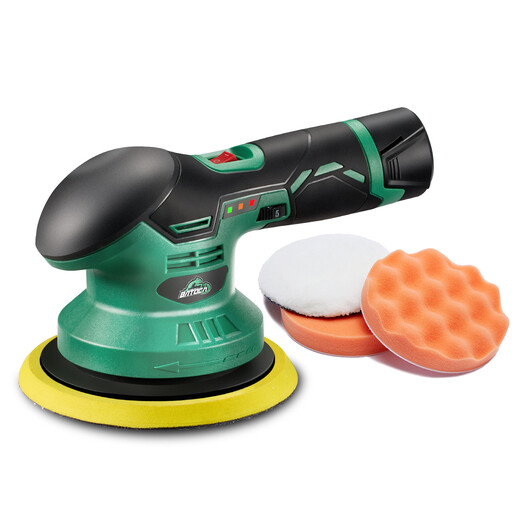
Why it suits this profile: The 5 mm DA movement and six speed settings are designed for even application of wax, sealant and glaze. The compact design and 12 V battery are well suited to occasional maintenance.
The speed can be adjusted from 2500 to 5000 rpm, so you do not have to work exclusively at the highest setting. The battery indicator shows when charging is needed.
2.0 Ah 12 V battery, six settings, 5 mm random orbit and compatibility with standard pads according to the product description.
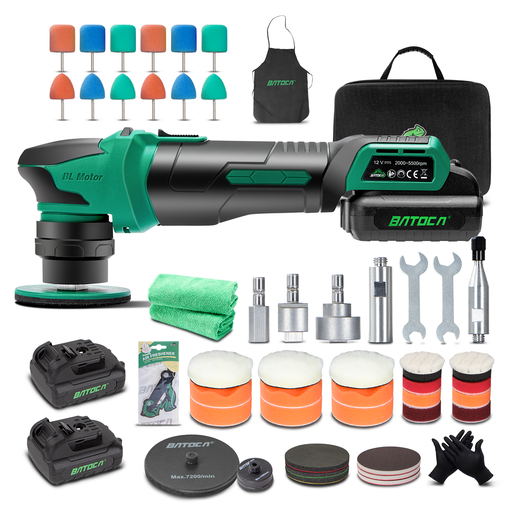
Why it suits this profile: The combination of rotary and random orbital action is suitable for detailed work around mirrors, bumpers and alloys. The included extension bar helps you reach awkward areas.
The machine is not limited to a single movement. With four settings from 2000 to 5500 rpm, you can adjust it to suit the pad, product and surface.
Brushless motor, two 12 V 2.5 Ah batteries, 25 mm and 75 mm backing plates and speed memory according to the product information.

Why it suits this profile: If you want to treat several panels one after another, replaceable batteries and a clear status display are more useful than a compact design alone.
The LCD display shows the speed and battery status. Two batteries help reduce interruptions, but check the charging time and replacement parts in advance.
Two 5000 mAh batteries, 8 mm random orbit, six speed settings and a 125 mm polishing sponge according to the product description.
We have compiled a complete, up-to-date list of products that fully meet these strict selection criteria and the applicable European safety regulations.
That depends on the battery life, the size of the backing plate and the type of work. For a full car, two batteries or a system with fast charging is practical. A compact machine is particularly useful for details and awkward areas. Always check the stated runtime under load.
A random orbital machine with adjustable speed is generally easier to control than a purely rotary machine. Start with a soft or medium-hard pad, low speed and a small test area. A cordless model gives you freedom of movement, while a corded model does not require battery changes.
Their lifespan depends on use, storage and maintenance. Rinse polishing pads clean after use, allow them to air-dry completely and replace them when the foam splits or becomes misshapen. Batteries generally retain their capacity for longer when they are not stored for extended periods either completely flat or fully heated. For charging, storage and replacement, consult the manual for the specific model.
